
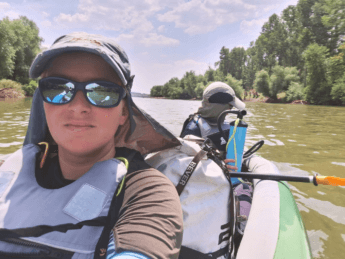

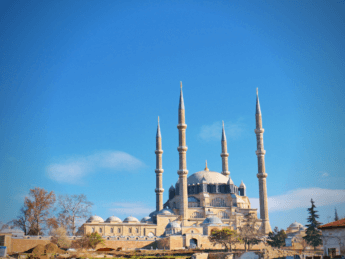

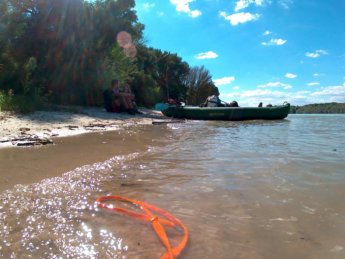
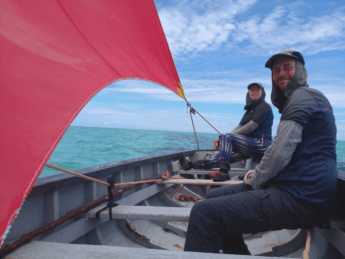


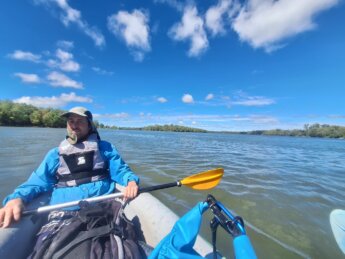


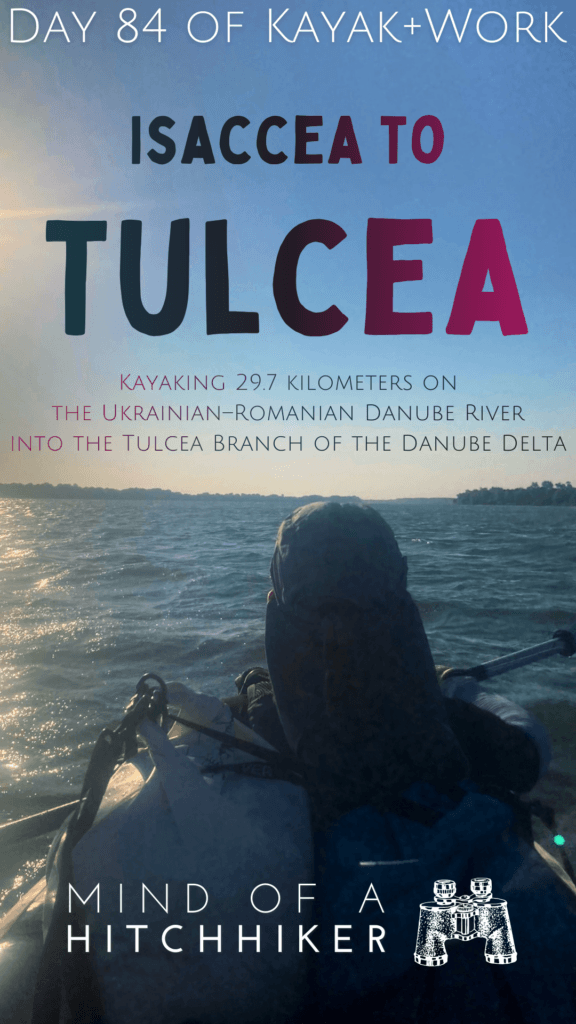
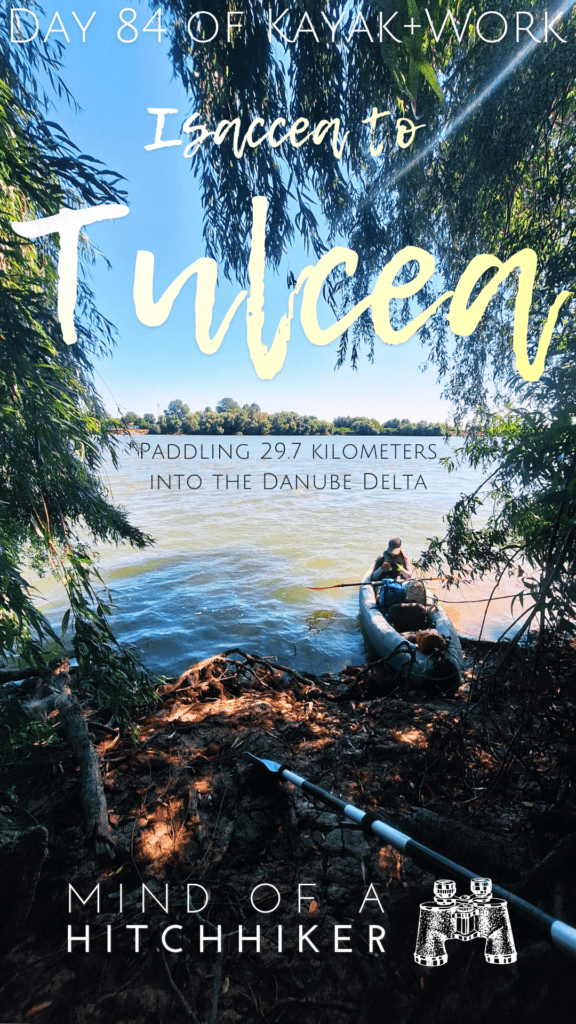
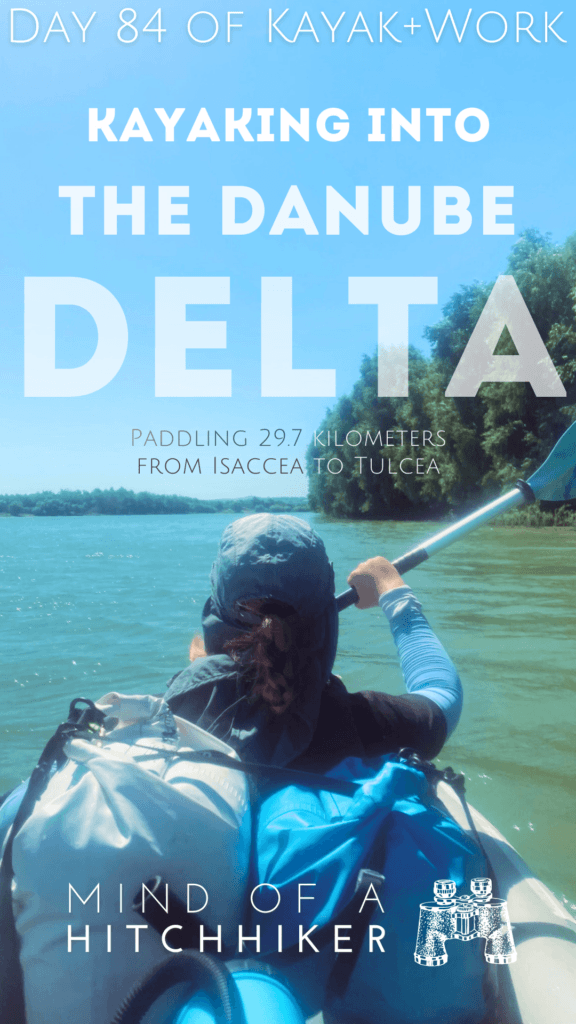
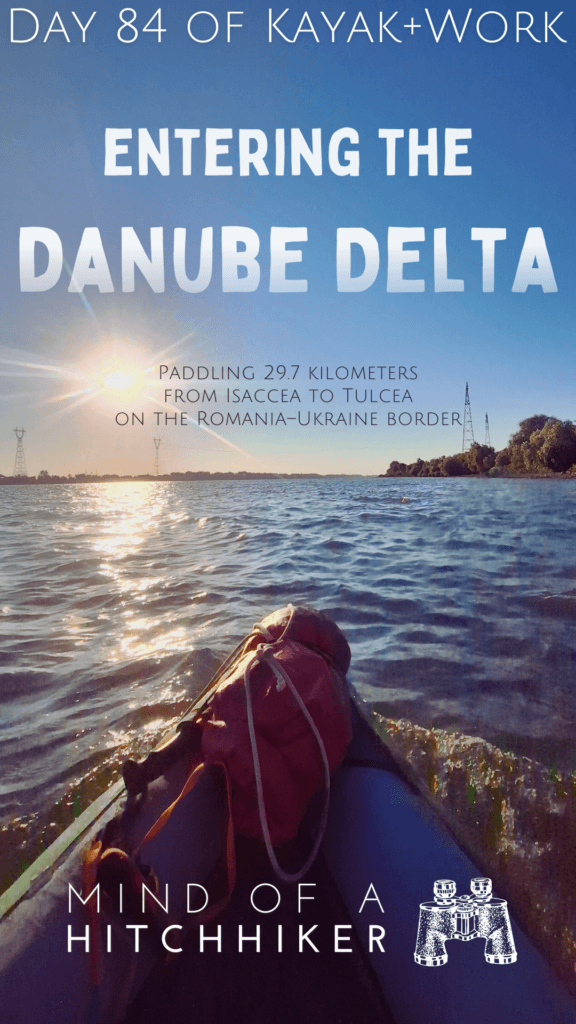
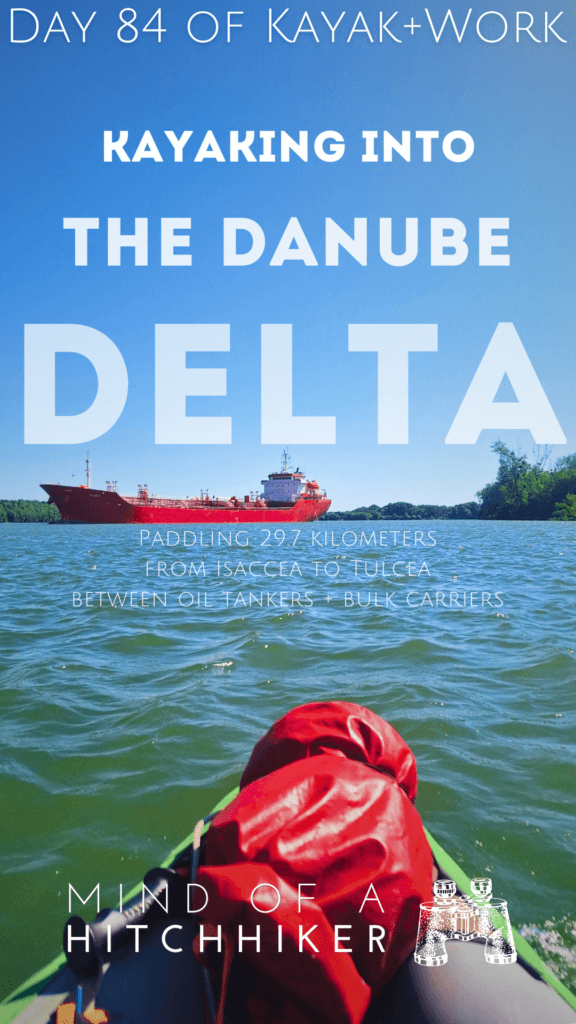
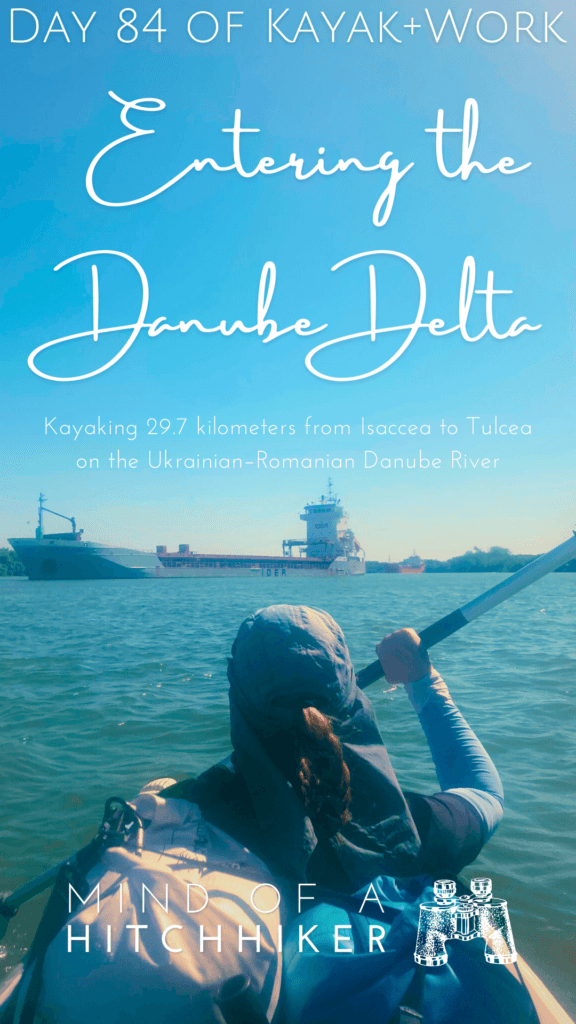
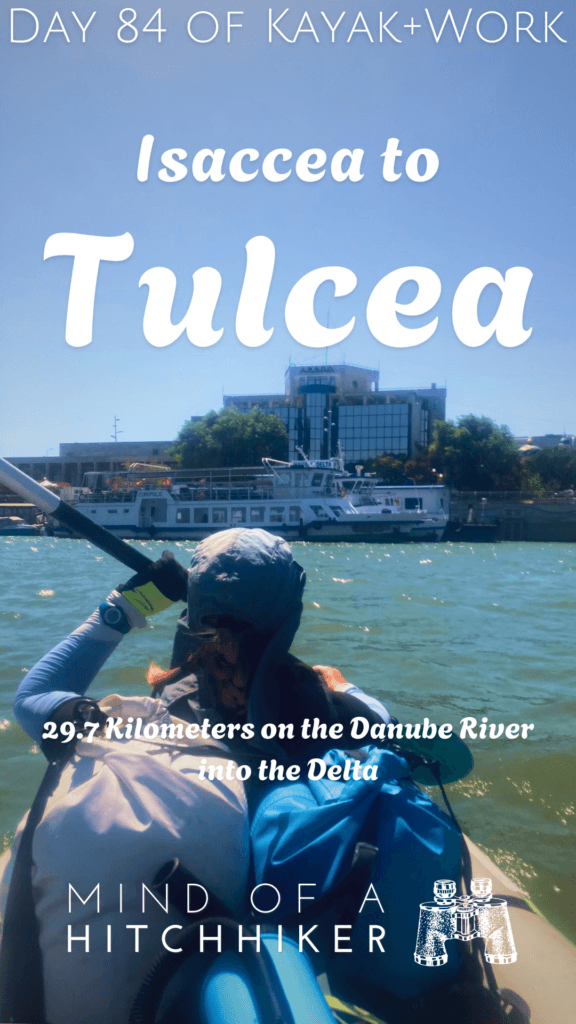
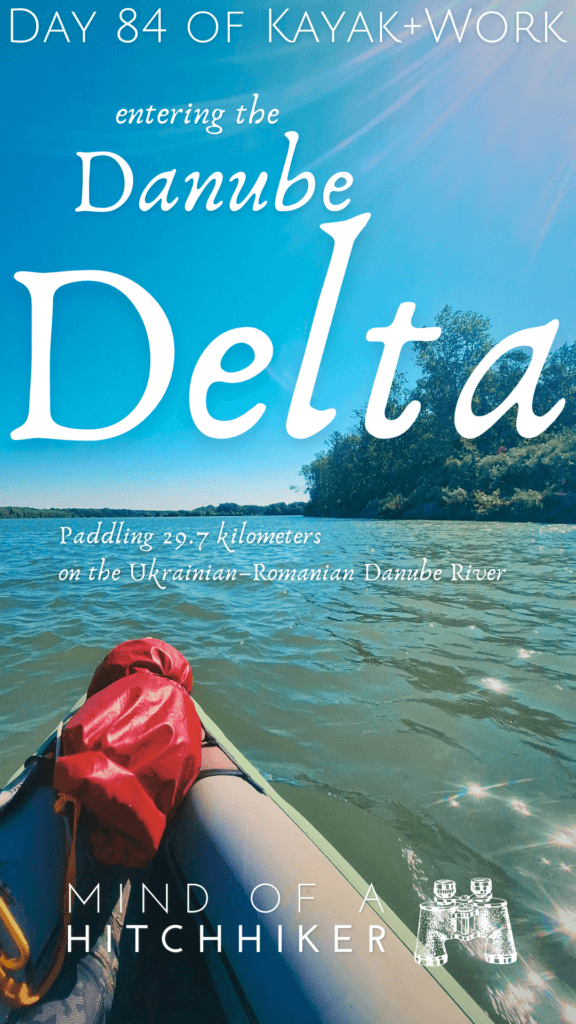
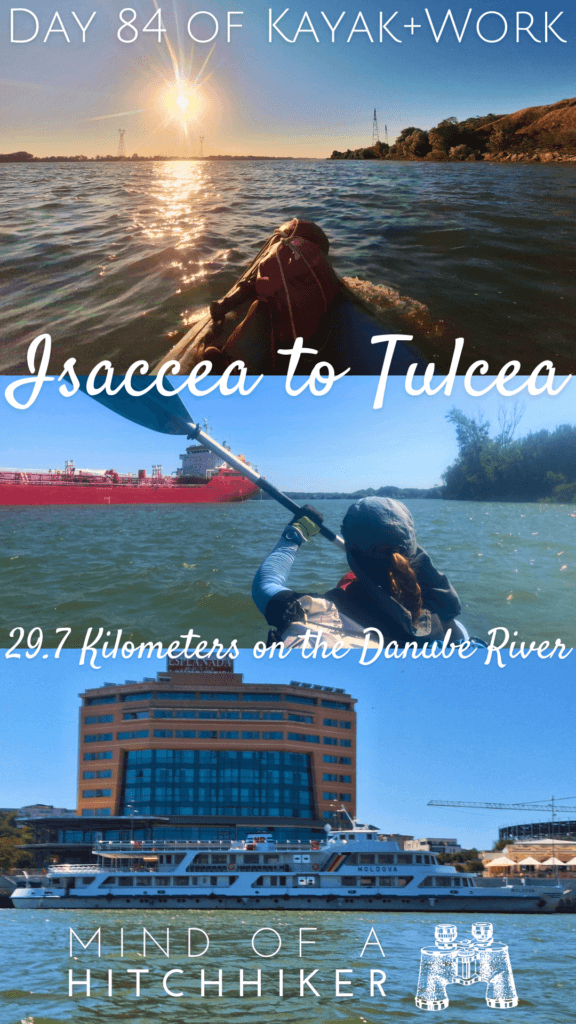
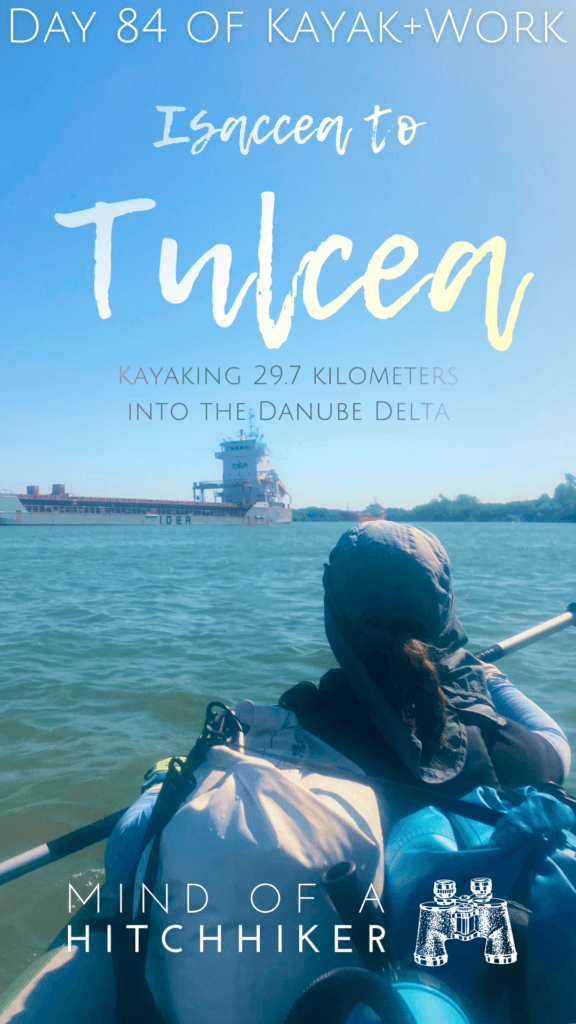
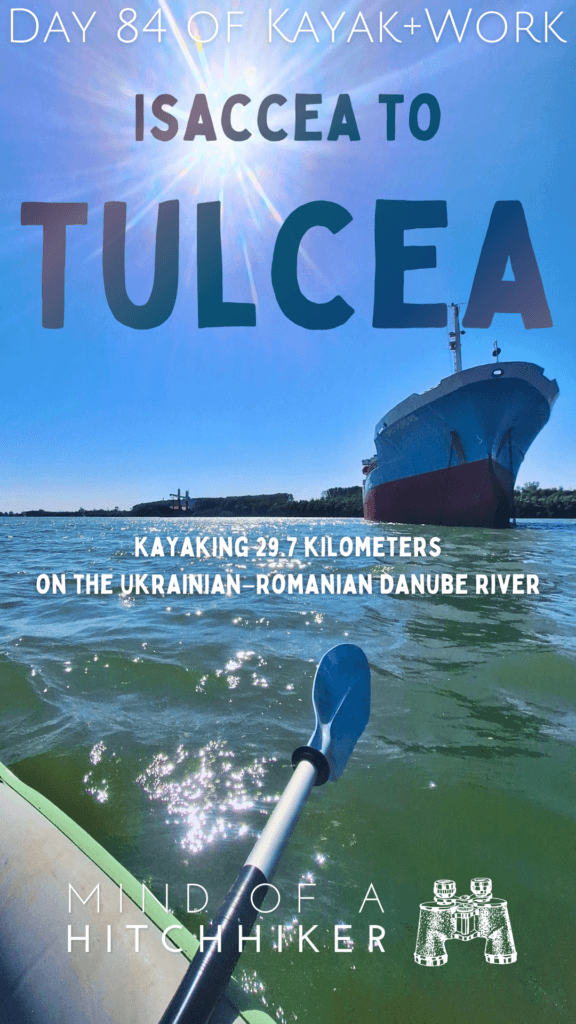
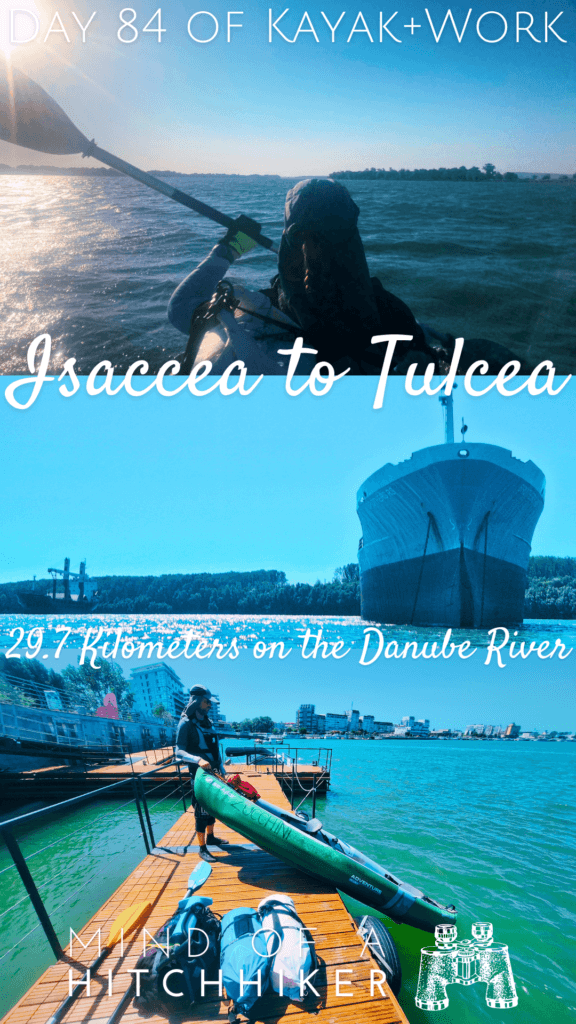
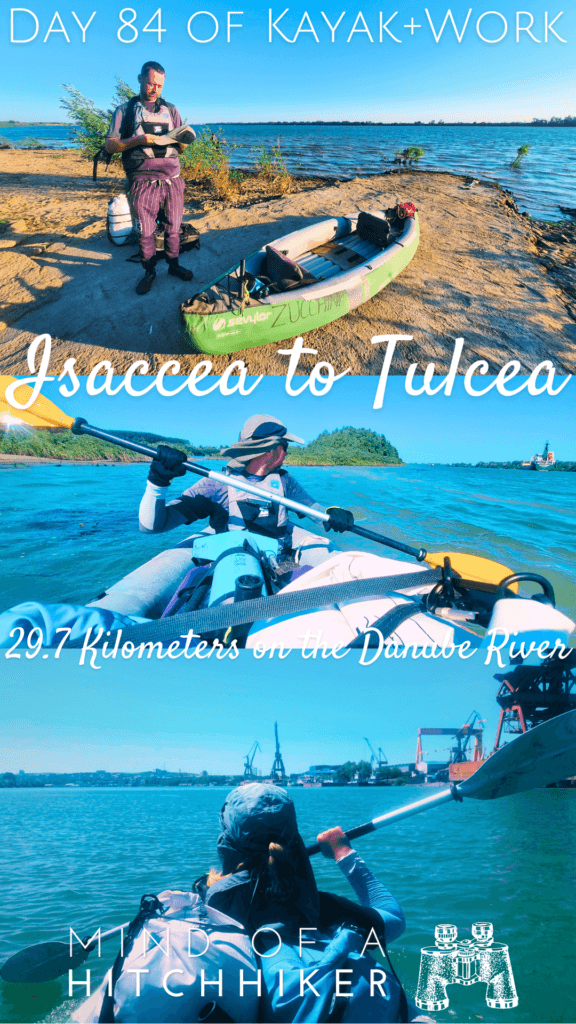
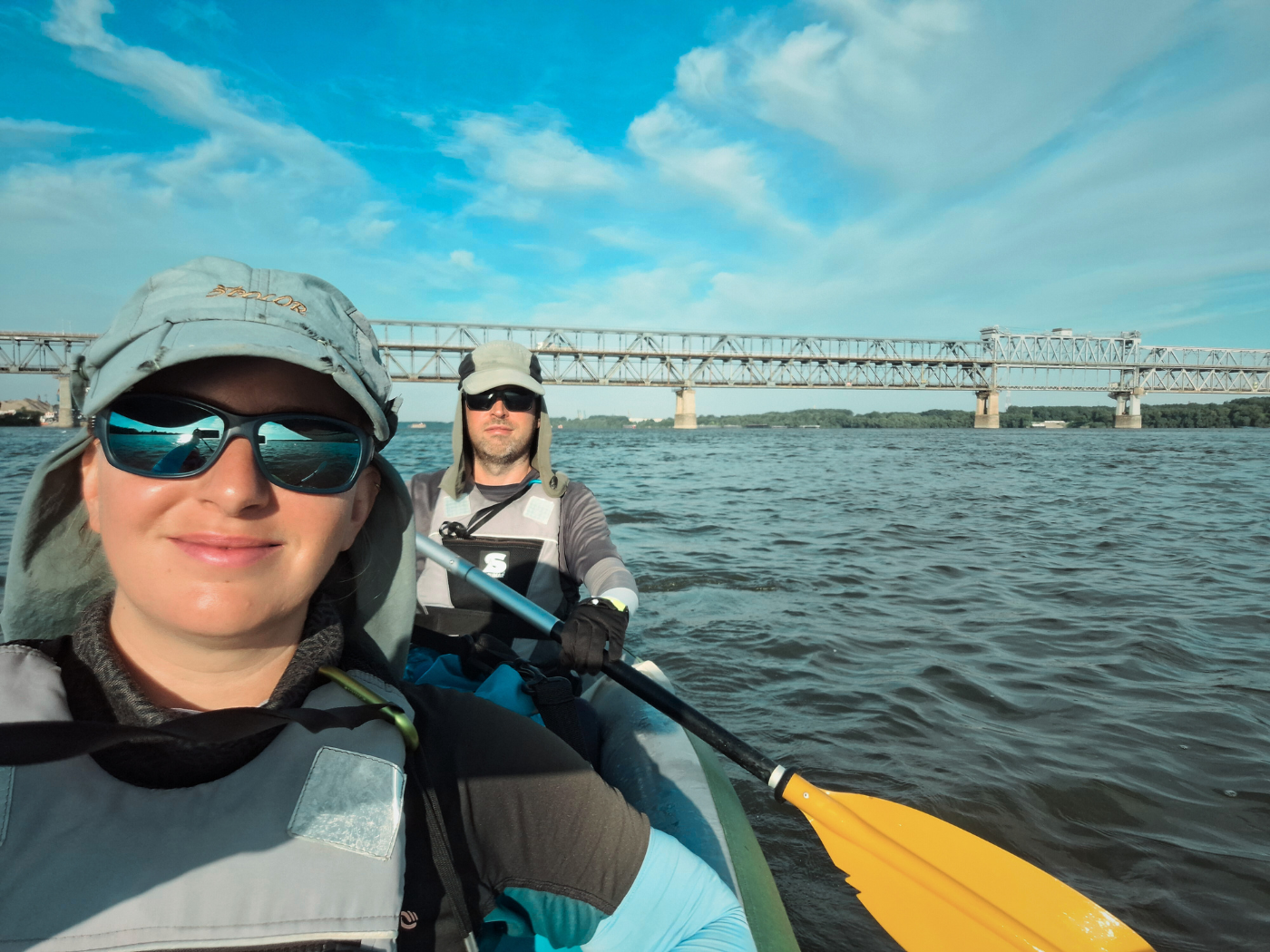
This kayak day happened on the 29th of July, 2024. We paddled from Isaccea to Tulcea in Romania. We followed the Danube that forms the border between Romania and Ukraine till the split that marks the official start of the Danube Delta. The Kiliya (aka Chilia) Branch took a left, and we followed the Tulcea Branch (future Sulina and Sfântu Gheorge branches) to the right.
Want to travel the (entire) Danube River in an adventurous way? Join our Facebook group Danube River Source to Sea: Kayak / Canoe / Bike / Hike / Sail to find your community
Contents
- 1 Leaving Isaccea for Tulcea
- 2 Surfing the Diagonal Waves
- 3 No Smoking, Safety First
- 4 Bye Ukraine: The Danube Delta Begins
- 5 The Start of the Tulcea and Soon Sfântu Gheorghe Branch
- 6 Arriving in Tulcea
- 7 One Week in Tulcea: Birthday + Illness
- 8 Helpful post? Please consider making a donation
- 9 Share or save for later? Awesome!
Leaving Isaccea for Tulcea
When we continued from Isaccea to Tulcea, we knew it wasn’t a long day. Initially, Jonas had miscalculated something and said that the distance between the two was 50 kilometers just like the last day from Galați to Isaccea. Thankfully, it was only a leisurely 30. But I’d been sick during my stay in Isaccea and hadn’t recovered. In fact, it was pretty bad. But my illness had nothing to do with my arm muscles, so off we go.
After seeing the sunrise from inside our room, we packed up our last things. It was a short walk to the Danube from our pension in Isaccea. When we started setting up the boat, Jonas grabbed the manometer to measure Zucchini’s pressure. But it was broken.
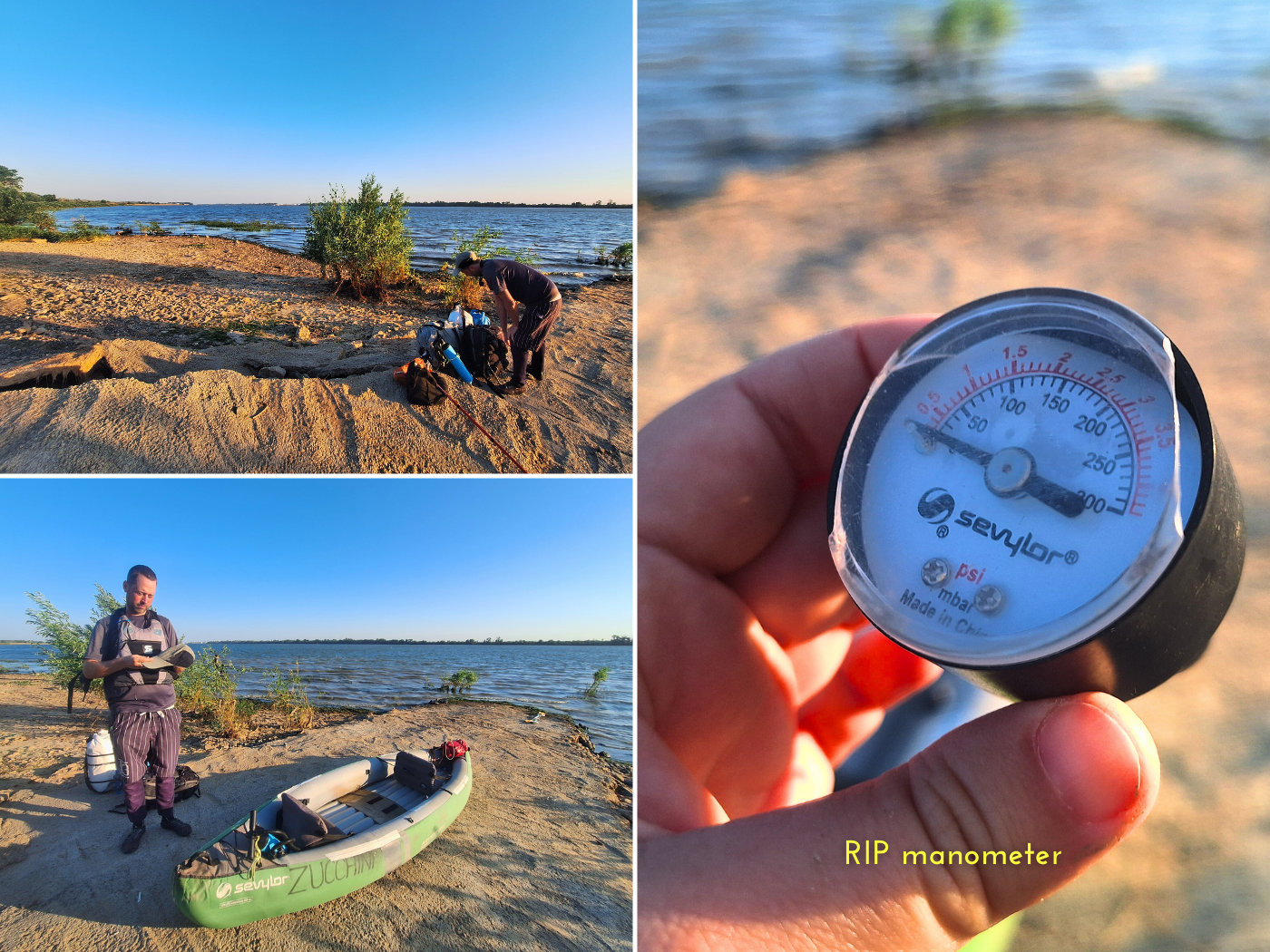
I said I wanted to replace the manometer once we arrive in Tulcea, since it’s my job to make sure the boat has good pressure and isn’t overinflated. But Jonas immediately said no, veto. I didn’t understand why and he didn’t give an explanation. We fought over this.
I still used the broken manometer to show to Jonas that now it says it’s underinflated no matter what. I don’t like to only judge this by squeezing. It’s imprecise. Three paddle days before arriving at the Black Sea, I’d like to not damage Zucchini any further.
Two guys arrived with three little dogs in tow. They went into the water to pick up some fishing stuff. Not sure what that was about, but we had to share the slipway for a moment. There was a strong onshore wind that kicked up big waves. Some water already entered Zucchini before even commencing today’s journey.
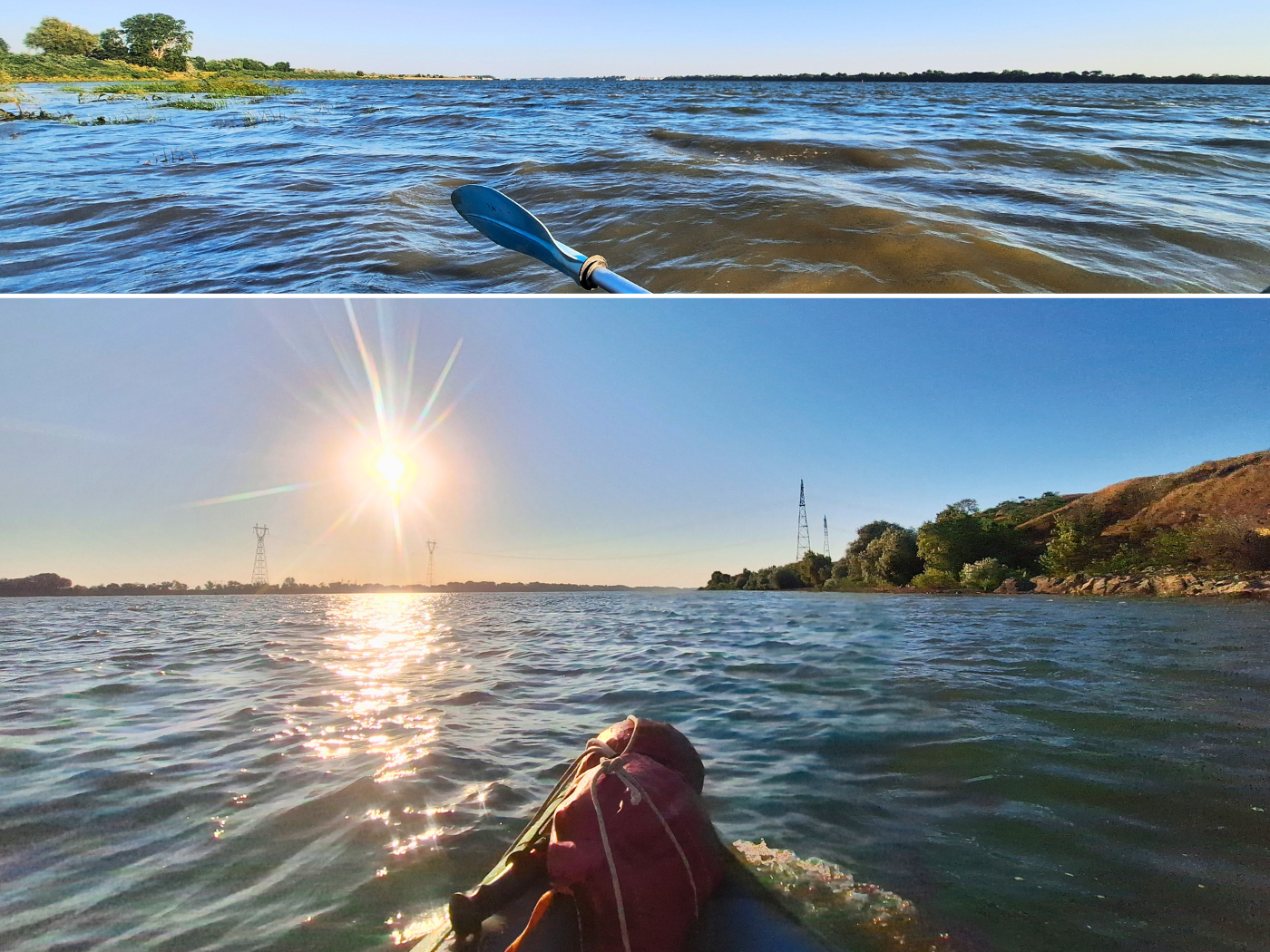
We eventually left for Tulcea at 7:08.
Surfing the Diagonal Waves
The first stretch went below the cliffs of the Noviodunum ruined Roman fortress. We were looking at the power lines that cross the Danube from Romania on the right to Ukraine on the left. It didn’t take long to get there, but we each had to adjust our seats a lot before we were comfortable enough to get into a rhythm.
The wind came from the left, a little more from behind than from the front, fortunately. The water was generally choppy, but at times, there’d be these rather large diagonal waves we could sort of surf. But each time, we’d have to correct our course afterwards to stay clear from the shore, causing splash to enter Zucchini. Most of the time they were doable, but sometimes they were a bit scary. I think it also has to do with the relief of the riverbed that determines how high the waves get.
The left air chamber was slowly deflating, but it’s the fourth day in a row that this is happening, so we weren’t too concerned. Zucchini needs very little pressure to stay afloat.
Close to Isaccea, there were still people on the land. Some people camping between the power lines, or a shepherd with a hundred sheep. Typical Romanian imagery in this area.
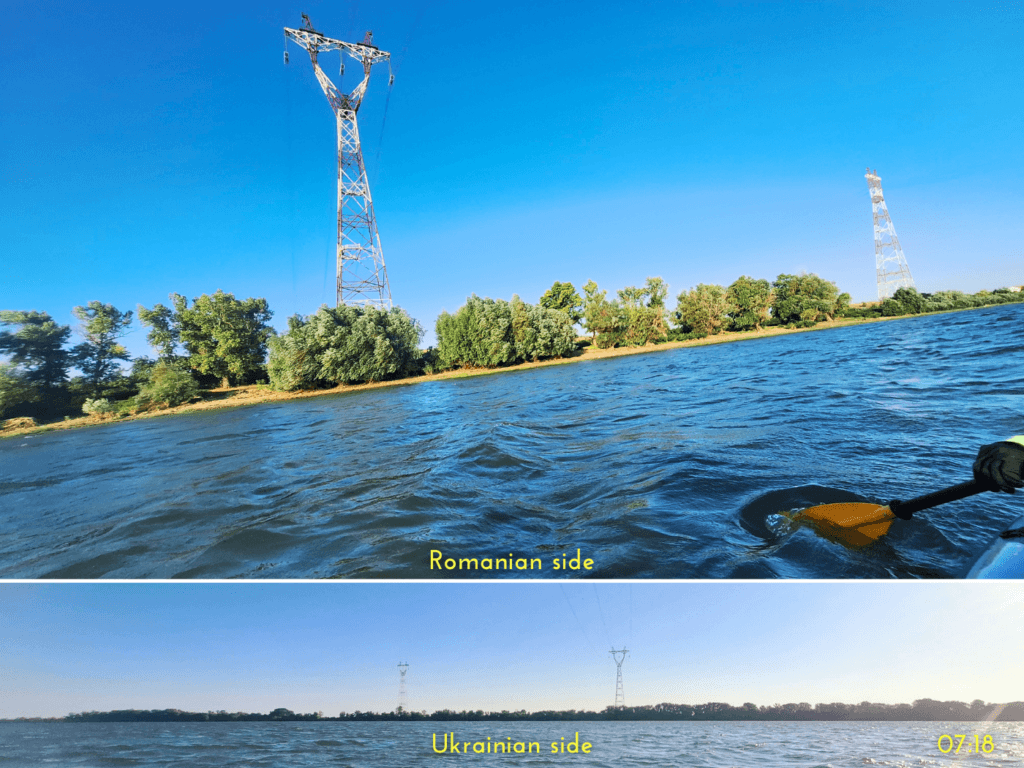
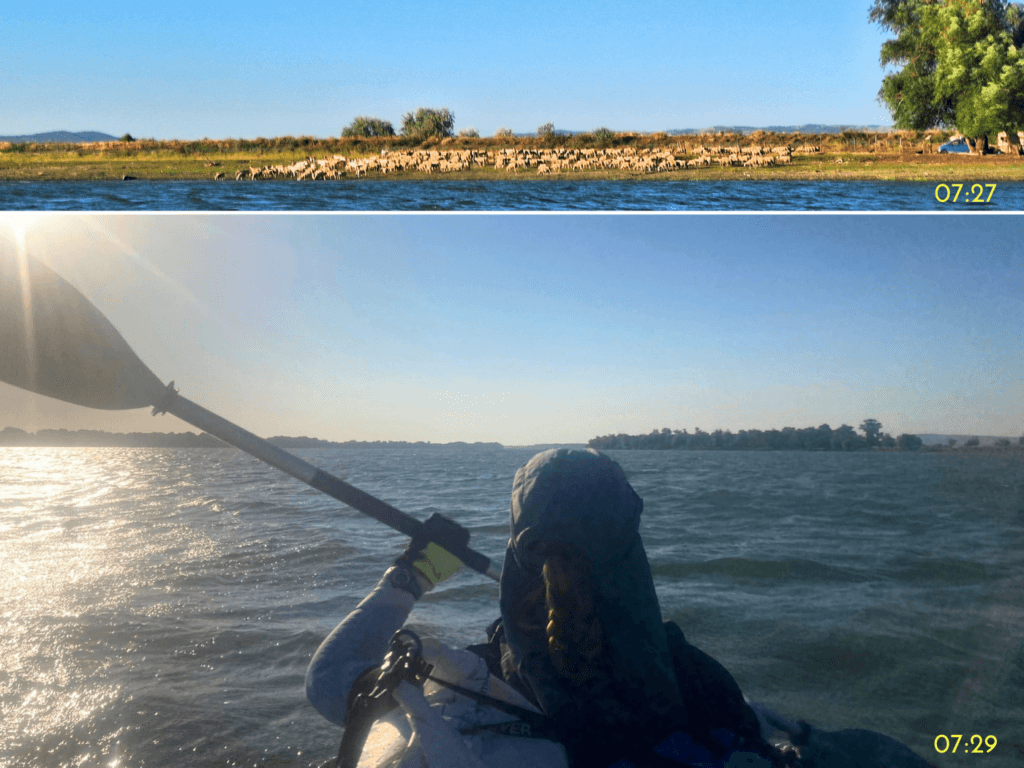
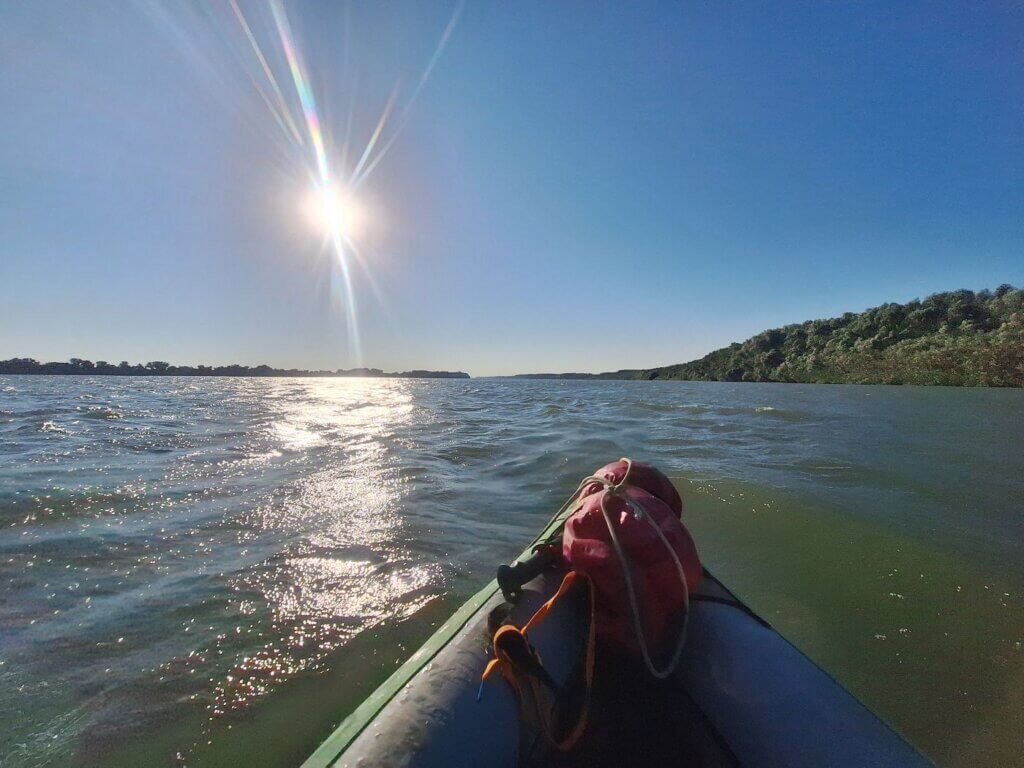
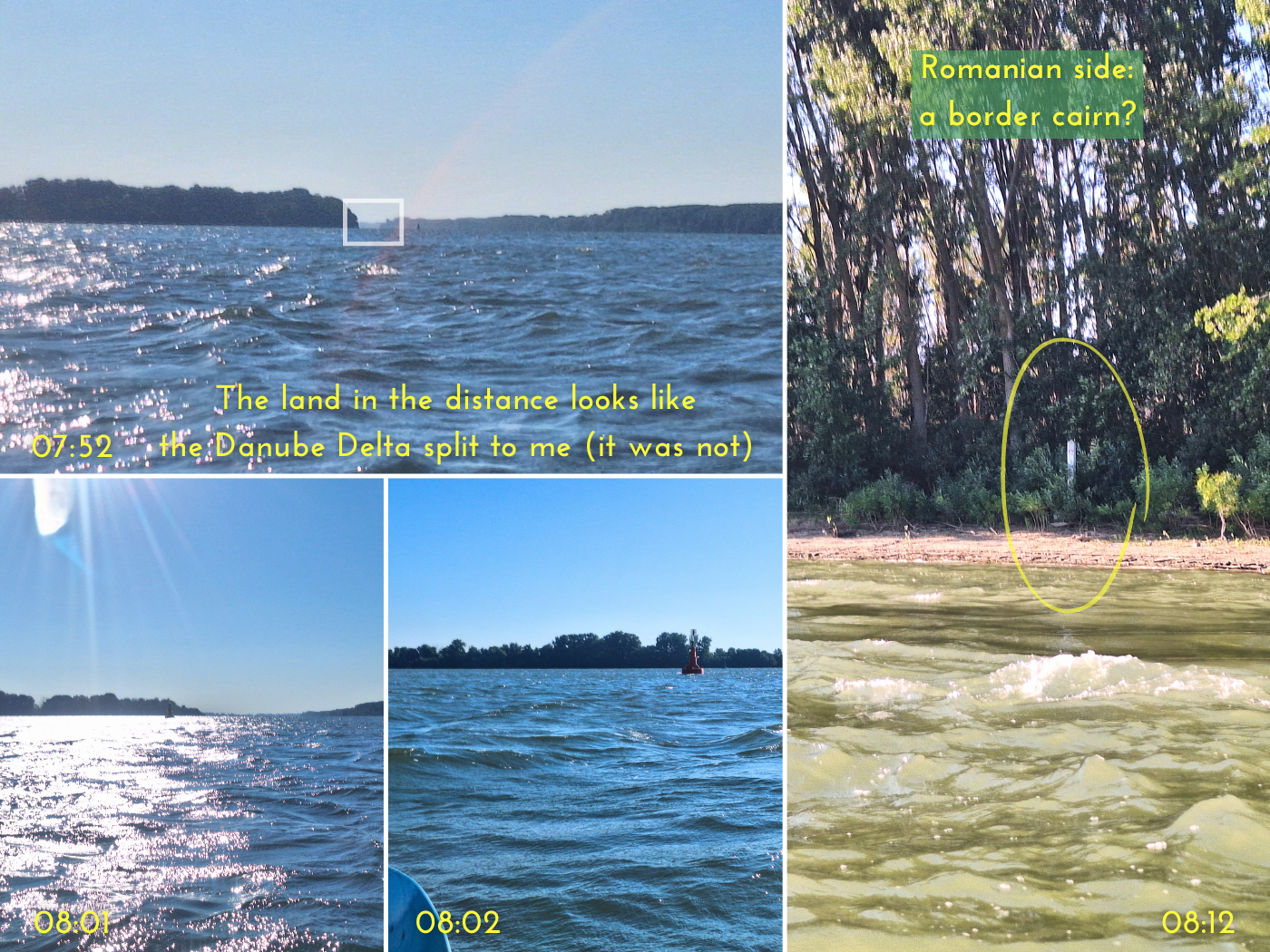
Once we turned a bit of a corner one hour into the paddle day, I thought I saw the first Danube delta fork in the distance. But on my map, it showed that that would be impossible, as there’s a left curve before the split between the Kiliya Branch and the Sfântu Gheorghe Tulcea Branch. We’re too far away to see it. By the way, the reason I spell it Kiliya instead of the Romanian Chilia is that the first option from the Ukrainian transliteration leaves little doubt about its pronunciation.
We identified buoys in the distance to calculate how close we can be to them to still stay out of the shipping lane. With this much ambient noise, we won’t hear any of the big oil tankers coming. This was also the area where I saw a pale white stick on the shore. It’s not the first time I’ve seen it. I believe it’s a faded Romanian boundary marker.
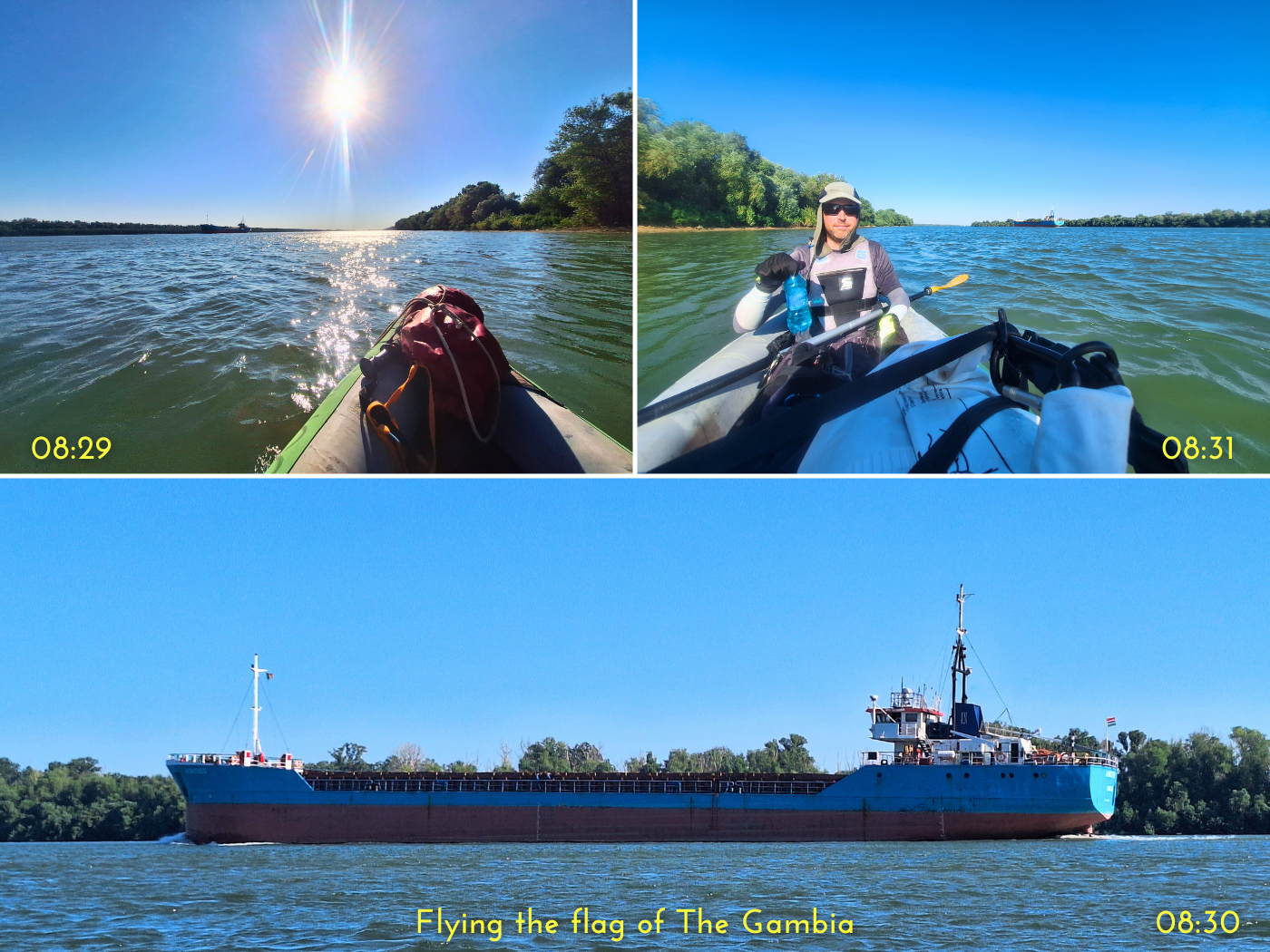
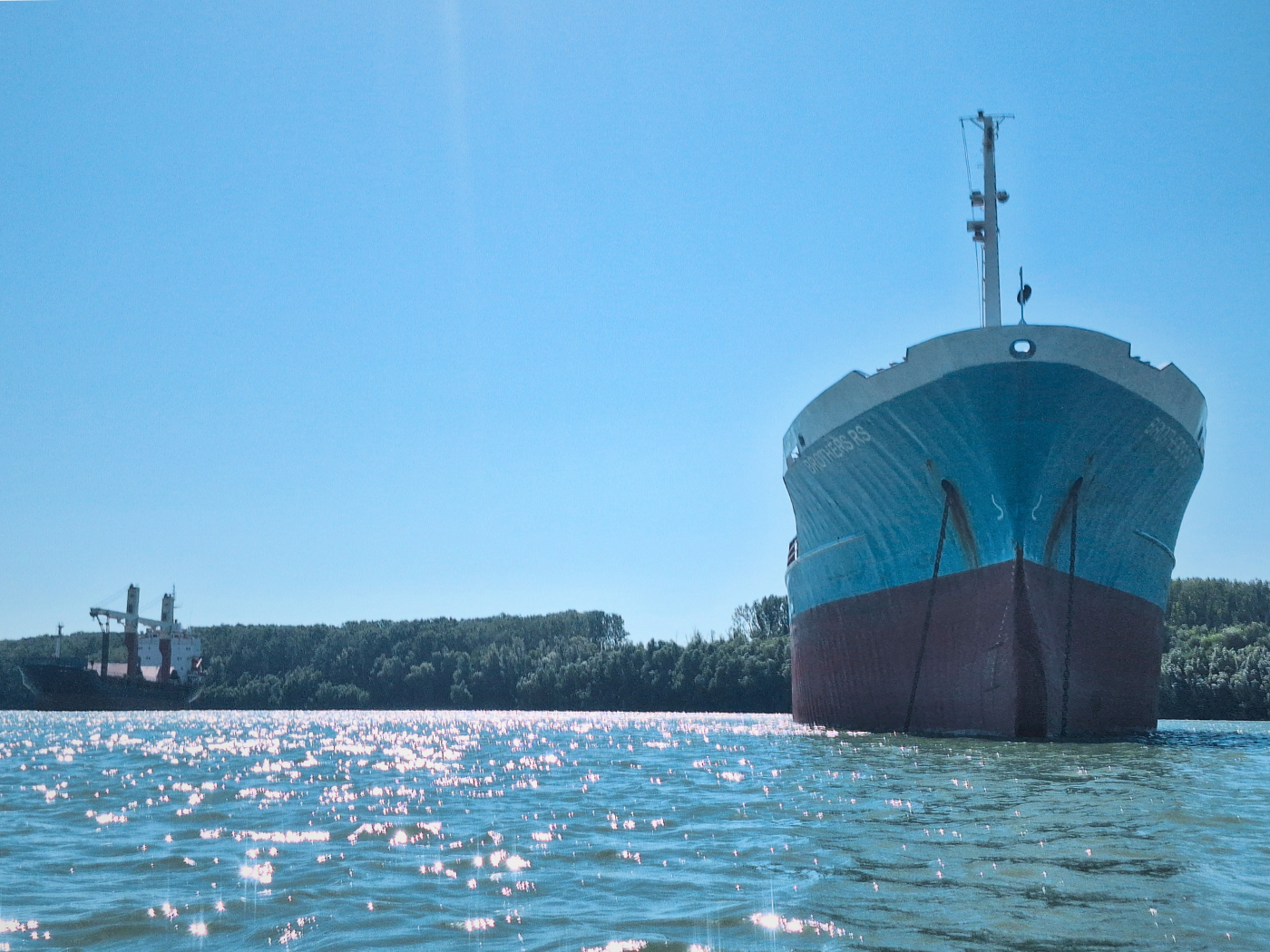
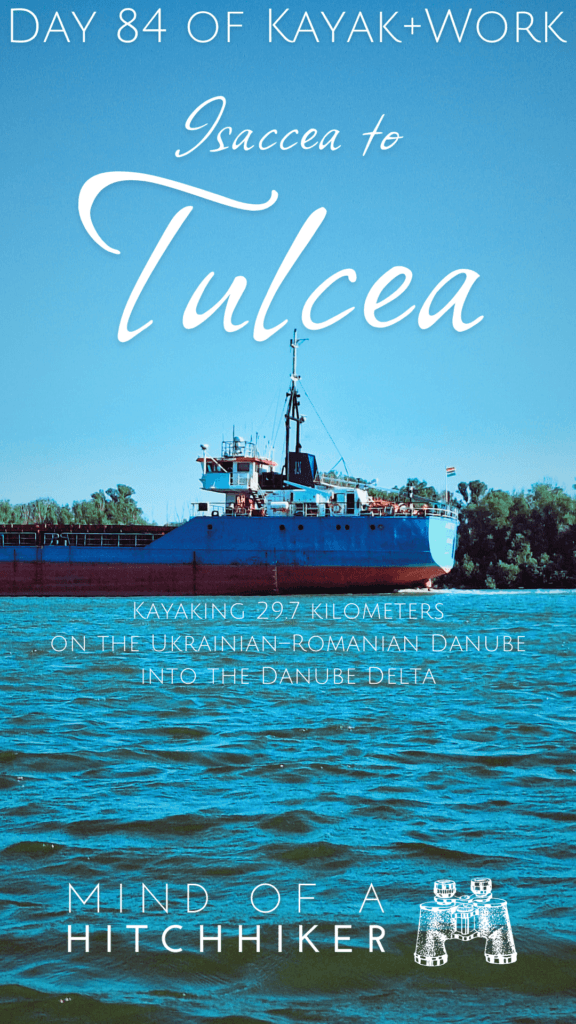
The first ships of the day appeared. A cargo ship called JN Brothers, flying the flag of The Gambia, pushed upstream in the middle of the river. There were many barges and pusher boats anchored across the river on the Ukrainian side. I thought they were stationary, but some of them were in motion, also going upstream. One of them was the inland motor freighter Destiny, flying a Dutch flag.
At 9:02, we paddled past something we’d missed on satellite view; a house with a mini port crane and a small river mouth. There was a man on shore who we wished a good day. It looked like quite a nice place to live. A bit further downstream, there was a man in a fishing boat, who returned our greeting. I only found out later that this little port is actually a channel connecting the Danube River to the Parcheș–Somova Lake System (also known as Somova–Parcheș) at normal water levels.
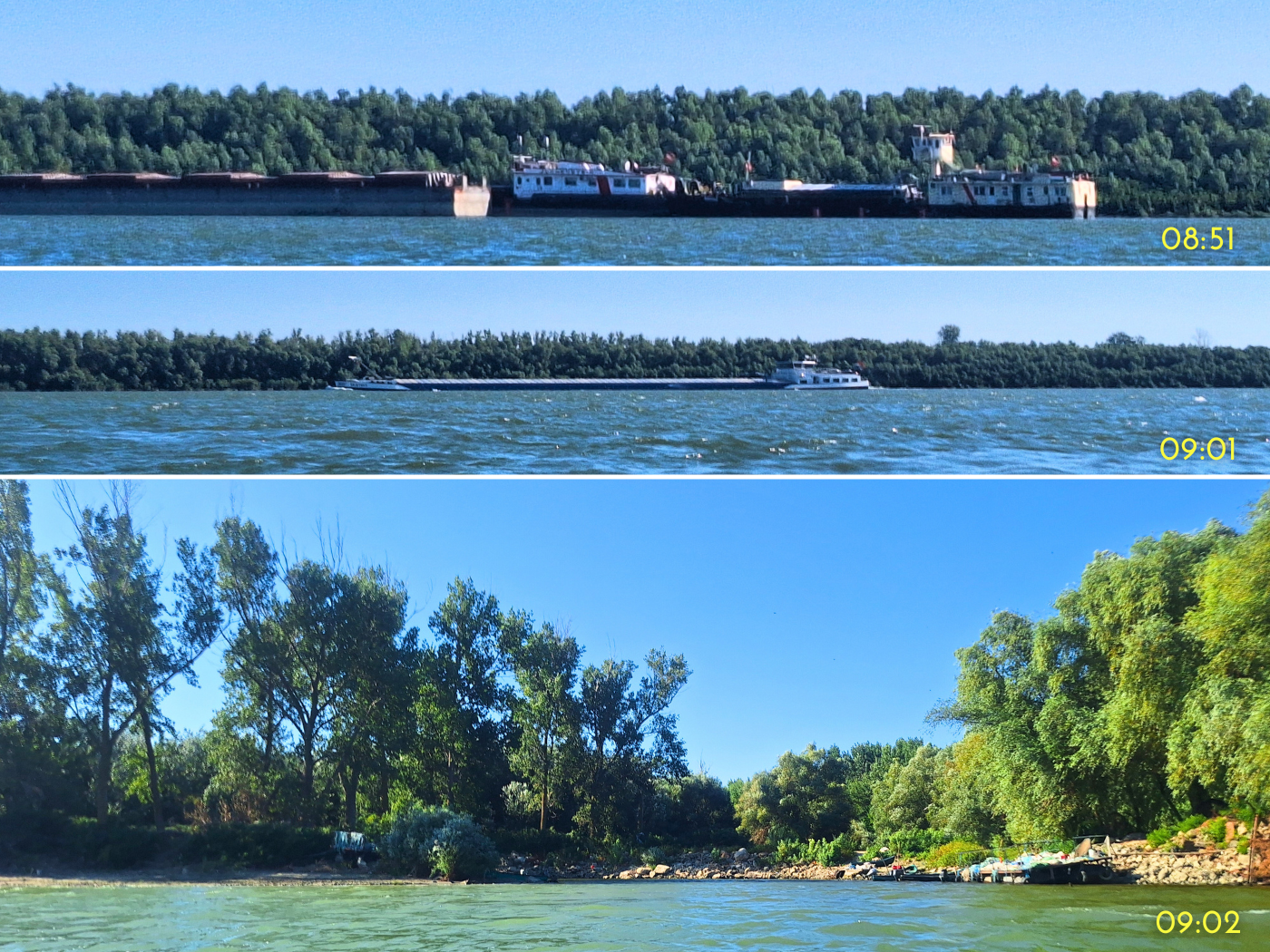
This lake complex is part of the Danube Biosphere Reserve. If you analyze it on the map, you can see that it’s (almost?) possible to reach Tulcea from the back entrance via this system of lakes and their connecting channels, ending up in Lacul Câșla. It’s also possible to spot the European Wildcat in this area, which just looks like a normal unneutered tabby cat to me. Here’s a drone shot of the Parcheș–Somova channel:
No Smoking, Safety First
A bit further ahead, we were a bit sick of the unruly water. Then I saw a narrow inlet passing the island of Scunda (source: OSM) on the right. The day before, we discussed our route and said we’d stay in the main Danube, but it might make sense if we wanted a sense of calm for a bit. I suggested it to Jonas, but he wasn’t interested.
Ahead of us were a lot of sea-going ships in the vicinity of a small island in the middle of the river. I tried my best to identify which ones were moving, but couldn’t really see much.
Jonas rather spontaneously needed to make a stop on land, so we landed on Scunda island near the end. It was too muddy for me to get out, so I stayed in the boat while Jonas did his business, pumped up Zucchini, while I was being pushed onto the shore by the strong wind. We continued three minutes later.
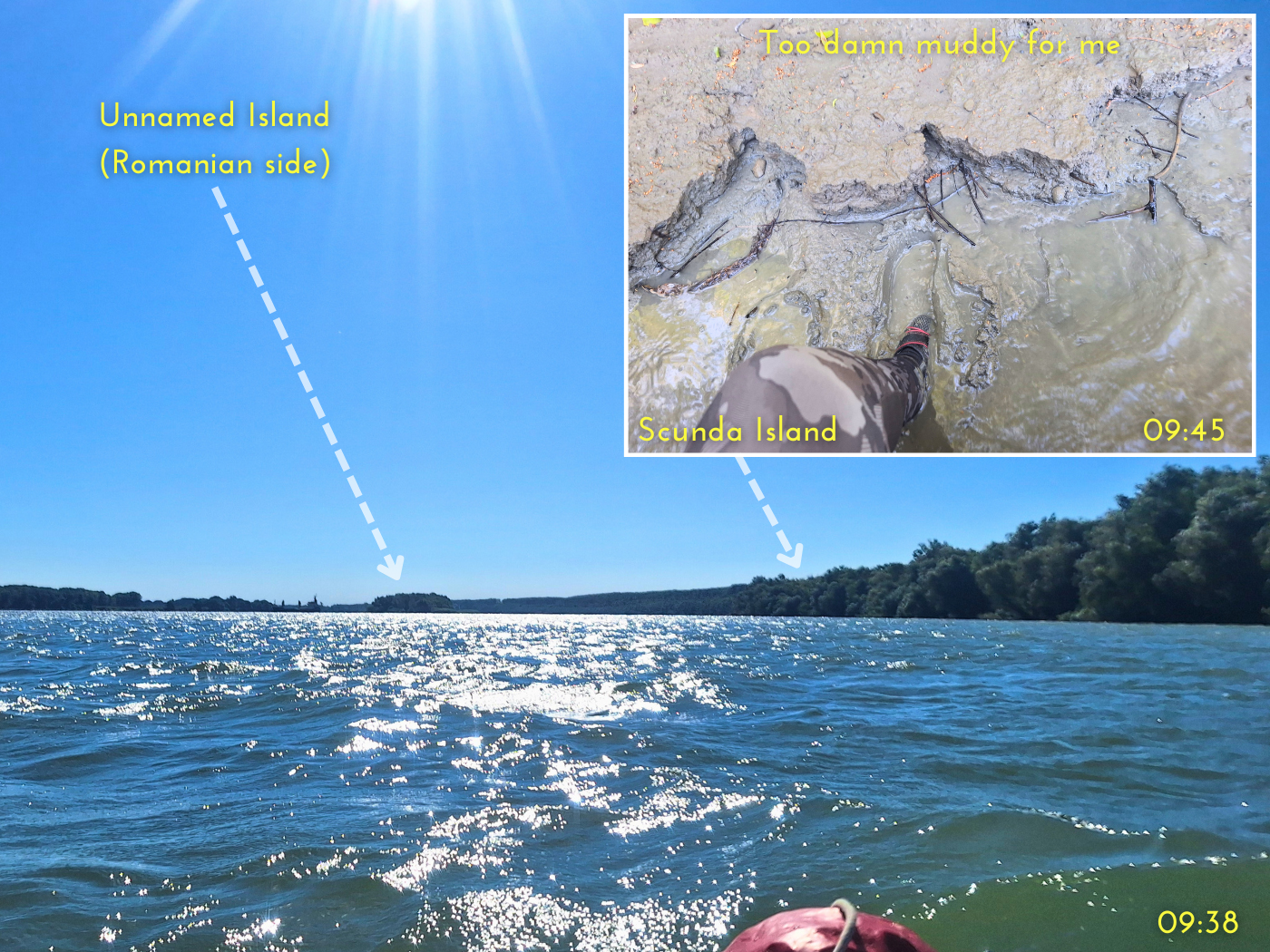
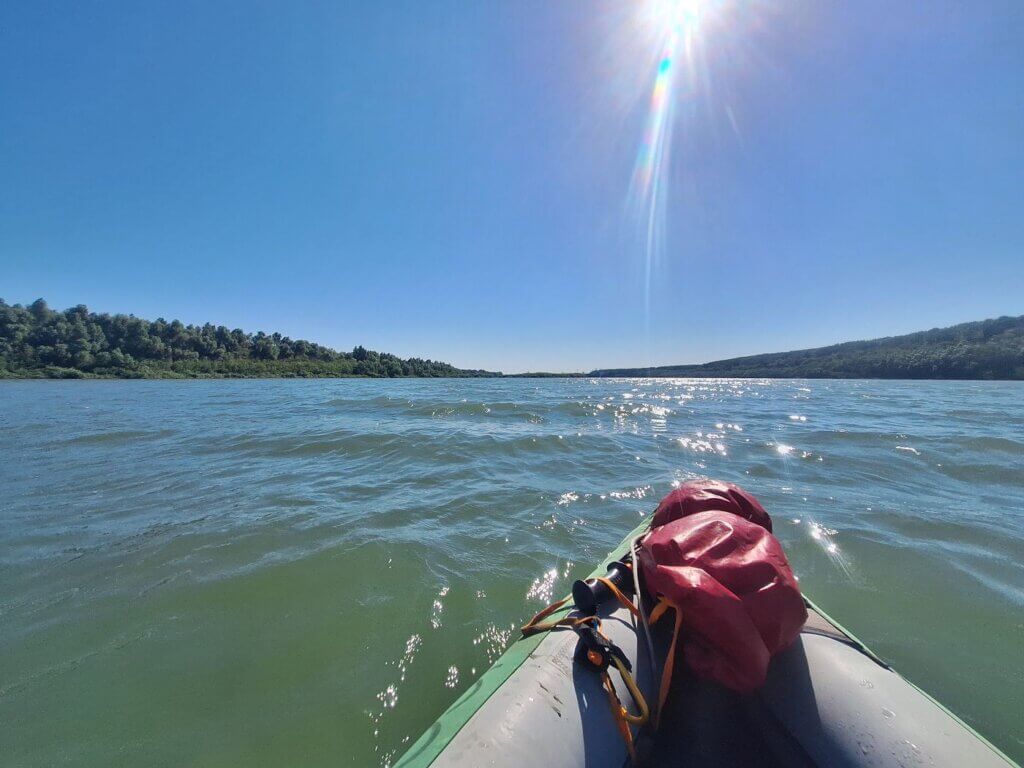
It was always the intention to paddle past this unnamed island on the right while the shipping lane presumably takes a left (because that’s where the border runs). But the island was a lot bigger in real life than it was on satellite view and the channel looked just as navigable. And behind the island, there were at least two huge oil tankers that looked either stranded or anchored. While paddling on the lee side of this island, we tried to establish whether there’d be enough space to pass these ships on the right. But it looked like there wasn’t, in which case we’d need to cross hard to the left after this island ends so we don’t end up hitting these big ships.
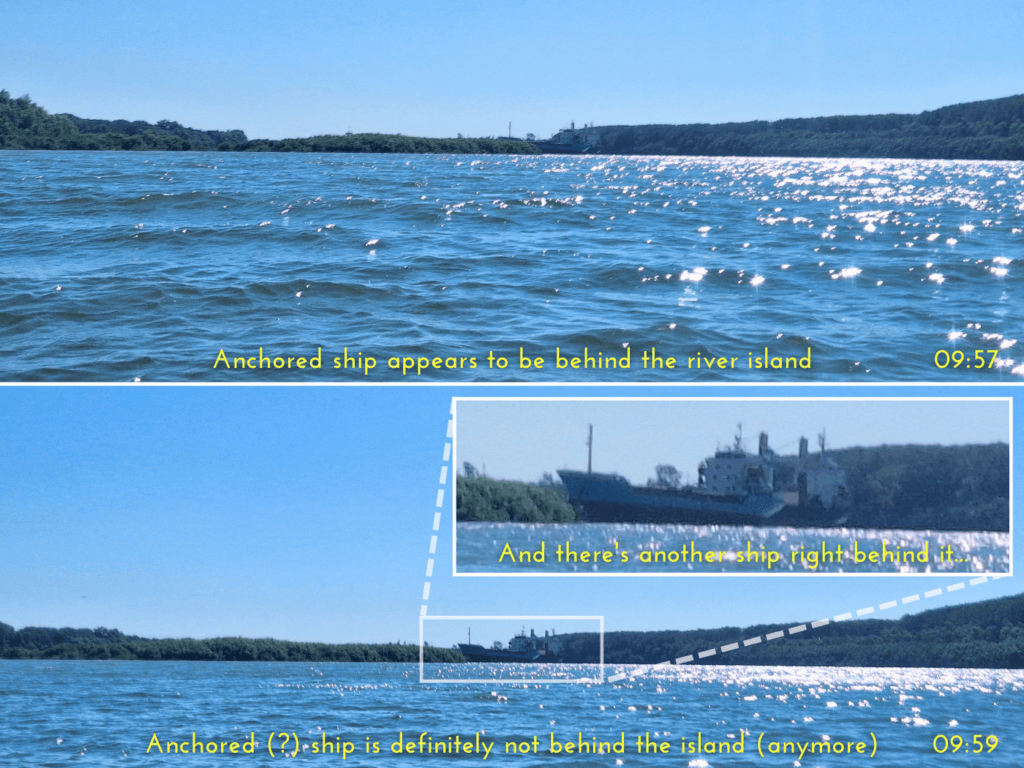
But there was another solution. According to OSM, this island was actually made up of two parts, with a little shallow gap of water between the two where we might be able to cross back to the main Danube. It’s a bit silly, yes, but we could give it a try. At some point we’ll probably run aground and then we have to lighten the boat a little bit by taking a leg out.
At 10:00, we decided to give that option a try. As we paddled in the direction of the island, the birds freaked out and flew off. We could see only half of the passage, trusting that we could find a way through. We entered the shallows, expecting to get stuck any moment now. I navigated us through by shouting to go left or right. It got really tight at one point and I felt us slowing down a bit. The fin/skeg beneath Jonas touched the sand. But we continued. And within moments, we were through to the other side.
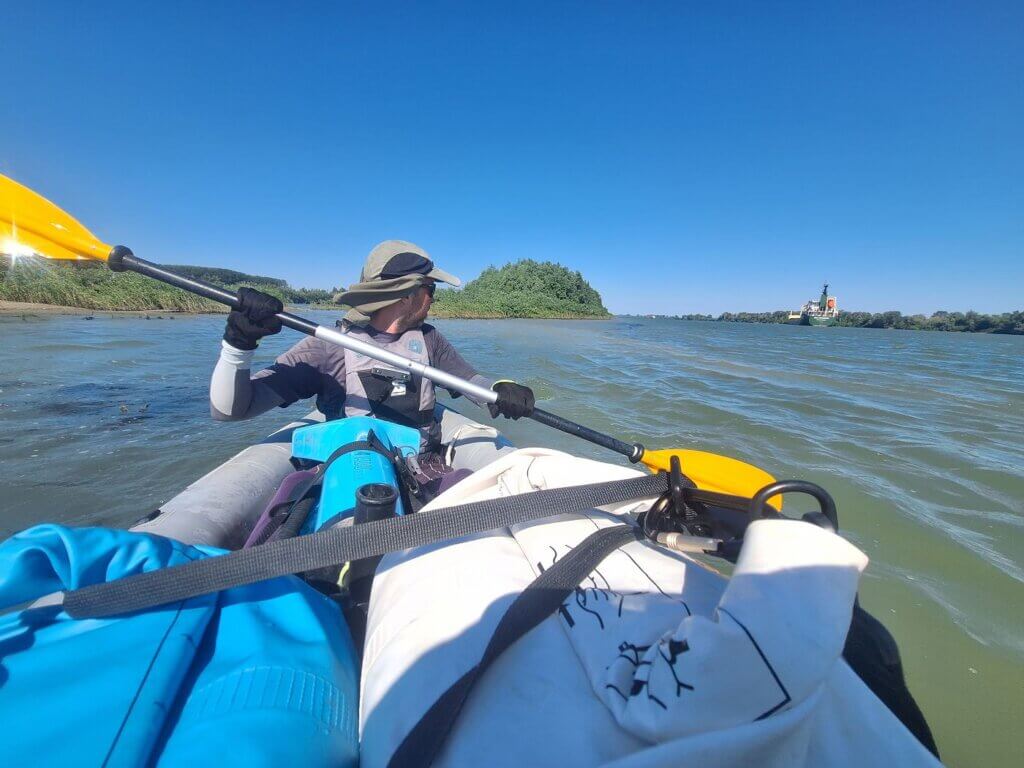
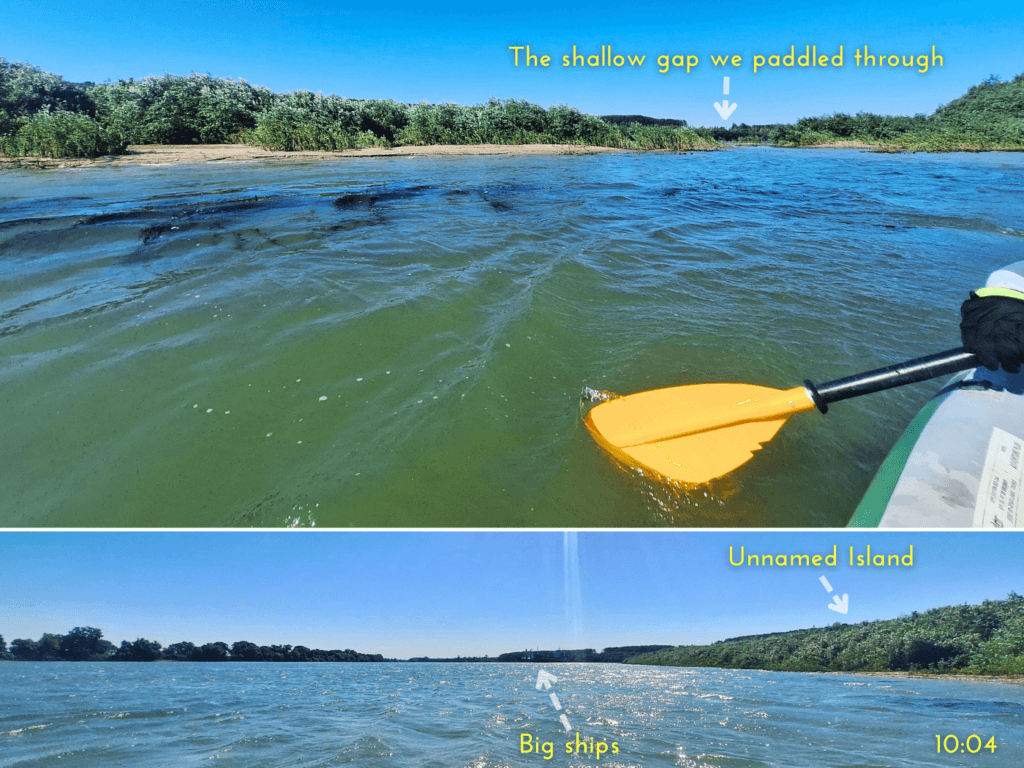
Crossing through shallow water is exactly where a kayak shines.
But we couldn’t rest. The two big ships were now really close to us. Good thing that we could confirm now that they are indeed at anchor. No worries about them moving anytime soon. But why they’re all hanging out here and so close to shore? No idea.
It’s funny to me that the accommodations of these ocean-going vessels always either says NO SMOKING or SAFETY FIRST in big red letters. If the ship is really big, it says both. Often in this format:
NO SMOKING
SAFETY FIRST
Besides looking funny if you’re reading it in an unserious way, I think merchant mariners are… often really into tobacco? I later found a useful video explaining the NO SMOKING part of the sign when it comes to fuel tankers.
Next, we saw a speedboat come our way before we’d passed the next anchored ship in full. It was headed straight towards us, so I got my whistle ready. I signaled them to move out of the way or slow down, and they did. Jonas had clocked them as a police boat, but they had a dark blue hood on their small speed boat. To me, normal Romanian water police has a dark blue hull with a white cockpit. No blue on top. But they behaved like cops, so we stopped paddling and let them come to us. I could only read the POLIȚIA DE FRONTIERĂ when they turned to the side. I have no photos from this interaction.
Jonas led the conversation while I tried to get a stable grip on the boat and not lose my paddle. They asked us where we came from today. I said “Isak-kea” and they apparently repeated it back like “Isak-cha”. The more you know.
They asked where we entered Romania, which gave me another opportunity to butcher the city name Călărași and Chiciu. Mission failed successfully. They asked for our passports and our crew manifest. Good thing we spent those 90 minutes in Chiciu answering border police questions and clarifying our itinerary to get this shiny and stamped crew manifest. I hoped they wouldn’t ask further about our first time entering Romania, because that’s a long time ago and we went to Bulgaria in between and everything is very complicated. In all, they were polite and professional and not emotionally dysregulated little boys. That’s how low the bar is to impress.
They asked where we’re going, so I said “Tulcea”, which is about one of the only places I know how to pronounce well because of Age of Empires II (Ivaylo). And I added in “Sfântu Gheorghe” for good measure. No one has given me feedback on how to pronounce that one. So now I shall google it and
OH MY GOD.
It’s “GYOR-GEH”. Damn.
After some minutes, Jonas received our passports back and we could go. He packed them up while I paddled us behind the next ship. The police zipped off to another ship in this border zone. It honestly surprises me that we hadn’t met them on the paddling day to Galați or to Isaccea. Considering the war russia has brought into Europe, we could do with some better checks on the entire border zone in my opinion.
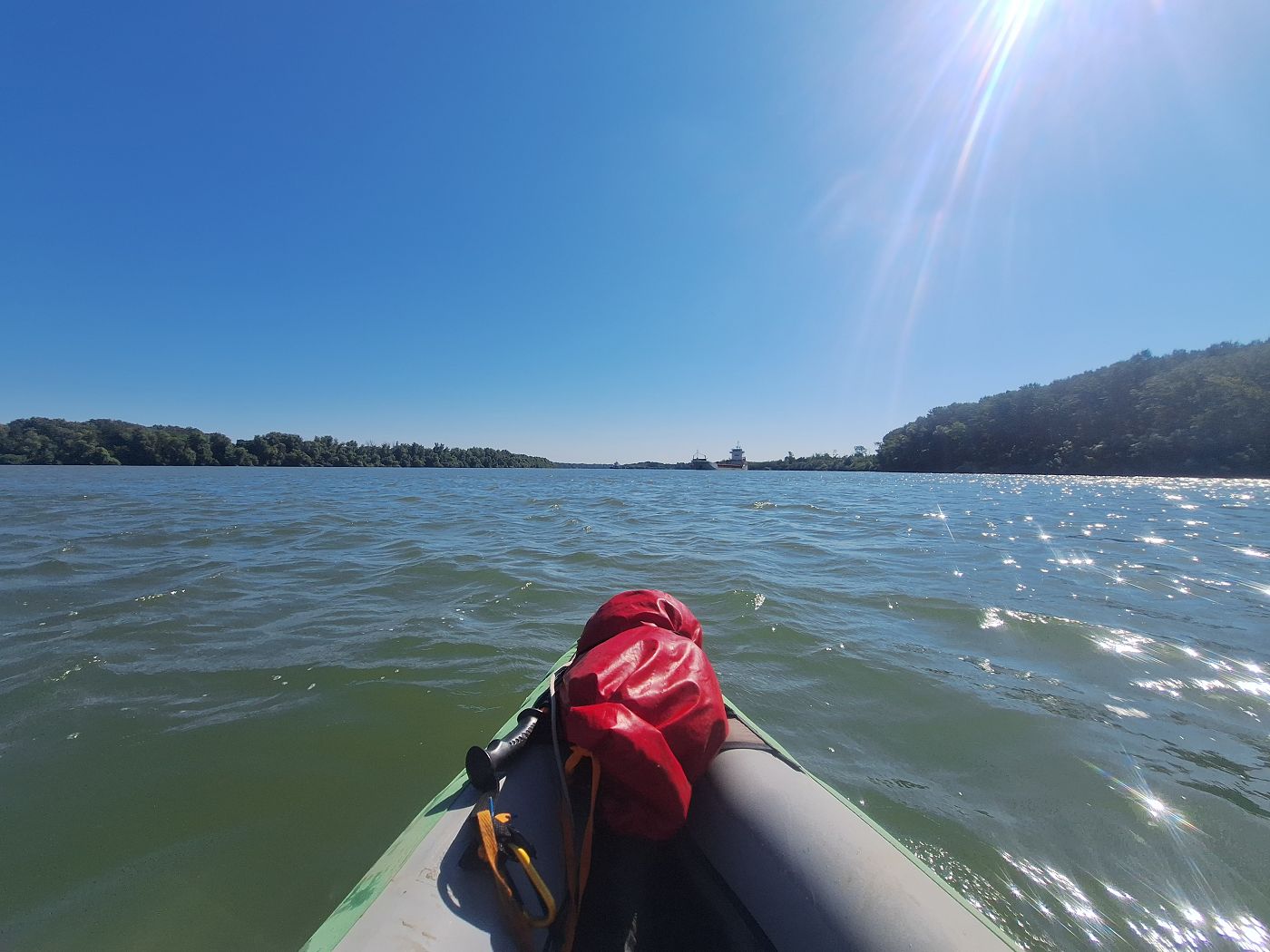
Bye Ukraine: The Danube Delta Begins
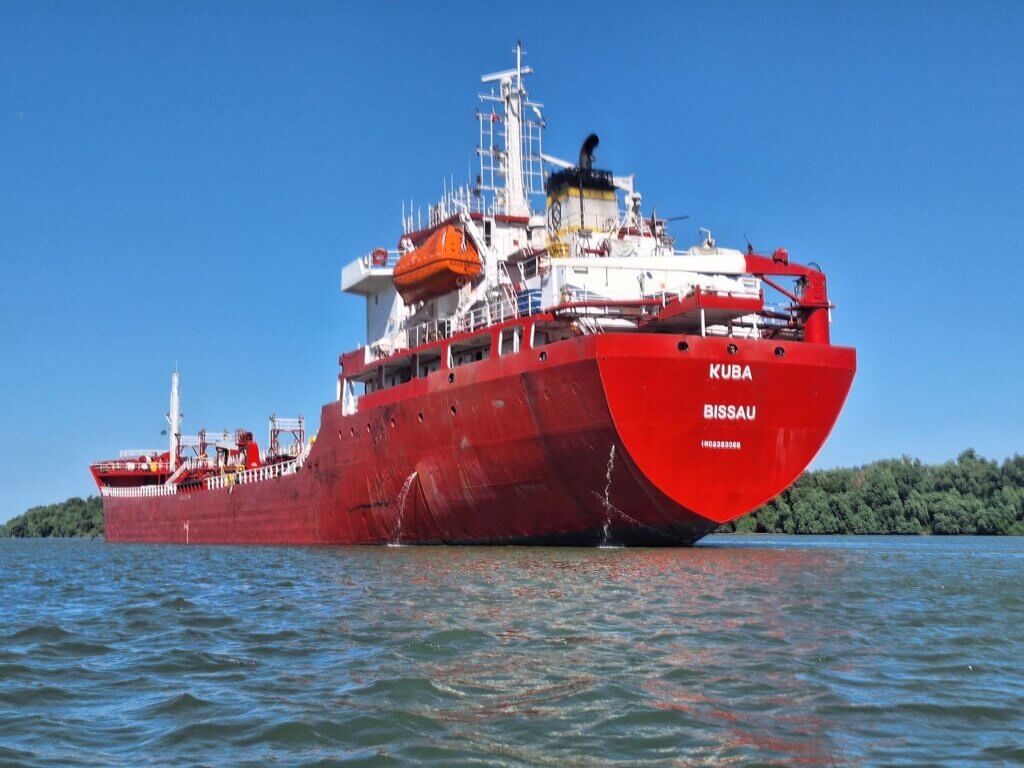
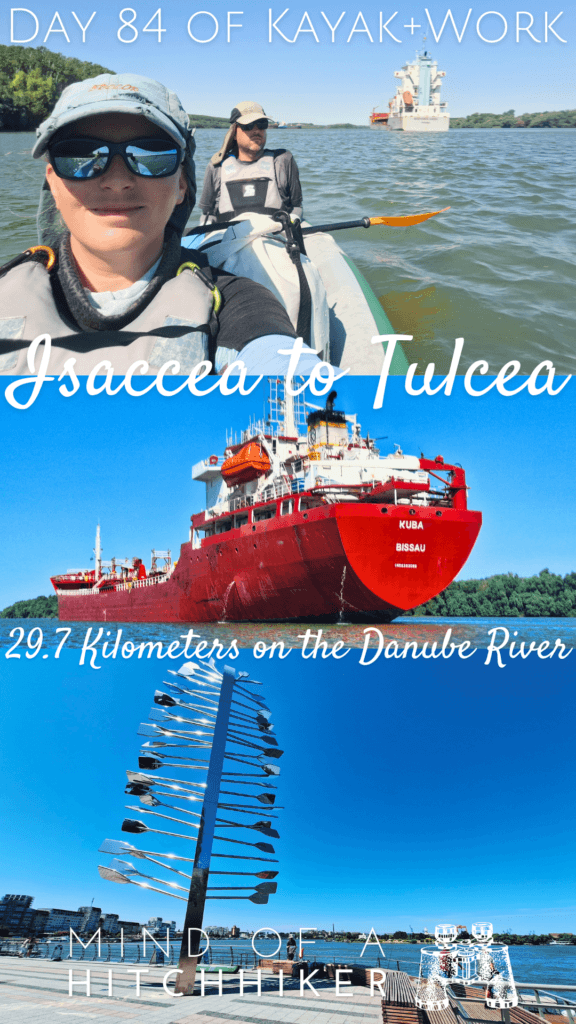
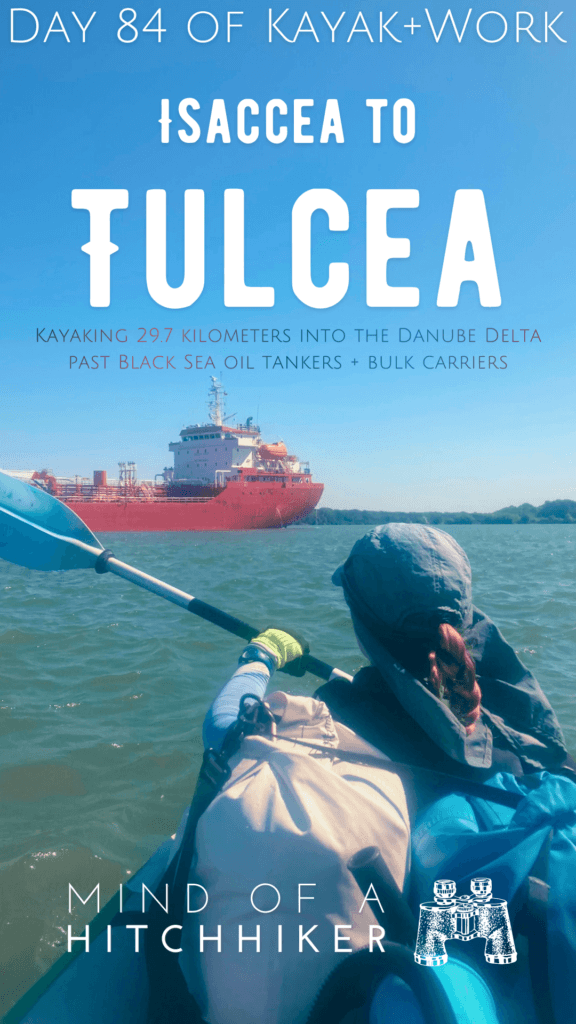
So we took some more photos with the next few ships. The Bosphorus Queen, flying the Panamanian flag, followed by a bright red ship partly blocking the view of the first Danube Delta distributary.
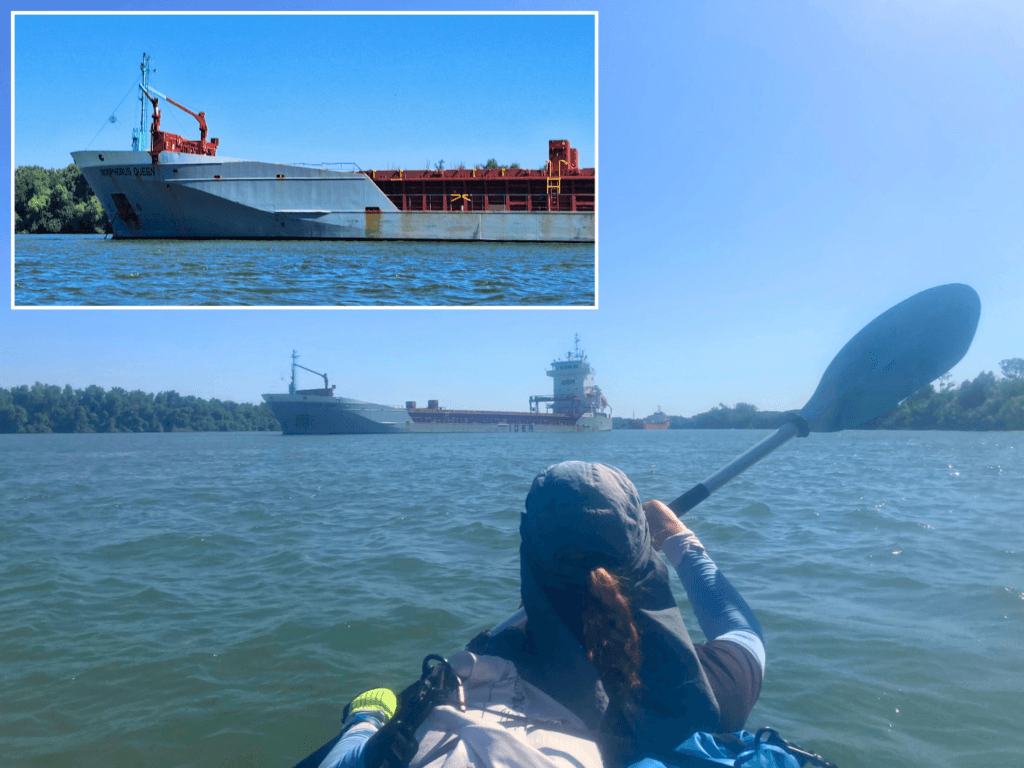
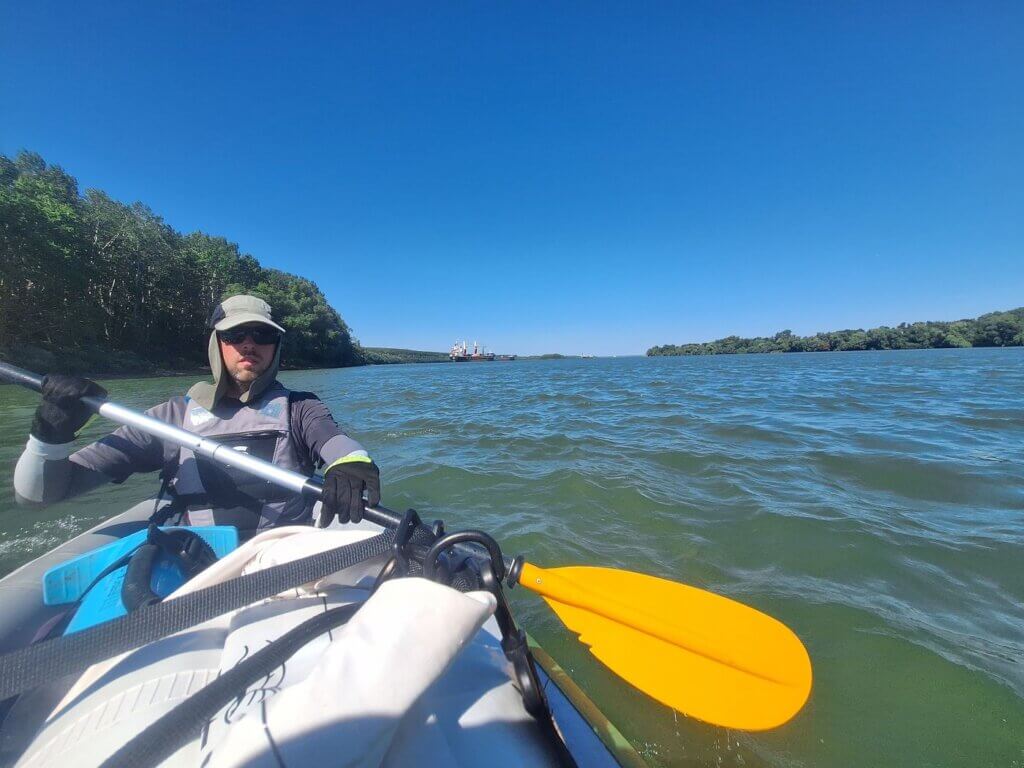
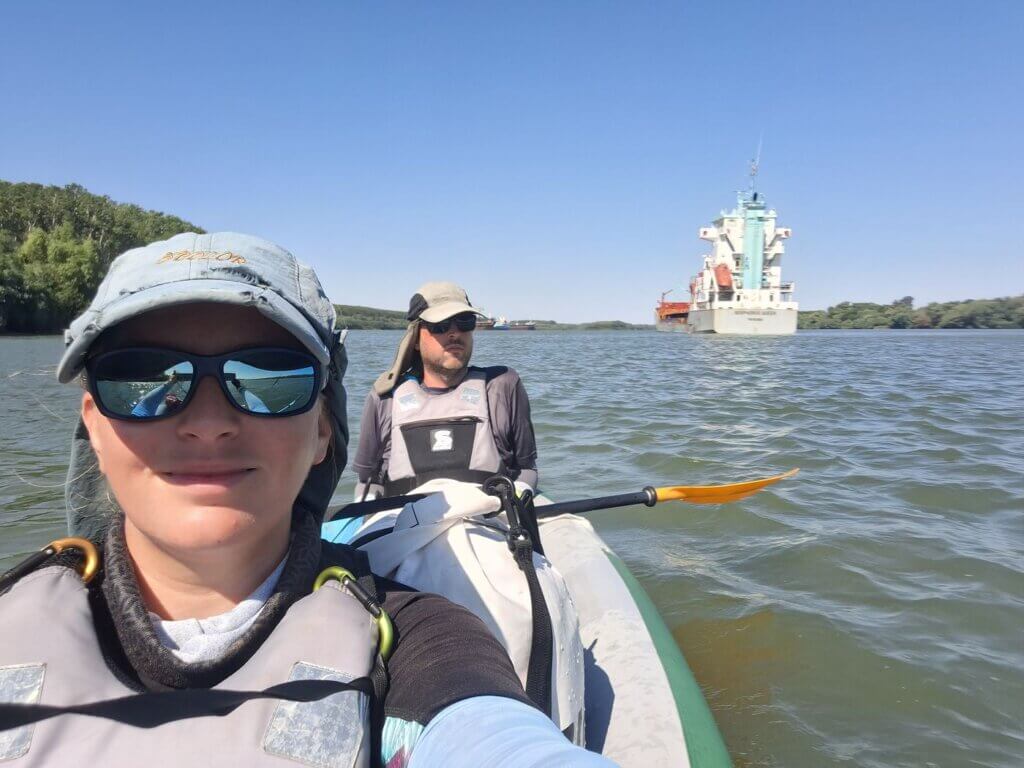
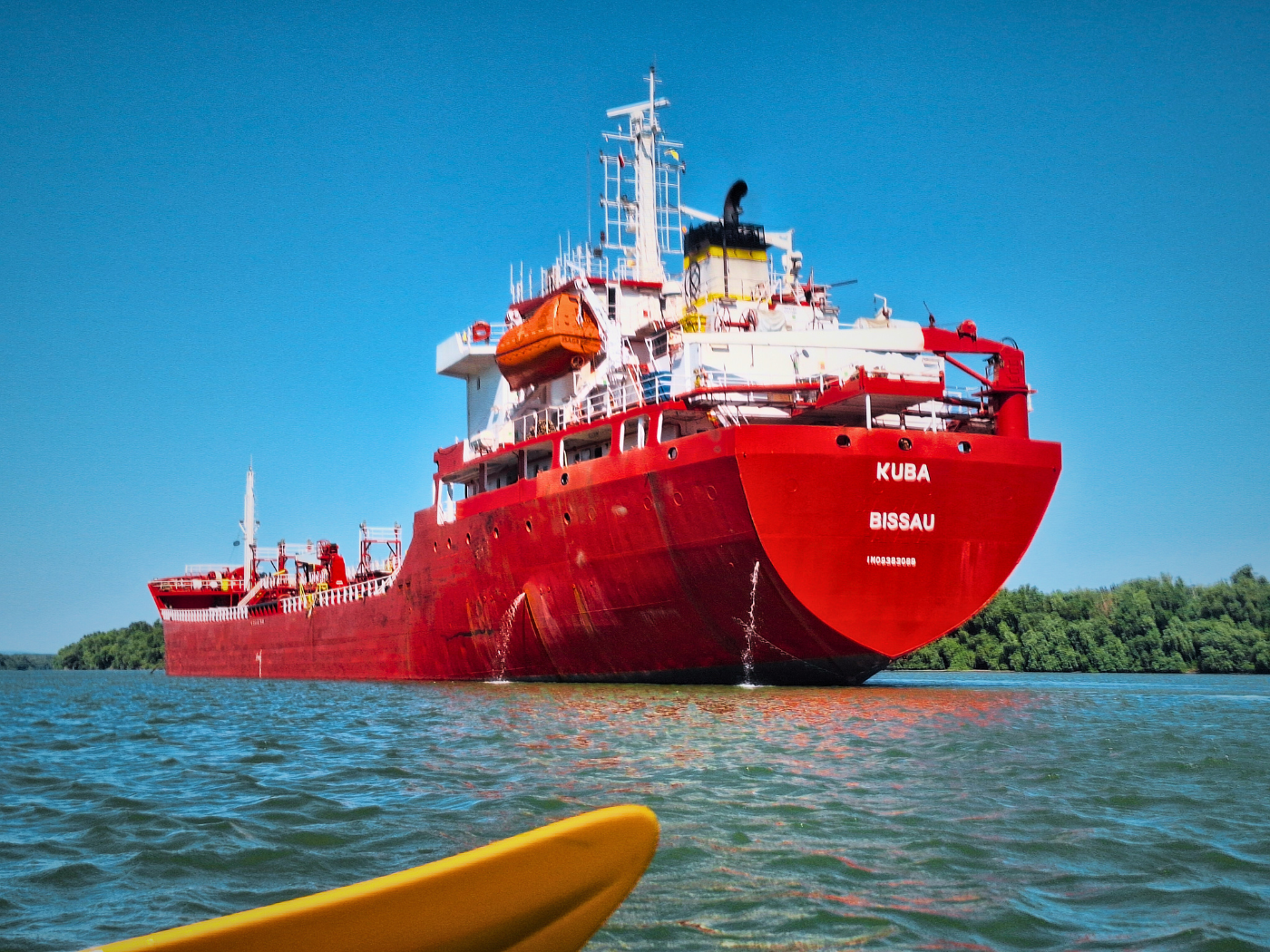
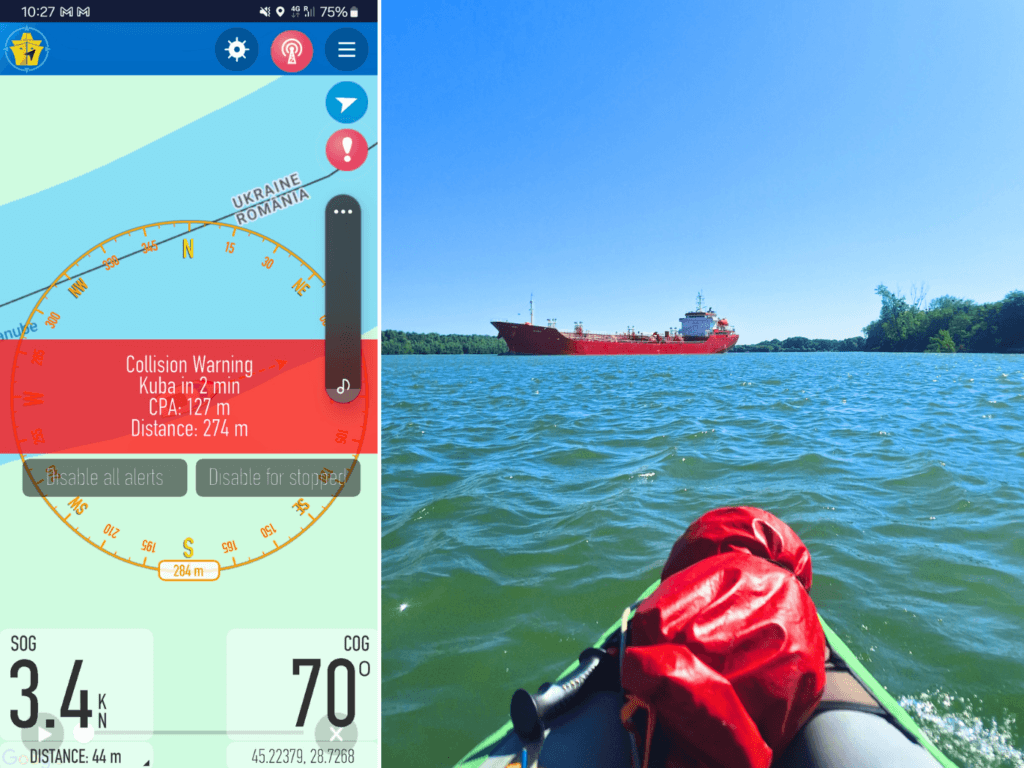
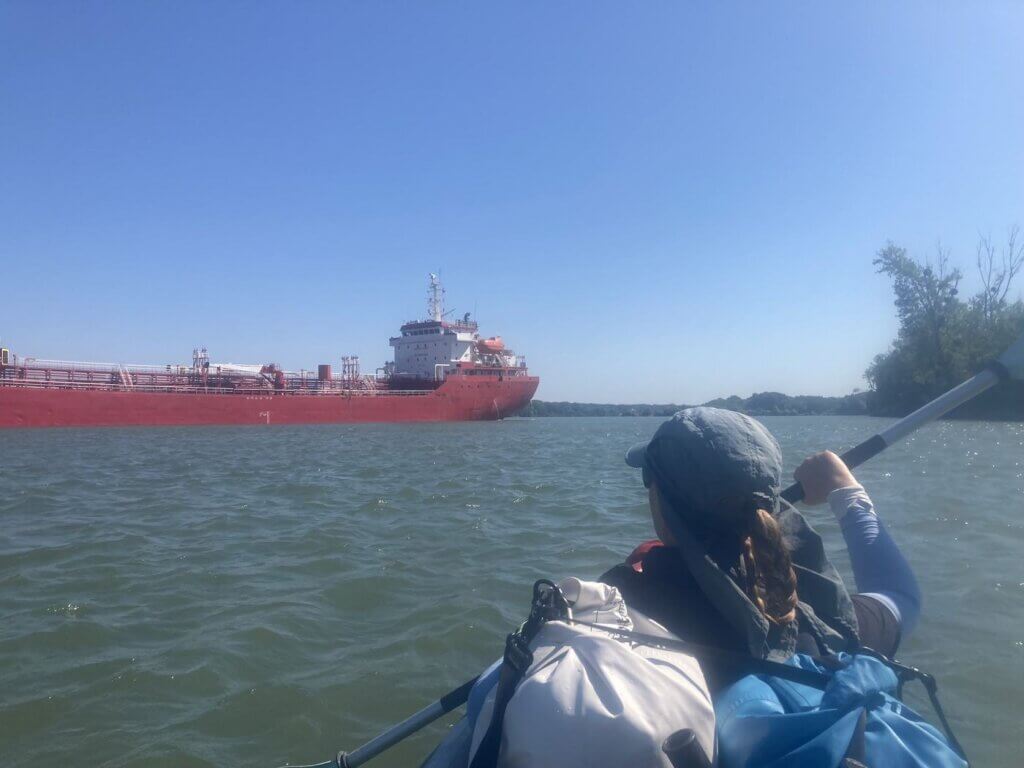
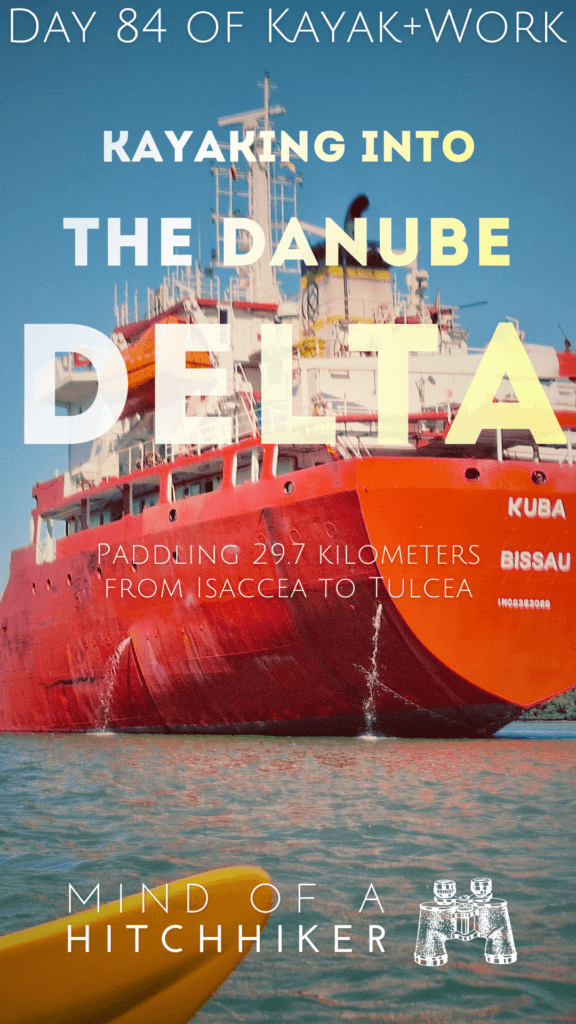
That bright red ship was the Kuba with a flag of convenience from Guinea-Bissau. I was tracking us with the OnCourse app for fun, and it gave me a collision warning with the Kuba. I wonder if they also got a collision warning with the four-meter vessel ZUCCHINI in menacingly close range.
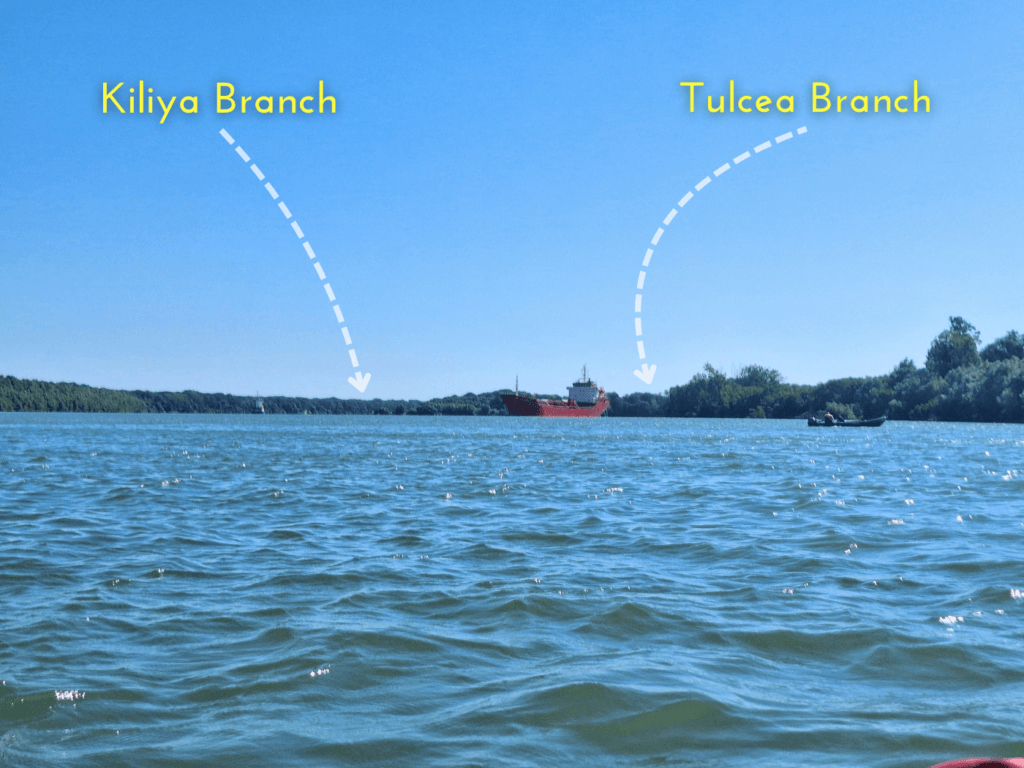
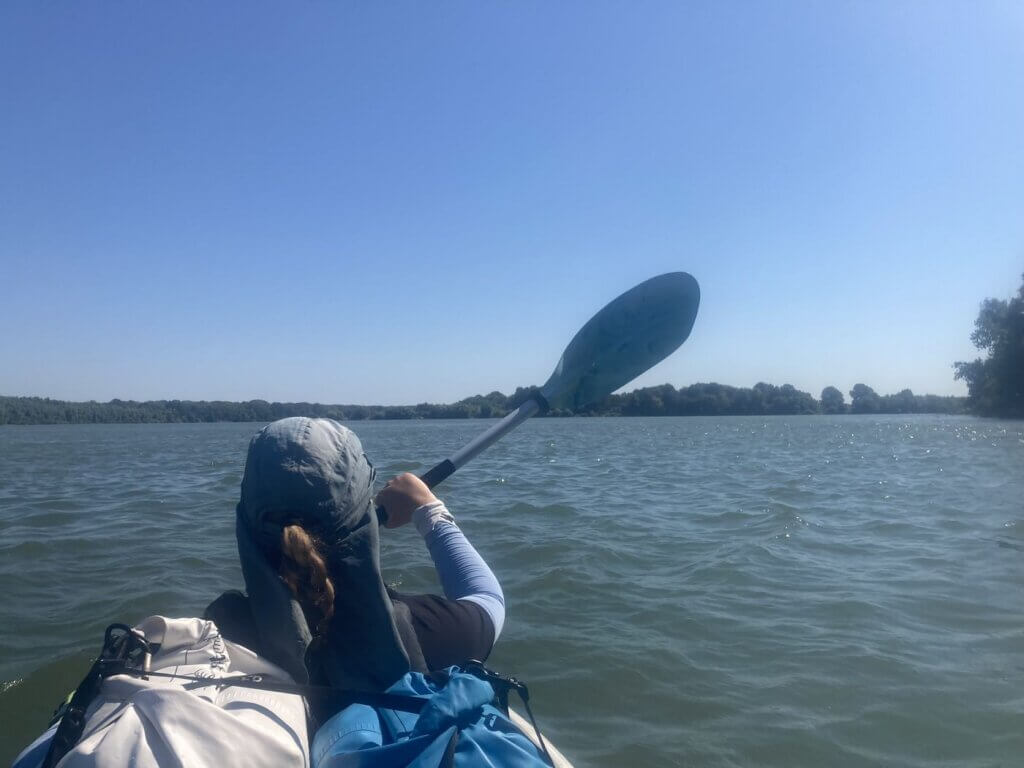
Jonas made a little vlog because now we could see the beginning of the Danube Delta: the bifurcation of the Kiliya and Tulcea branches at Ceatal Ismail. The Danube is officially atomizing itself into ever-smaller divisions.

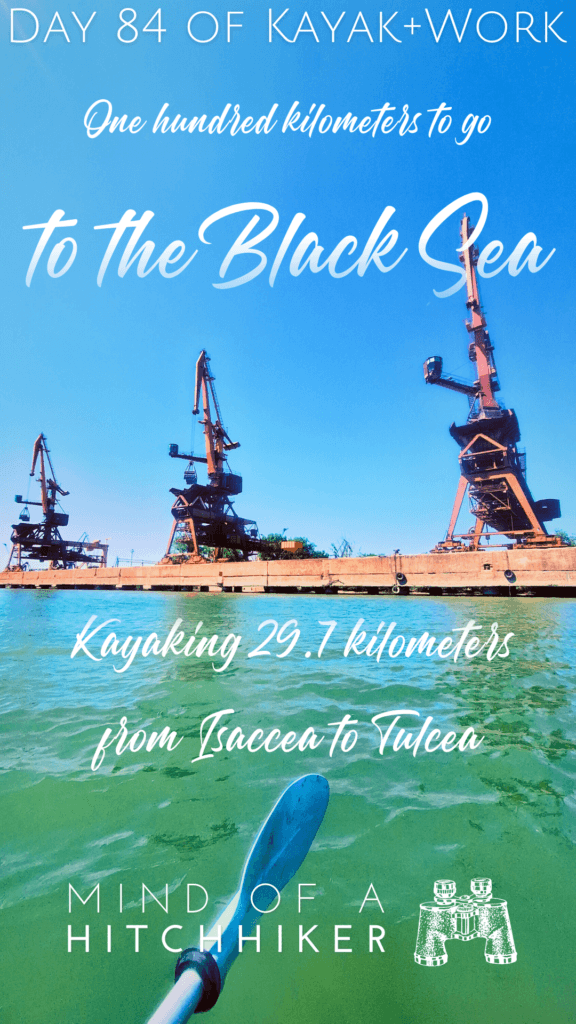
Though we don’t know exactly what kilometer we’re at, we know we have less than 100 kilometers to go to the Black Sea. The beginning of the Danube Delta is the last big milestone of this long kayak trip. I bawled my eyes out. Weeping because I was so happy to reach this point and miserable at the same time. And not miserable because this is tough physically. No, it’s the mental anguish and tormenting coming from behind my head that’s doing me in. I am frustrated.
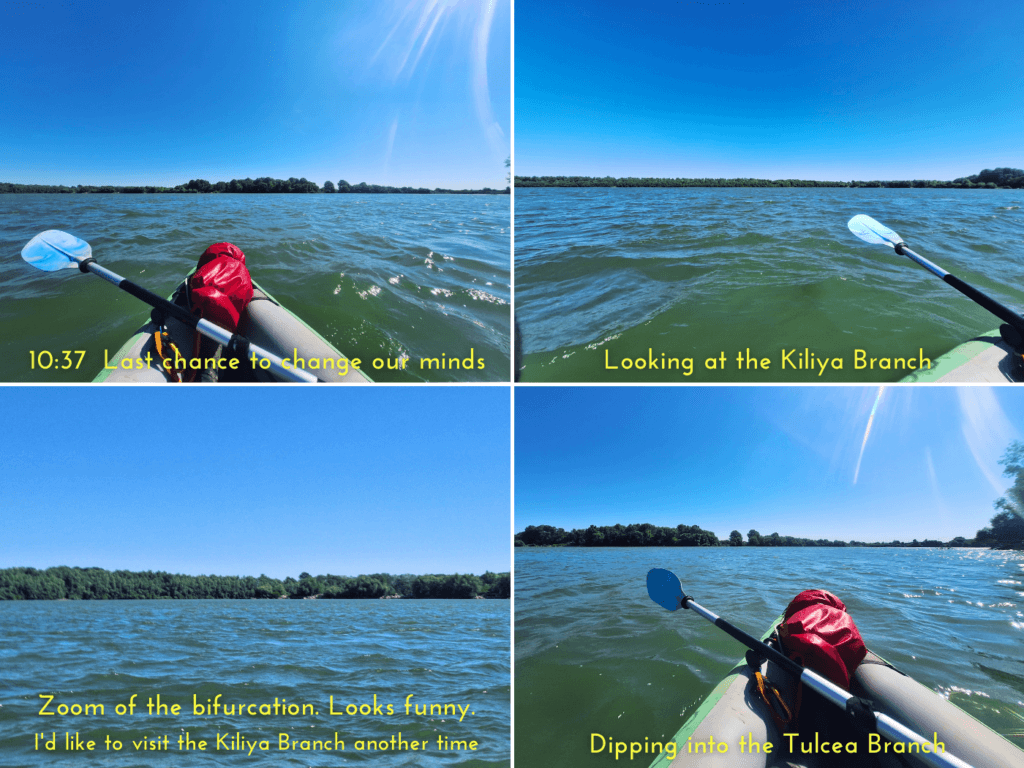
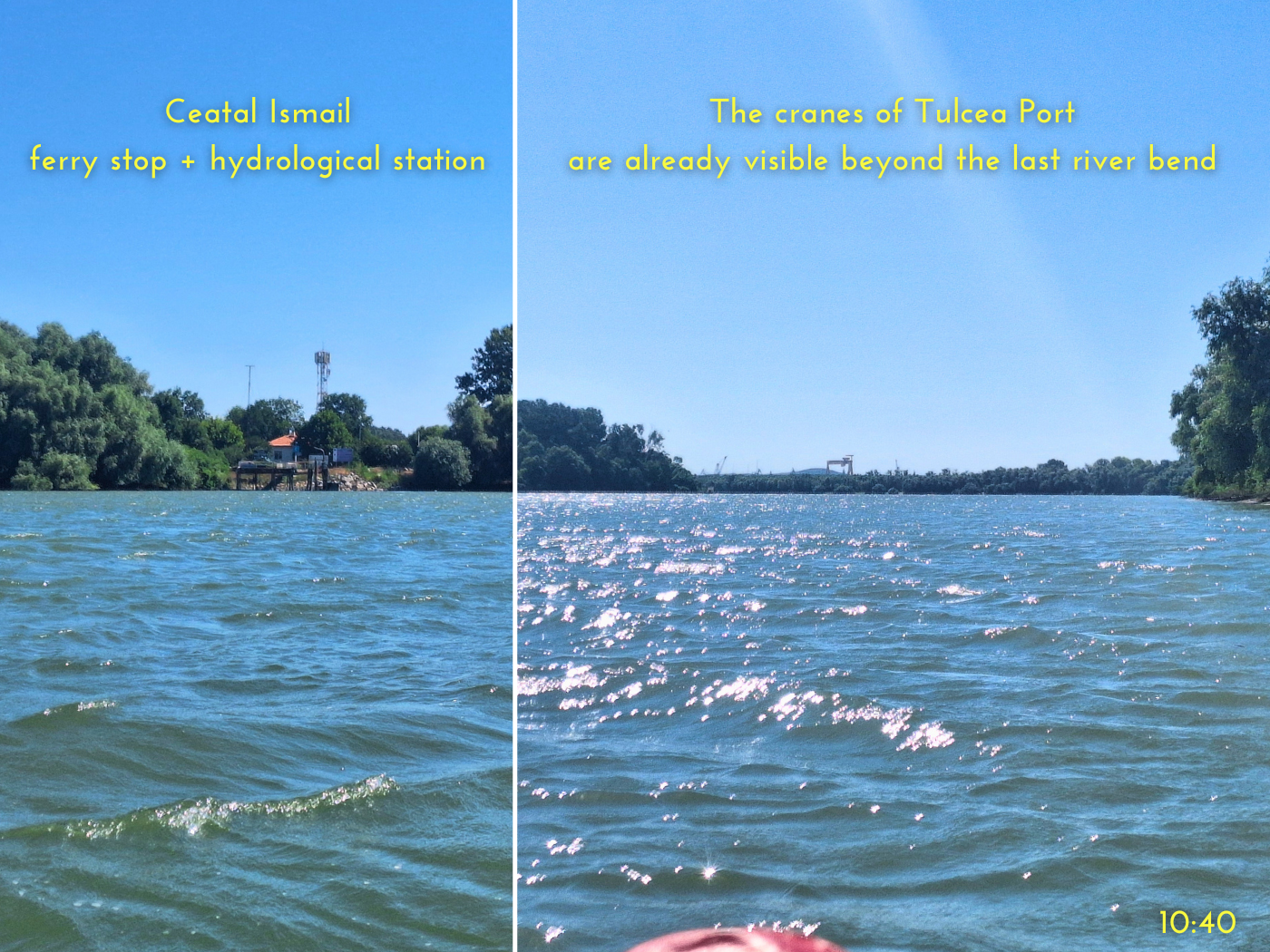
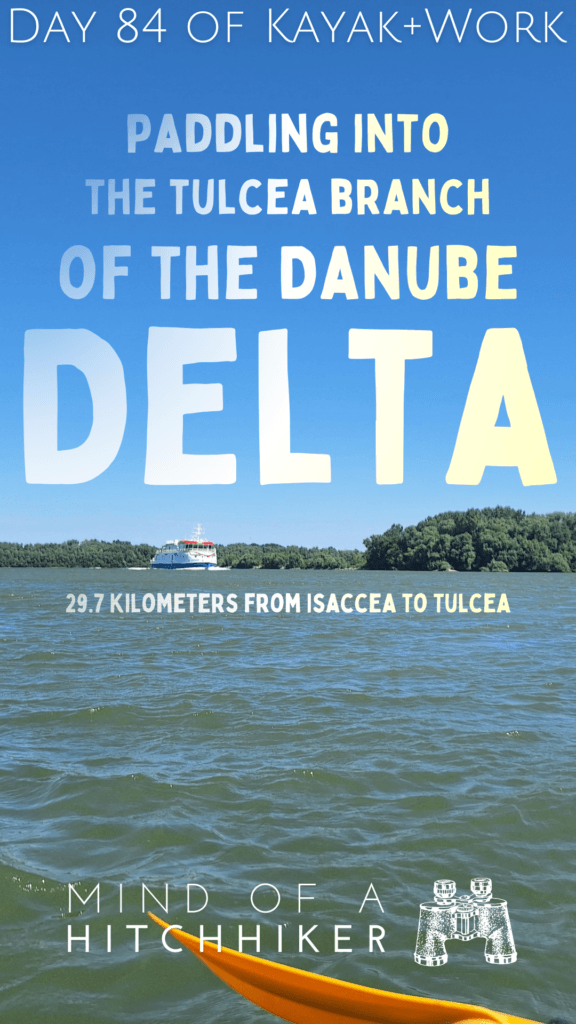
At 10:33, we ducked into the Tulcea Branch, spotting a ferry stop Ceatal Ismail on the headland of what is the first major delta island: Ostrovul Letea. In the turn, we could already see the cranes of the port of Tulcea above the treetops. It’s quite a sharp right turn compared to the Kiliya Branch, which is just going straight. Several ships in motion were taking the Kiliya Branch, which remains the border between Romania and Ukraine pretty much till the Black Sea.
I said goodbye to Ukraine, which was honestly a very relaxed section to paddle. I understand the TID needs to make a bigger deal out of it because they’re taking responsibility over a lot of people and need to plan without knowing the future of this war. But for us, I think this was chill and no big deal.
The Start of the Tulcea and Soon Sfântu Gheorghe Branch
The next stop is Tulcea, though we’re still not quite there yet. On the corner of the bifurcation, we landed so I could also pee. The ground was nice and firm. No mud suctioning to steal my shoe.
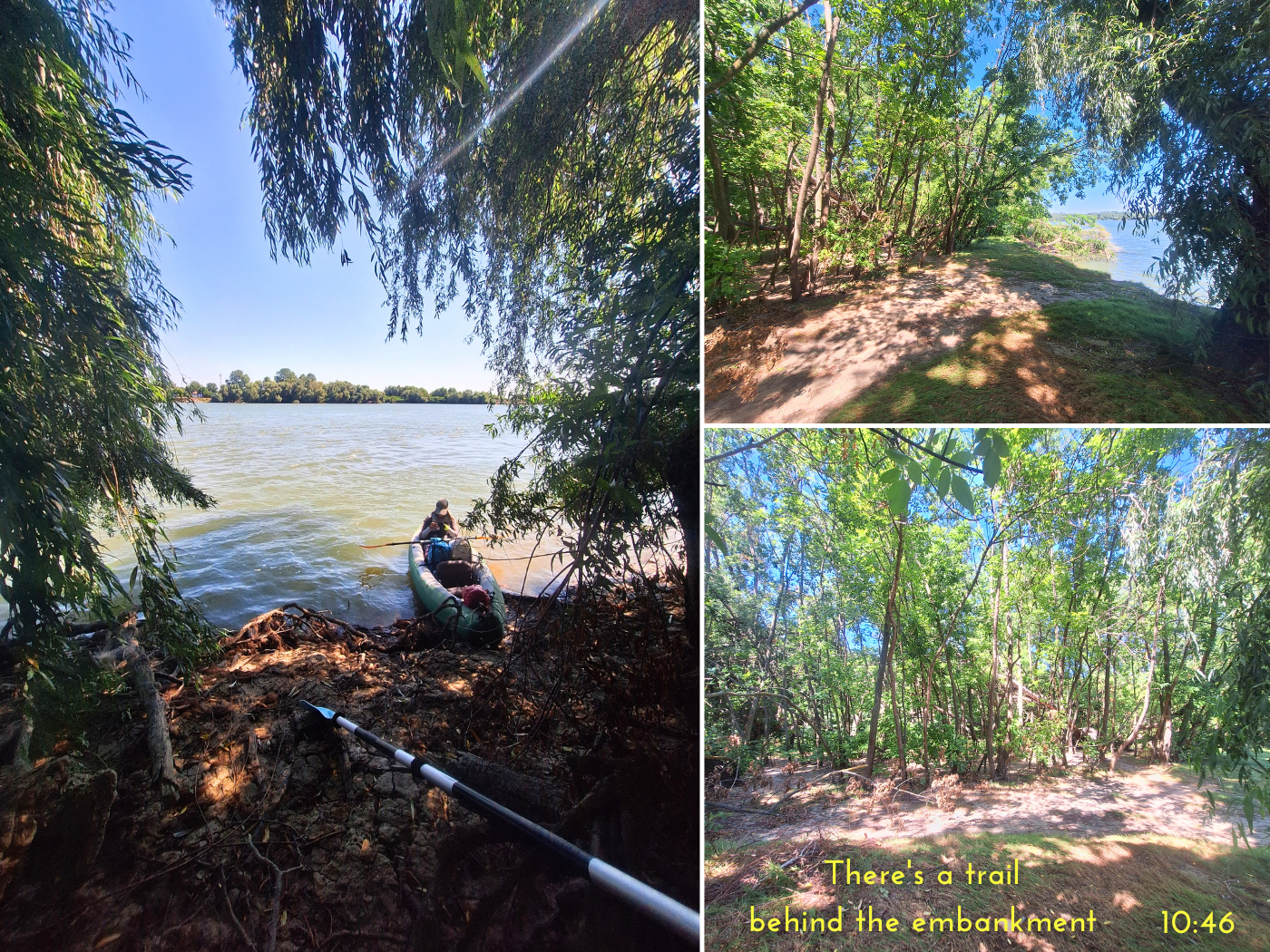
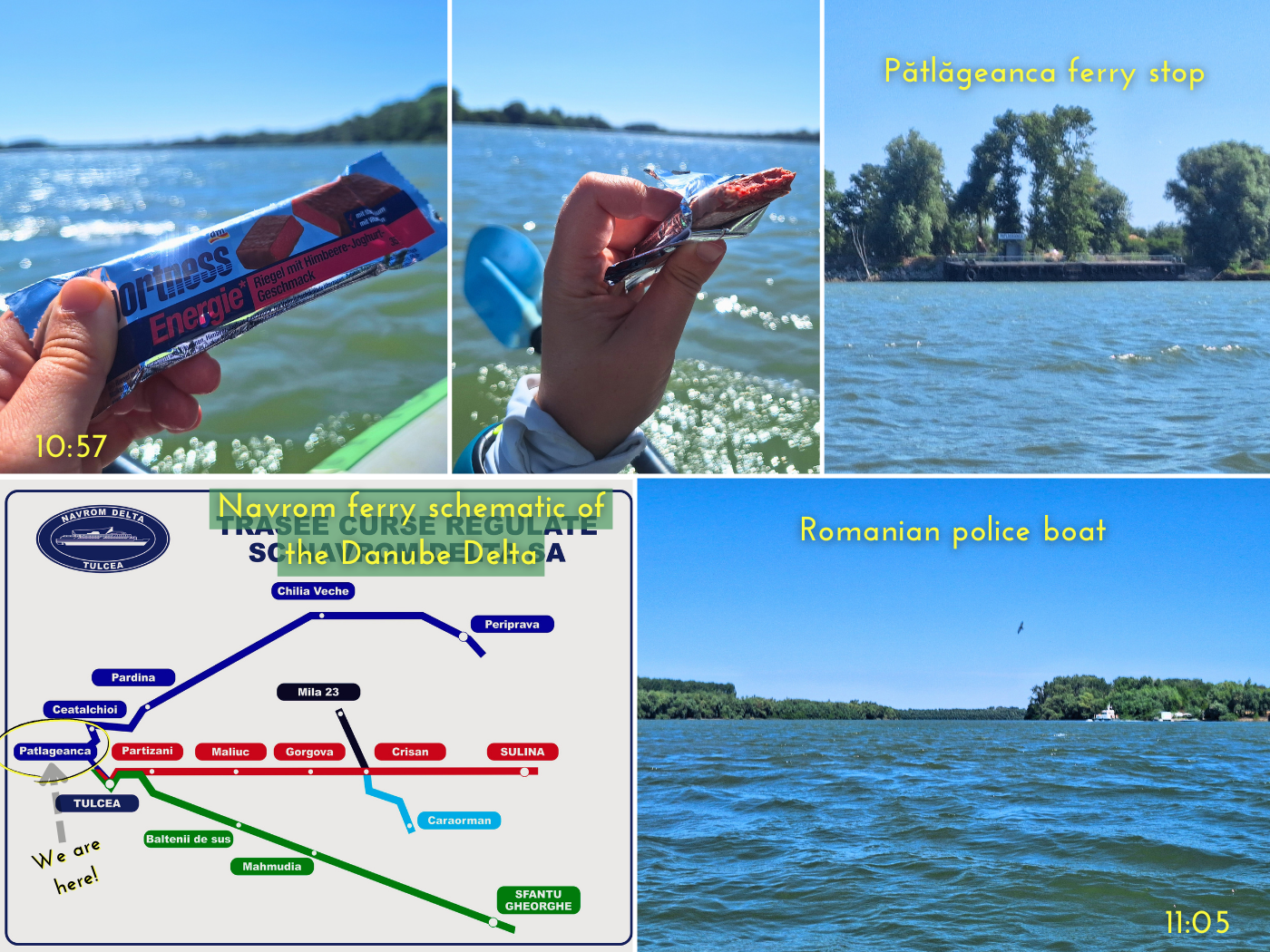
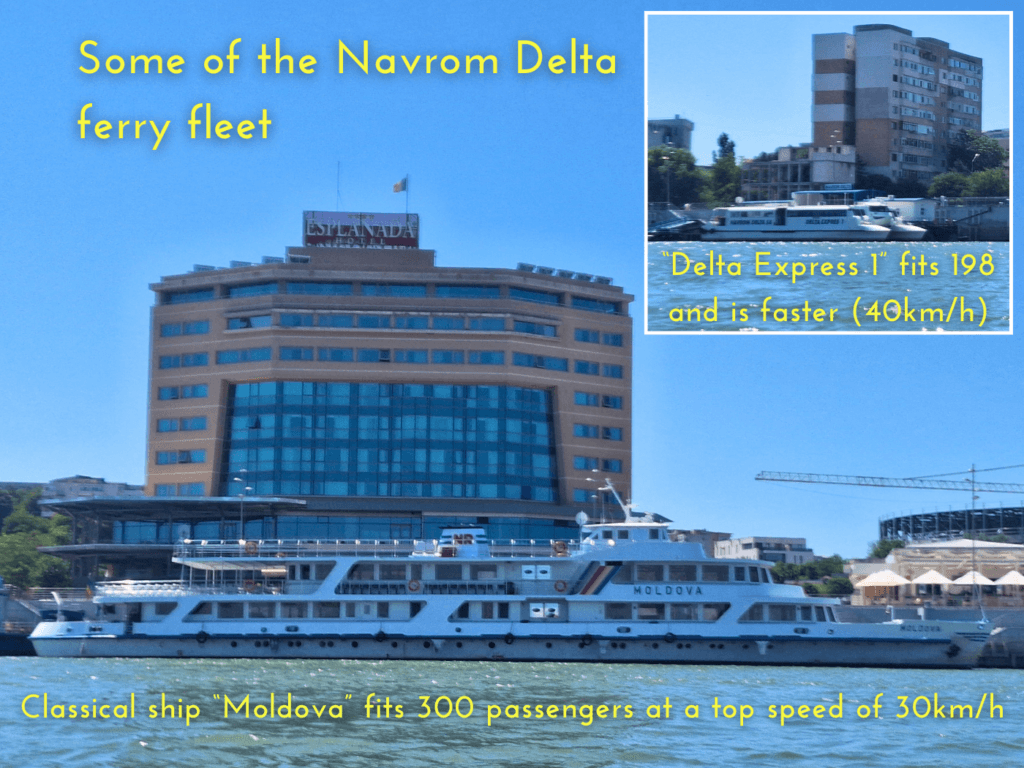
Afterwards, I intended to reapply sunscreen and eat my protein bar, but an imposing ship came towards us from the main Danube at lightning speed. It took only one minute between us spotting it and it passing next to us. Scary. I thought it was a ferry, because it said Navrom at the side. But why did it come from the direction of Isaccea if it’s a Danube Delta ferry? Luckily, I caught its name: Rexdan.
Turns out that it’s not a passenger ferry! The Rexdan is a research vessel from the University of Galați. It has laboratories aboard and can take samples and make bathymetry surveys. The ship can even go onto the Black Sea in the coastal areas. We were actually really lucky to see such a rare specimen on a voyage.
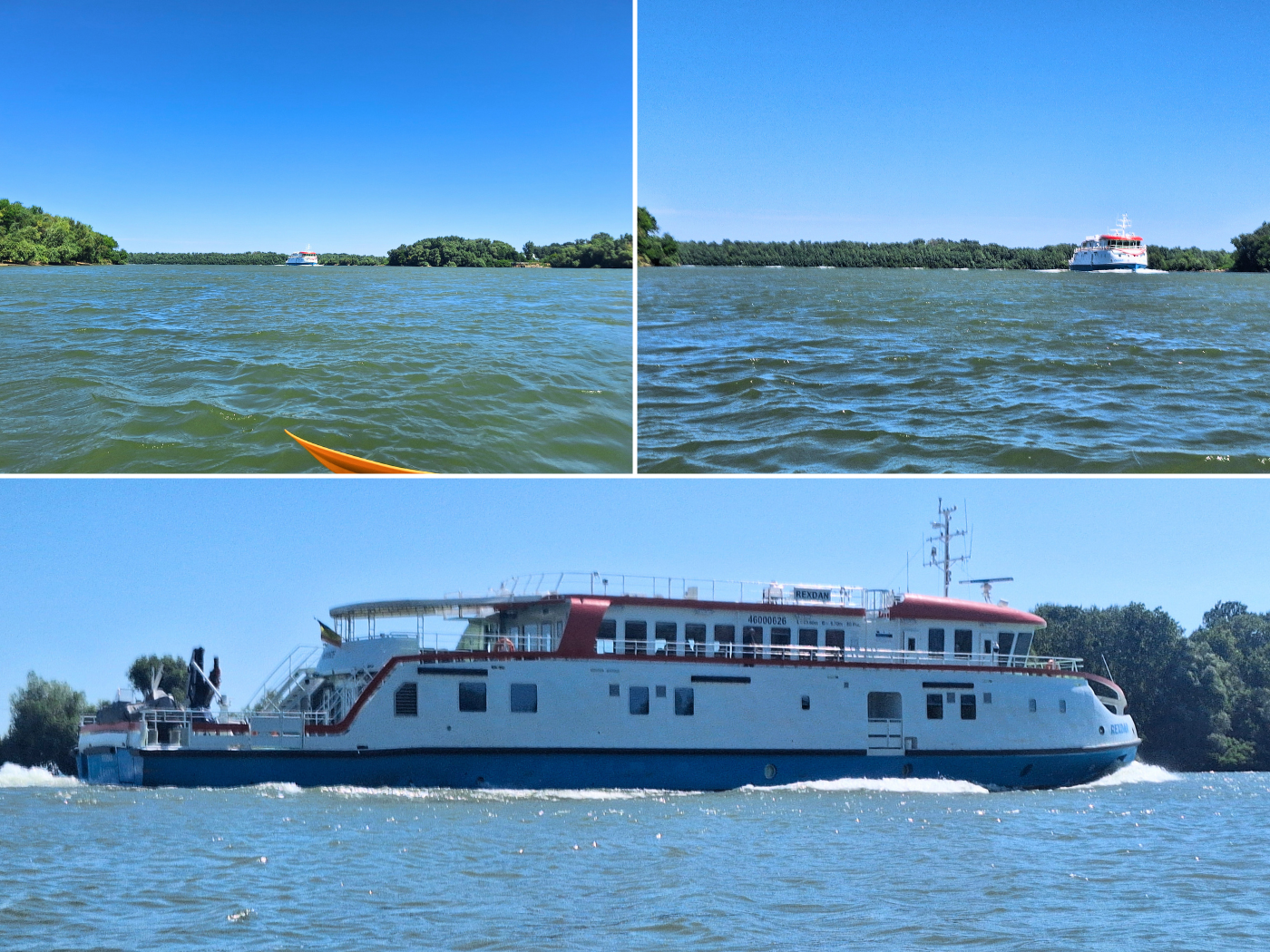
But the wake of this ship was quite bad. Good thing we weren’t moored at the shore anymore. That would have been hell for Jonas.
Across the river is the ferry station of the village of Pătlăgeanca (meaning: eggplant/aubergine). The village occupies the bifurcation. I know it from the map of the Navrom Delta ferry routes. Now that the water had calmed down, I could finally chomp my protein bar.
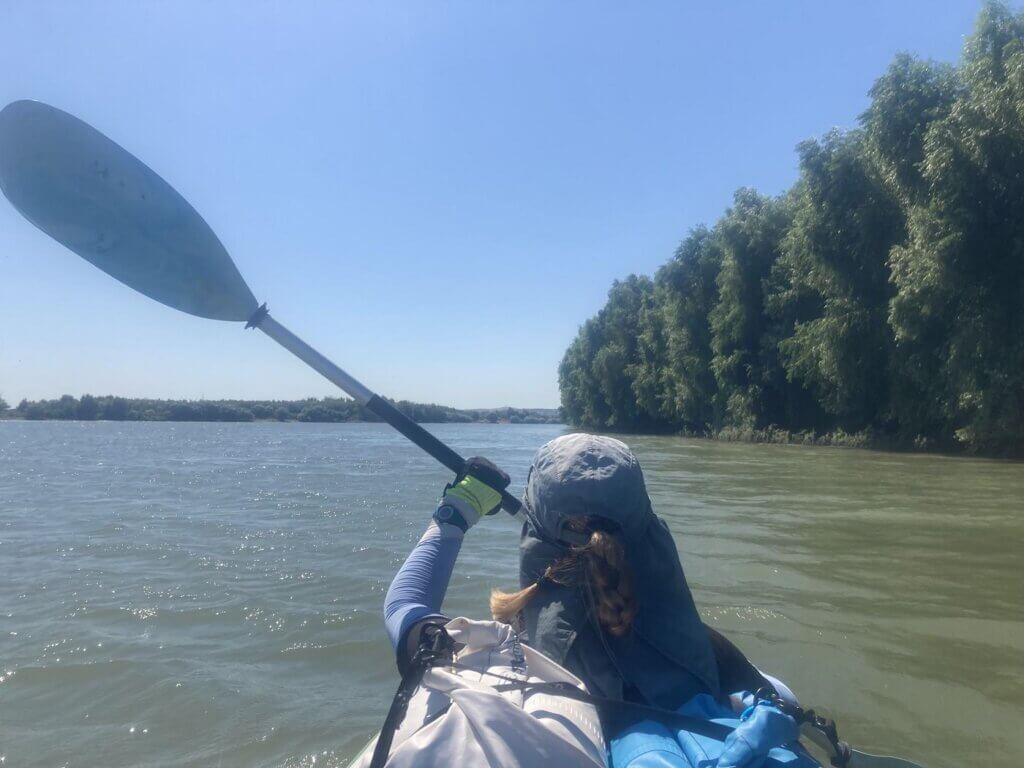
Heading south and then east and then south again, the wind was now properly in our backs. We didn’t experience the water as very choppy anymore. And we of course wished we had a kayak sail. I don’t think I’ll ever get over my bitterness of the kayak sail breaking for the third time.
We encountered another police boat going at high speed and I signaled it again to take some distance from us. The wake is always huge.
The beginning of the Tulcea Branch – though navigable by big ships – was quite narrow in some sections. There were some anchored barges in the last turn before Tulcea.
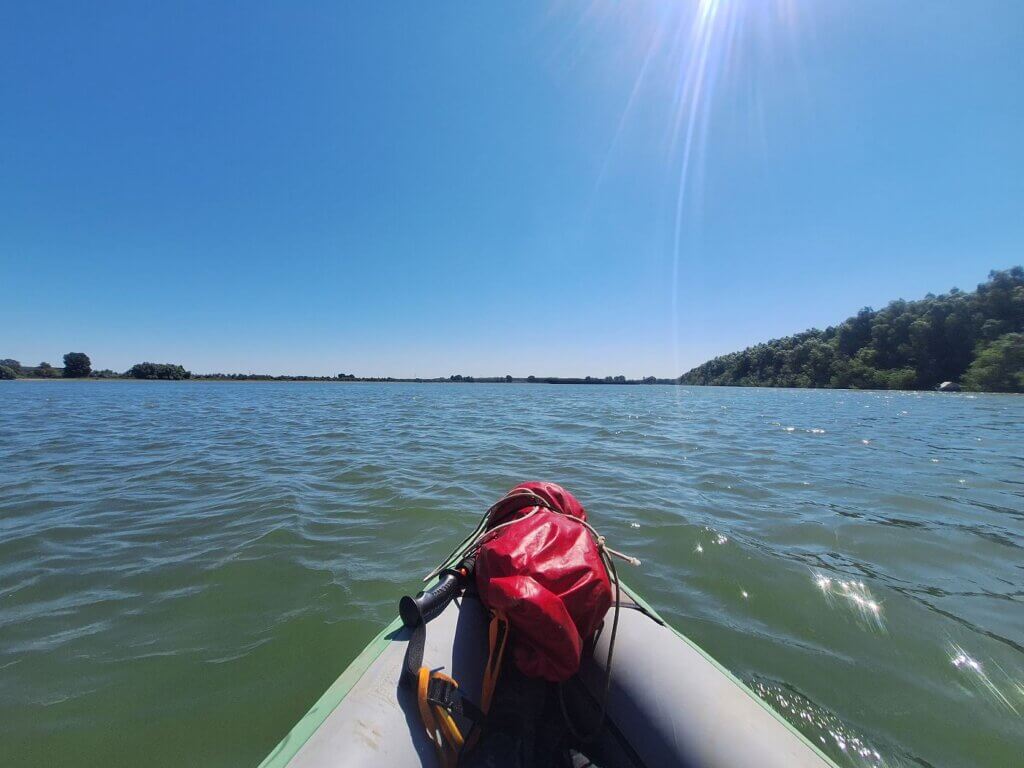
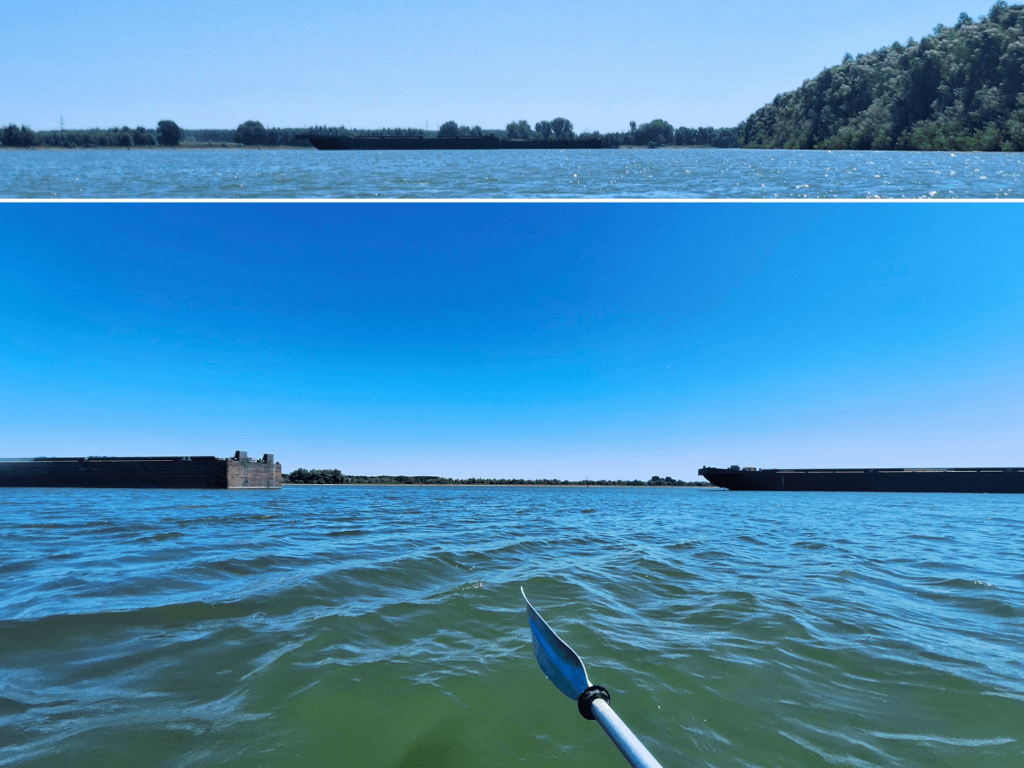
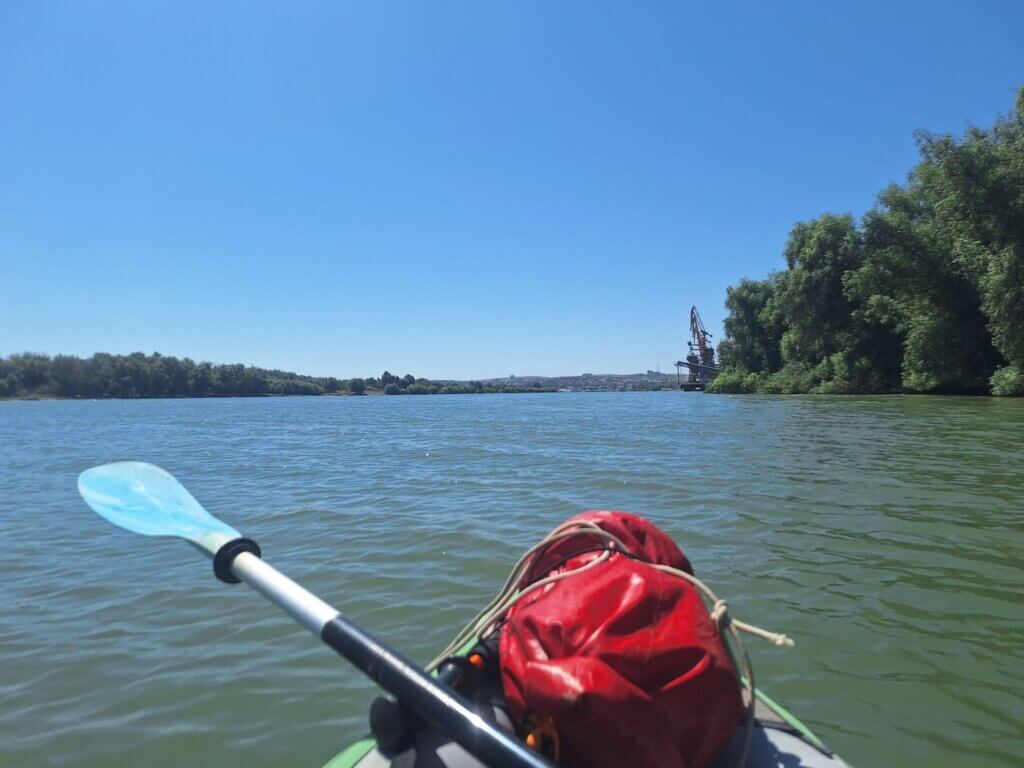
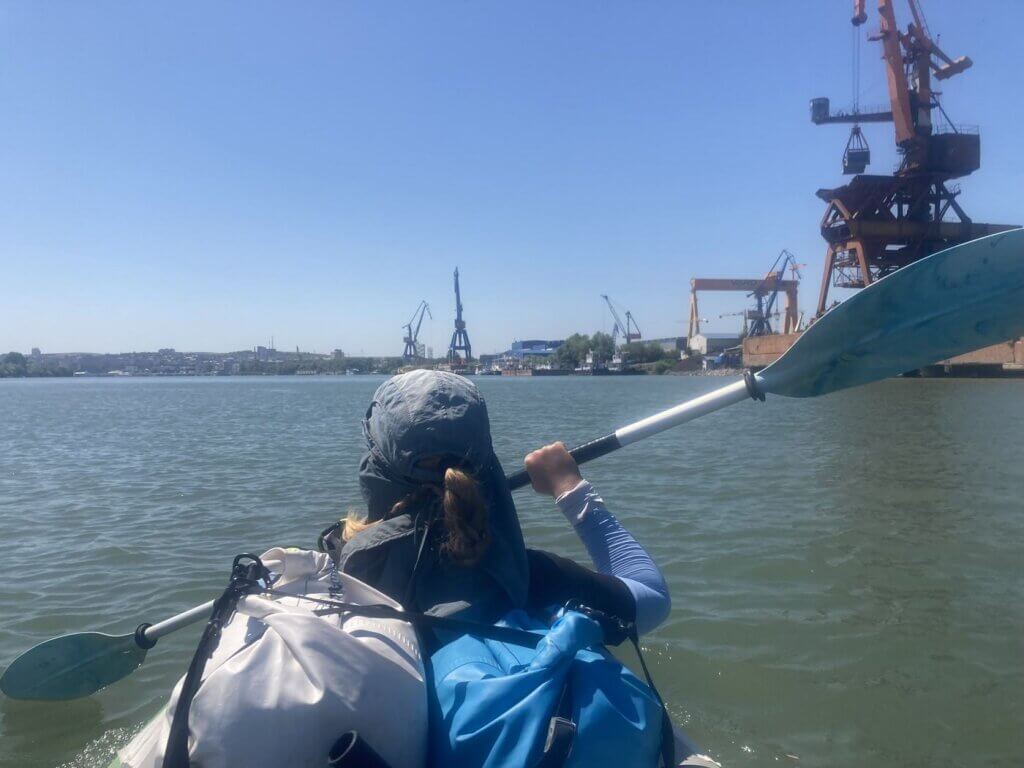
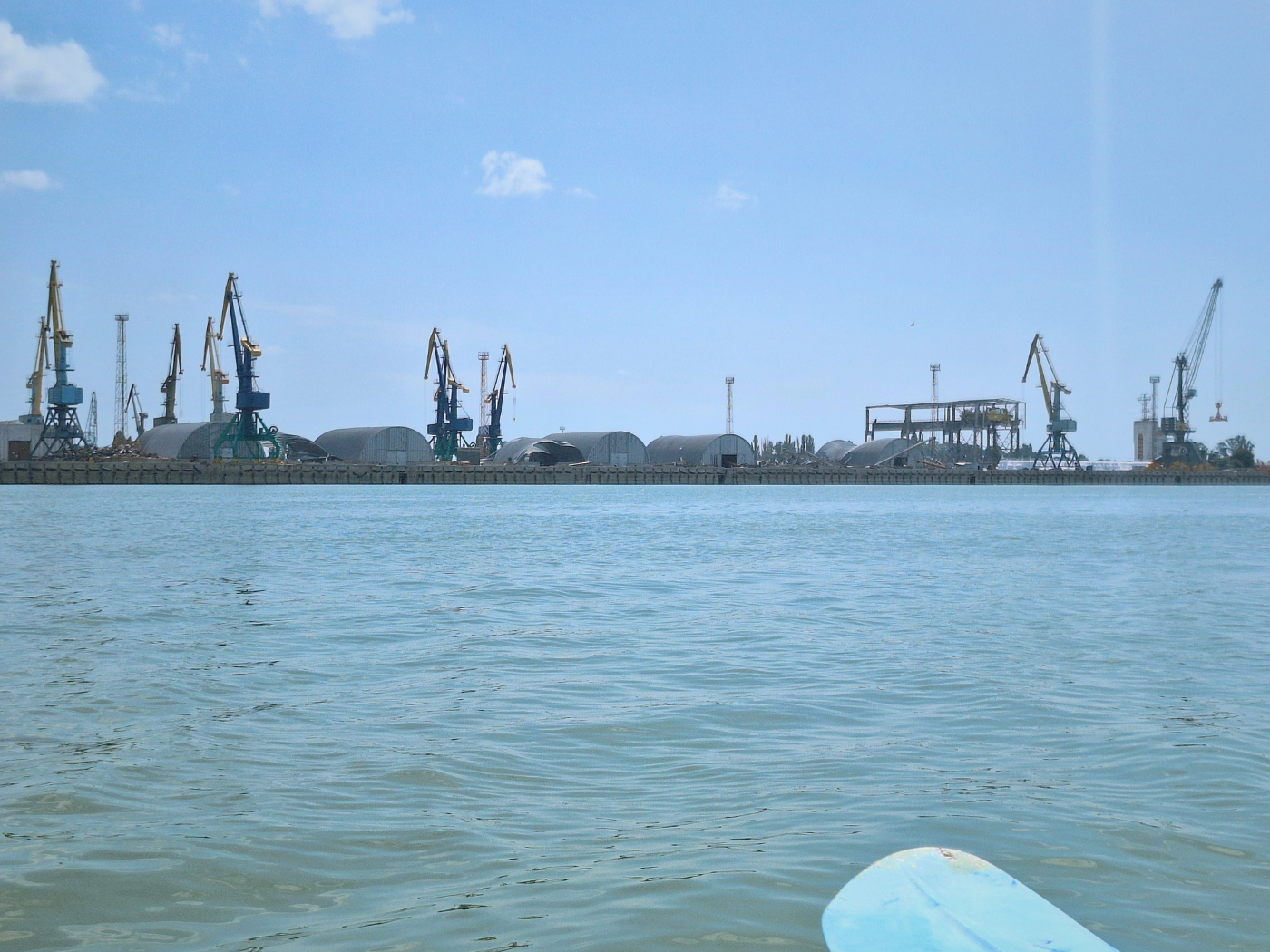
Slowly but surely, we made the turn and saw the first cranes from the port of Tulcea. It was 11:43. Jonas was unhappy that today is taking us longer than he anticipated.
Arriving in Tulcea
There wasn’t much activity in the port of Tulcea. No moving cargo ships, only one crane was moving. There was a historic paddle steamship permanently moored called Republica. It was laid in 1903 in Linz in Austria-Hungary, served as a military patrol vessel during WWI near Orșova, returned to civilian use, served the short-lived Hungarian Soviet Republic, and was finally taken by the Kingdom of Romania as war reparations. In WWII, she served as a command battleship of the Romanian Navy.
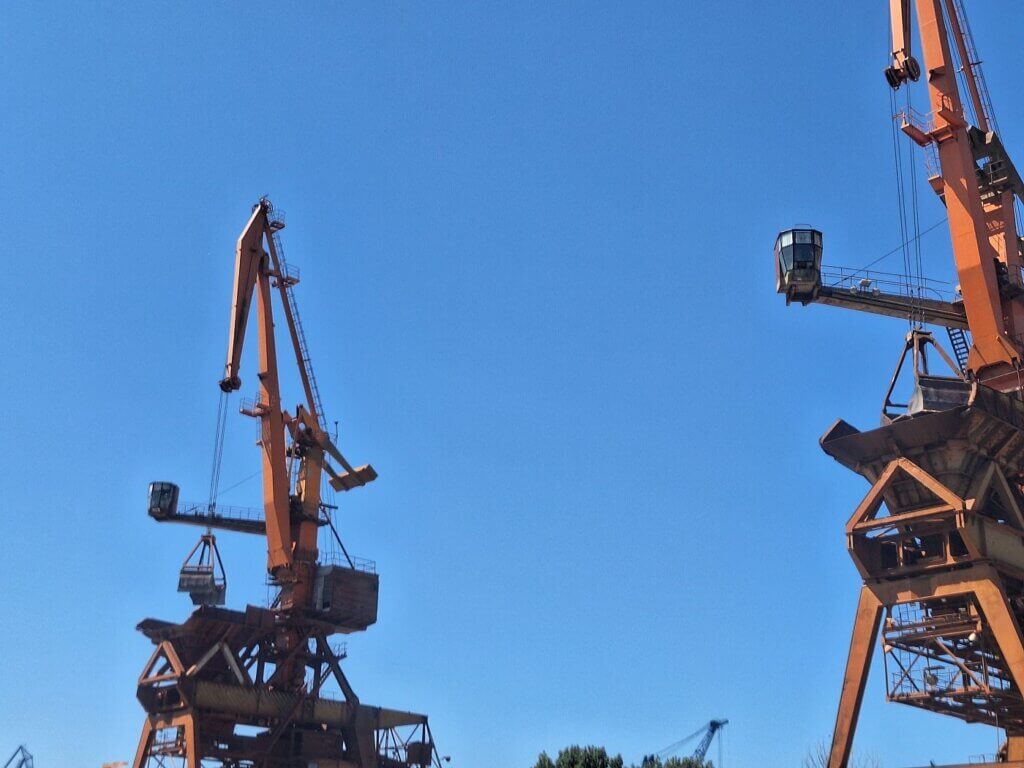
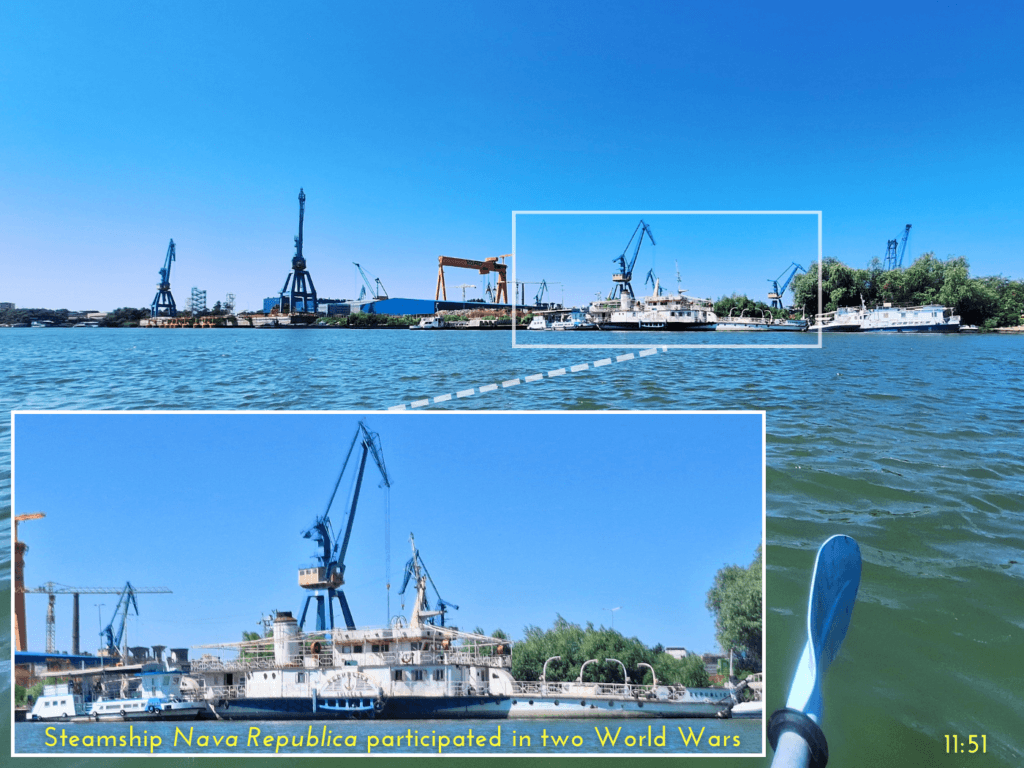
On satellite view, it looks like the harbor basin is blocked by some kind of pontoon bridge. Perhaps a shortcut for dockworkers. Perhaps it’s a moveable barrier.
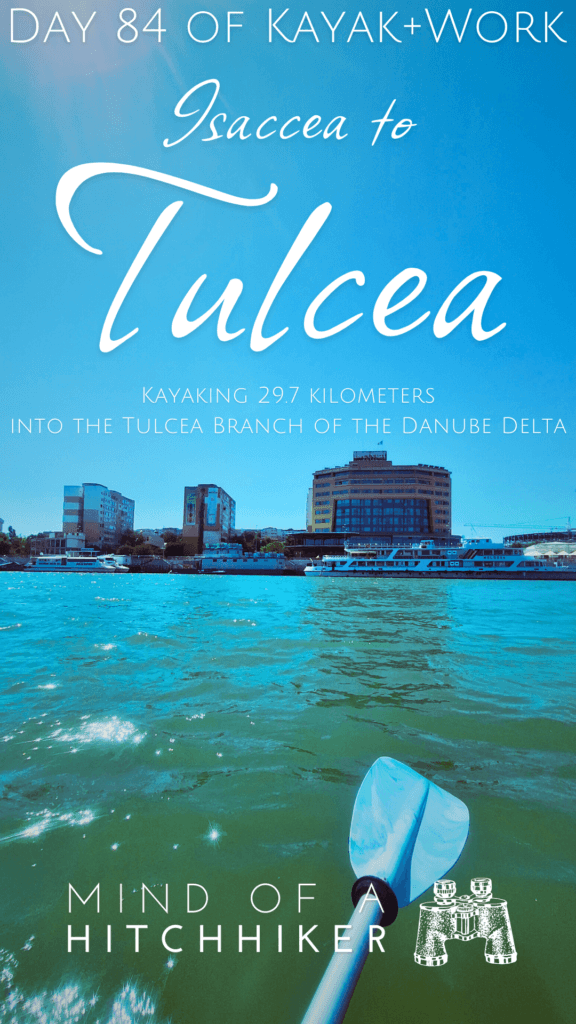
The center of Tulcea became more defined. We paddled past the Tulcea Oraș train station, which we’ll probably use when we leave the Danube Delta. My OnCourse app went nuts with collision warnings with all sorts of ships. Most of them were ferries or tour boats. Tulcea is where a lot of the Danube Delta tours depart from

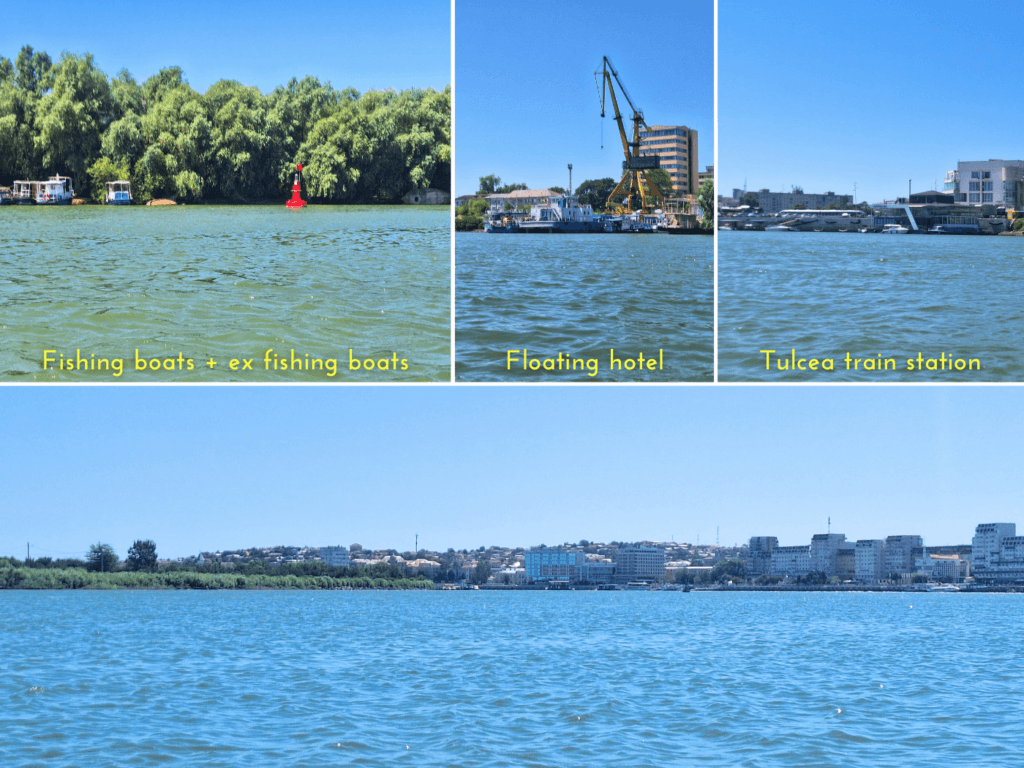
Tulcea appears to also be a bit of a boat graveyard, judging by the abandoned pleasurecraft at the shore. To think that Jonas wants to get rid of our Zucchini like that. OK, maybe not like that, but still.
There were many speedboats moving about on the river and also a hydrofoil called Diana, which was moored. The buildings on shore were truly hideous, I must say. Blocks of buildings 12 stories tall that are super wide. They must be hotels of some sort. But this massive? The level of ghastliness doesn’t add up.
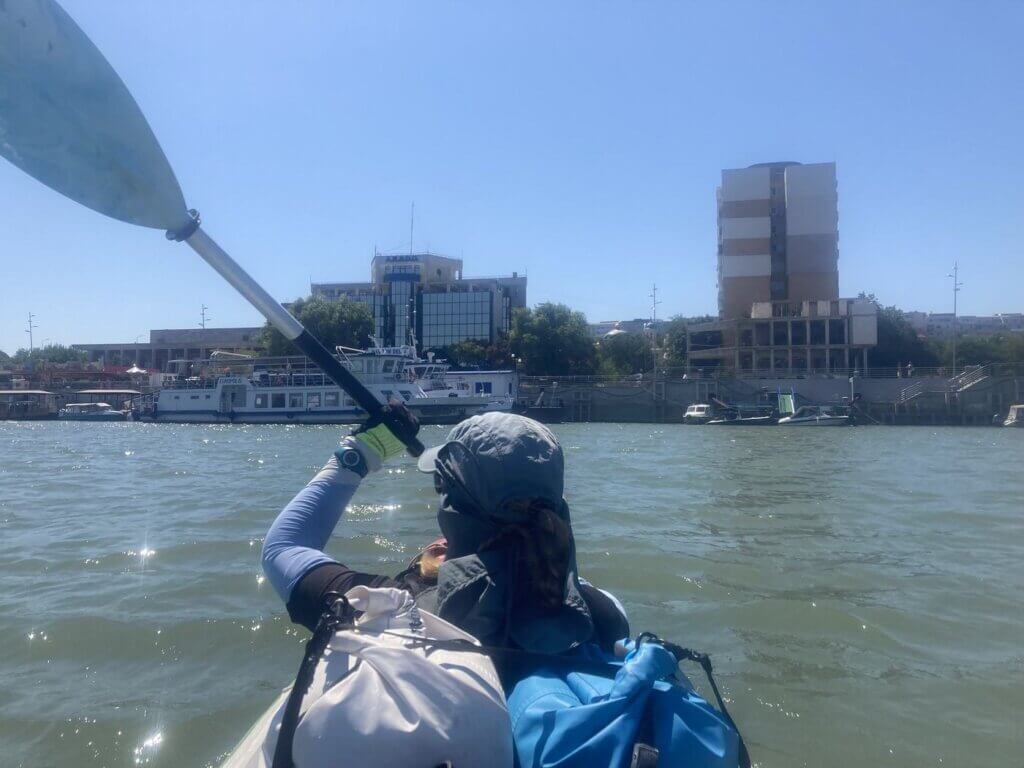
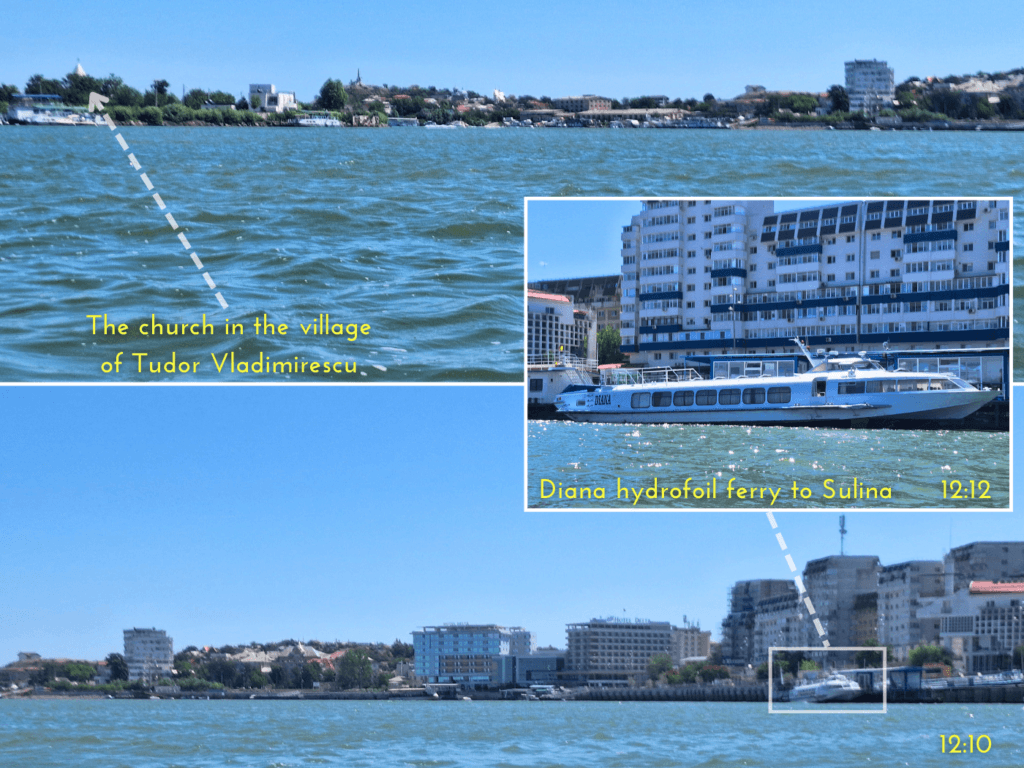
After the path of one of the ferries across to Tudor Vladimirescu, were in our approximate landing area and wanted to find someplace to get out that’s closer to our Airbnb. The sharp turn the Danube takes in Tulcea is quite disorienting, as you can see from this drone shot:
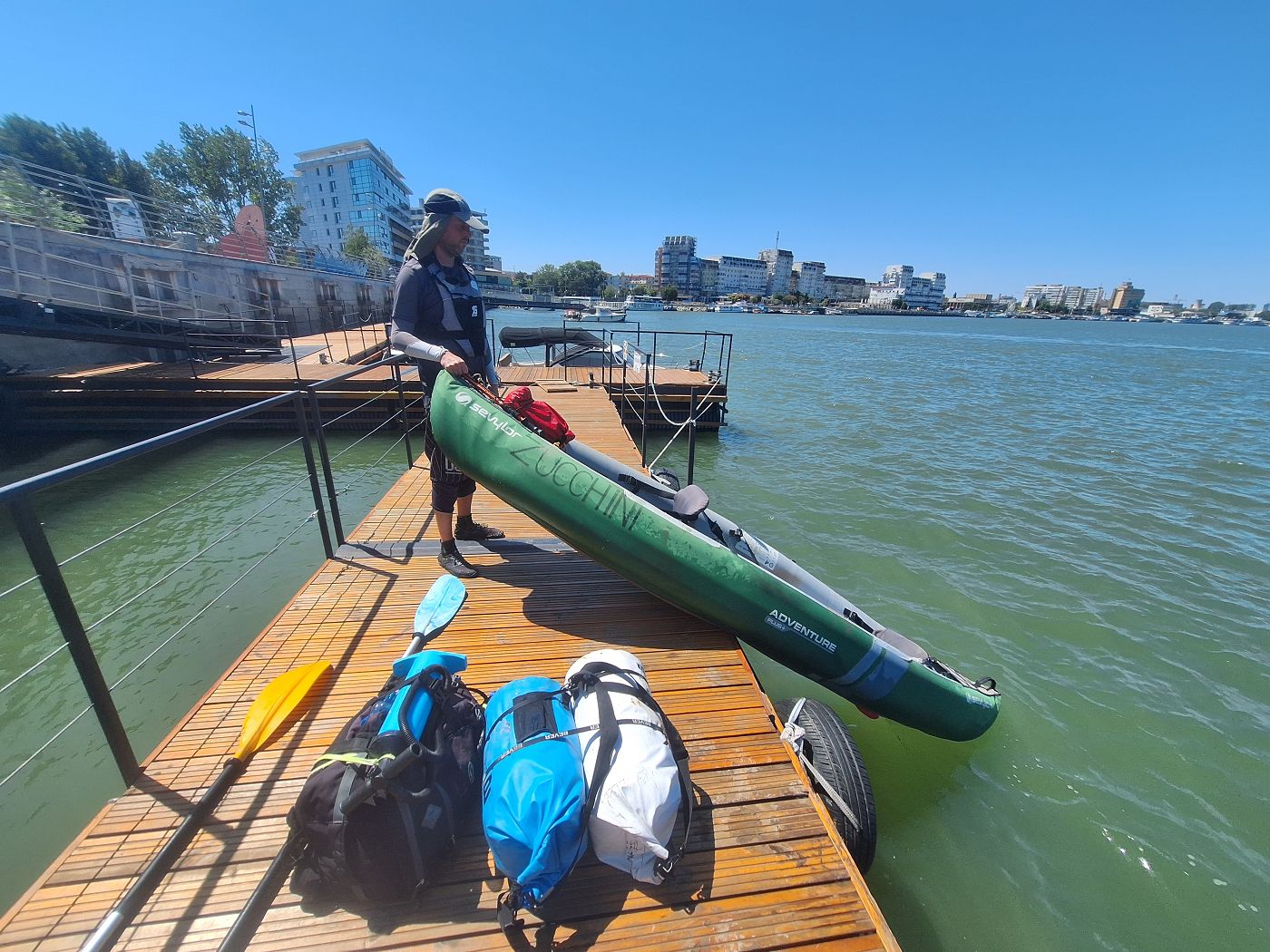
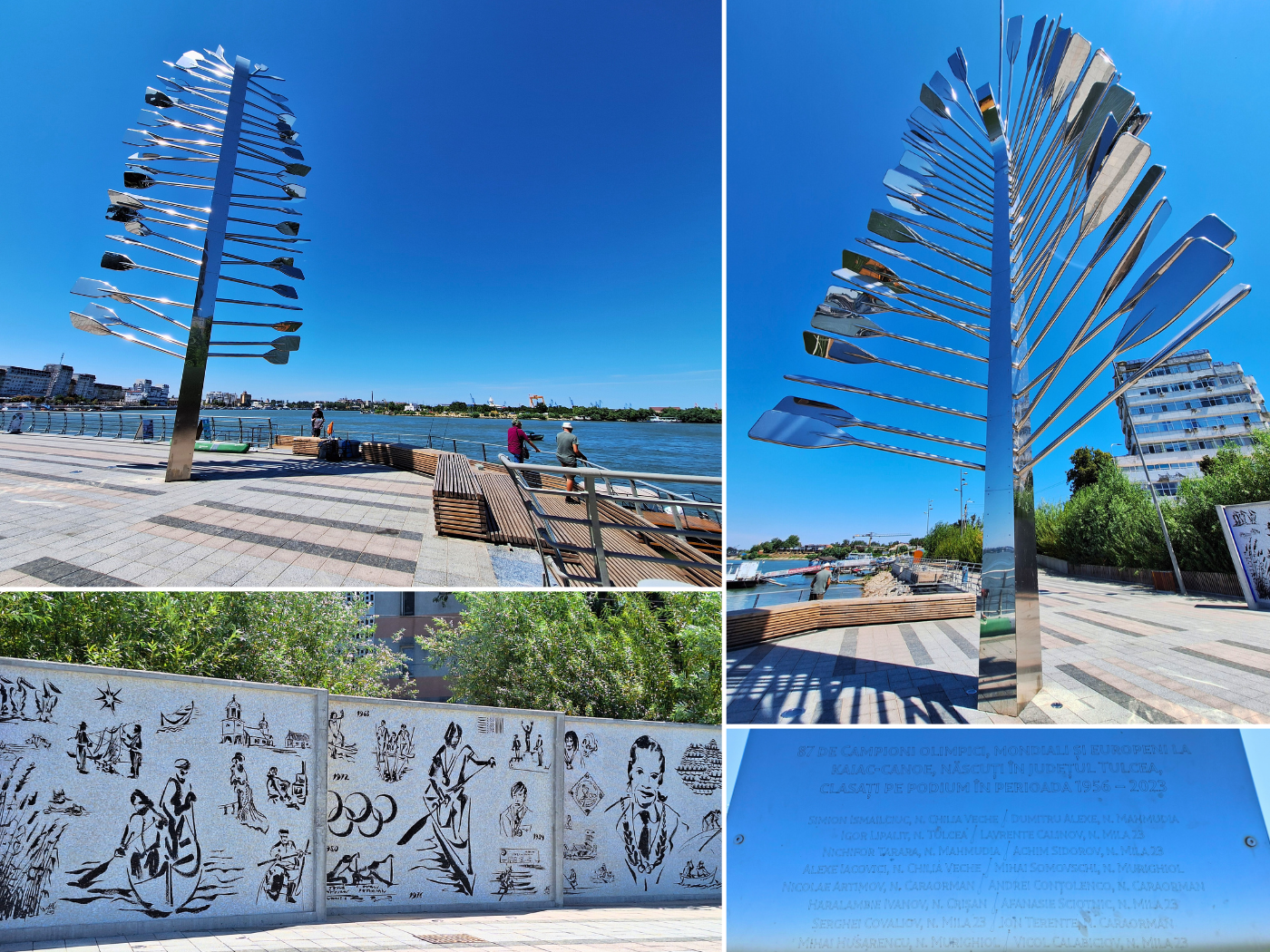
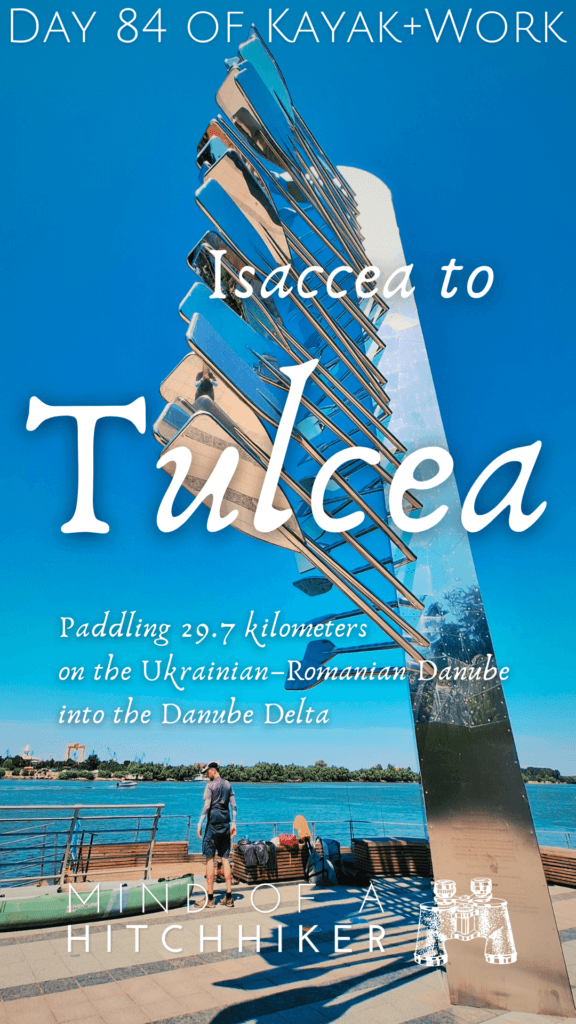
We had the backup slipway at this location, but would be open for alternatives that we couldn’t research before arriving. In the end, we landed at a floating jetty used by tour boats below a statue that was literally a bunch of canoe paddles. Arrival time: 12:20. Jonas had expected to arrive before noon, but mind you, I am unwell.
Though it was very tall to climb up, Jonas managed to get everything on shore and then lift Zucchini out. We portaged her with the luggage on our backs and had to open a little gate. It was all about making this as quickly as possible before someone would come and yell at us, as is often the case in Romania.
Once through the gate, we set up our drying and packing process on this rather new public bench in the shadow of the chrome paddle statue. There was a fisherman next to us who was just friendly and pointed out that part of the bench area overhangs the water and has gaps. NO PHONES over this area, for us.
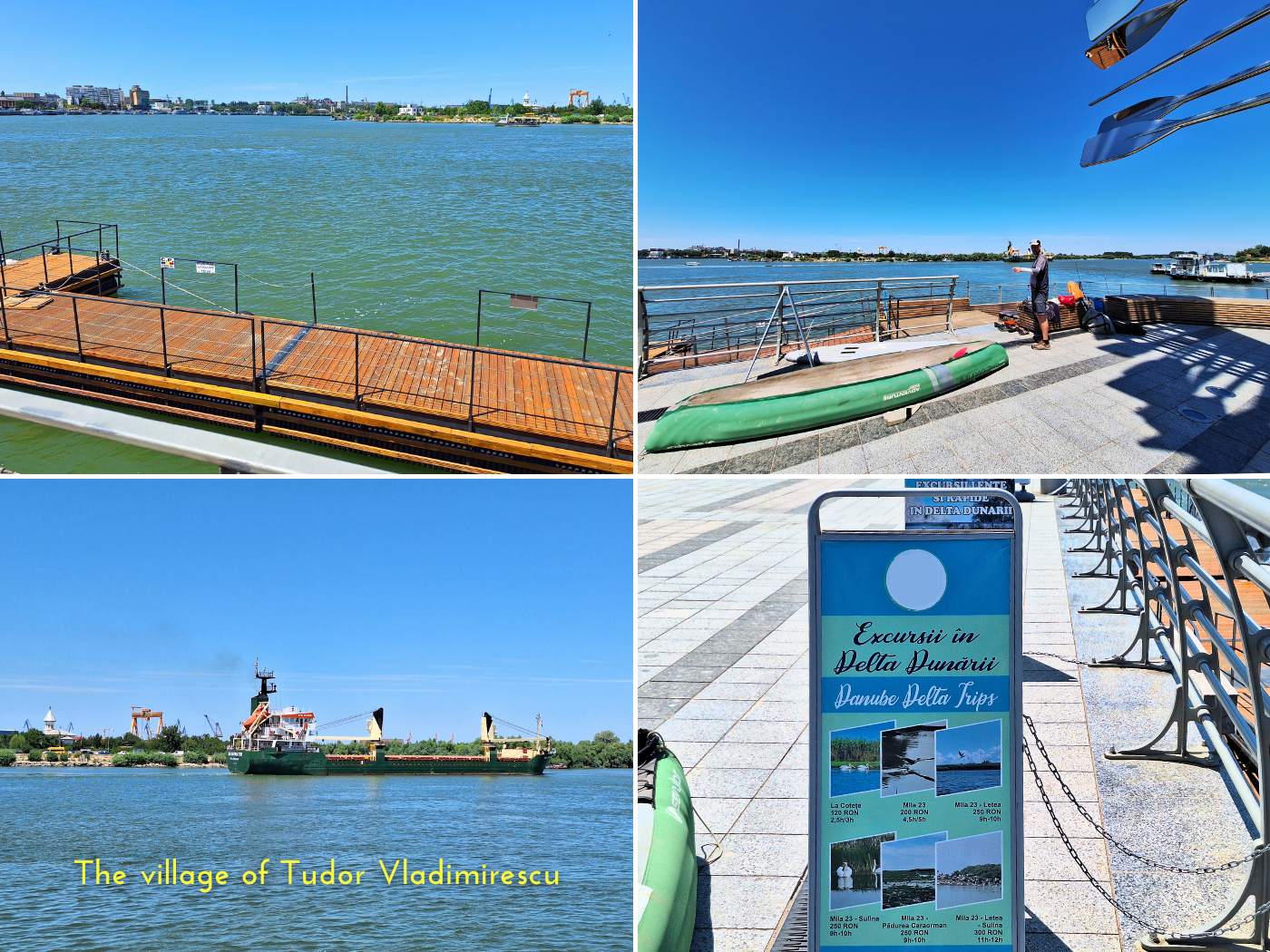
We dried Zucchini and Jonas contacted the Airbnb host about an earlier check-in. That was fine, so we packed everything up. I saw some cats, but they were in the middle of a standoff and not pettable, so I tried to diffuse the situation and left. The canoe paddle statue is quite cool and has all the names of the Olympic, World, and European winners in canoe and “caiac”. My god, Romanian spelling is inconsistent as hell.
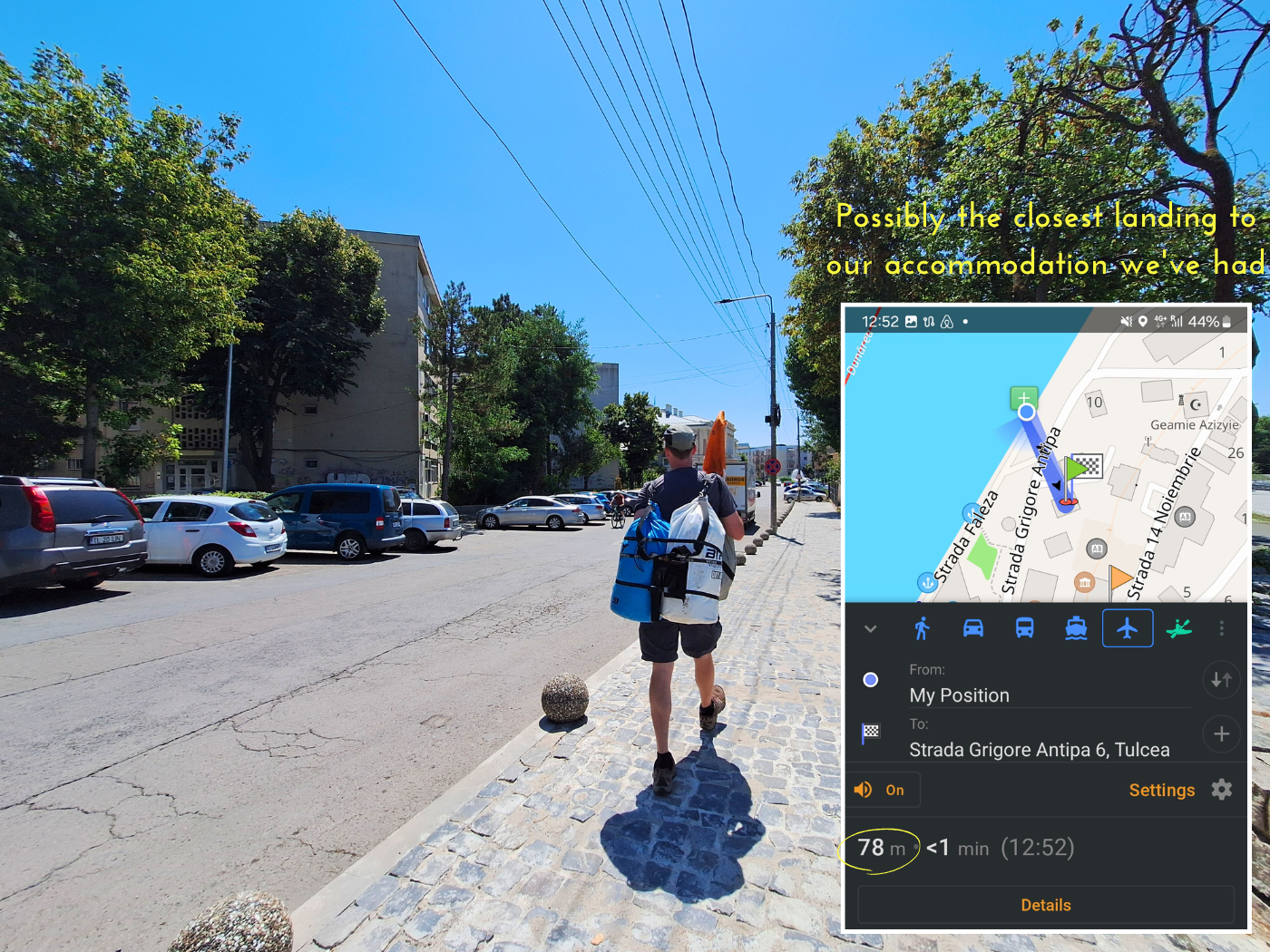
Once packed, we walked the 70 meters to our apartment, which was also on the first floor. Awesome. And now it’s time to rest, wallow in illness, and think what we want to do for my birthday in two days.
One Week in Tulcea: Birthday + Illness
This is how we spent our time in Tulcea, which ended up being one week in total after a move and an extension:
Monday: after checking into the apartment, showered, tried to do laundry, and spent some time feeling sick. Though we had booked this place for three nights over my birthday, we were both gravitating towards extending our stay. We fought some more over the littles things.
At 18:00, we took a Bolt to the Kaufland Tulcea shopping center to buy food and protein bars.
In the evening, we went downstairs for a little cat walk. There were owned and stray cats right outside our door that loved some kibbles and attention. But the main goal was trying to find the tuxedo cat I’d seen a glimpse of when landing. We met him on the sunset boulevard of Tulcea.
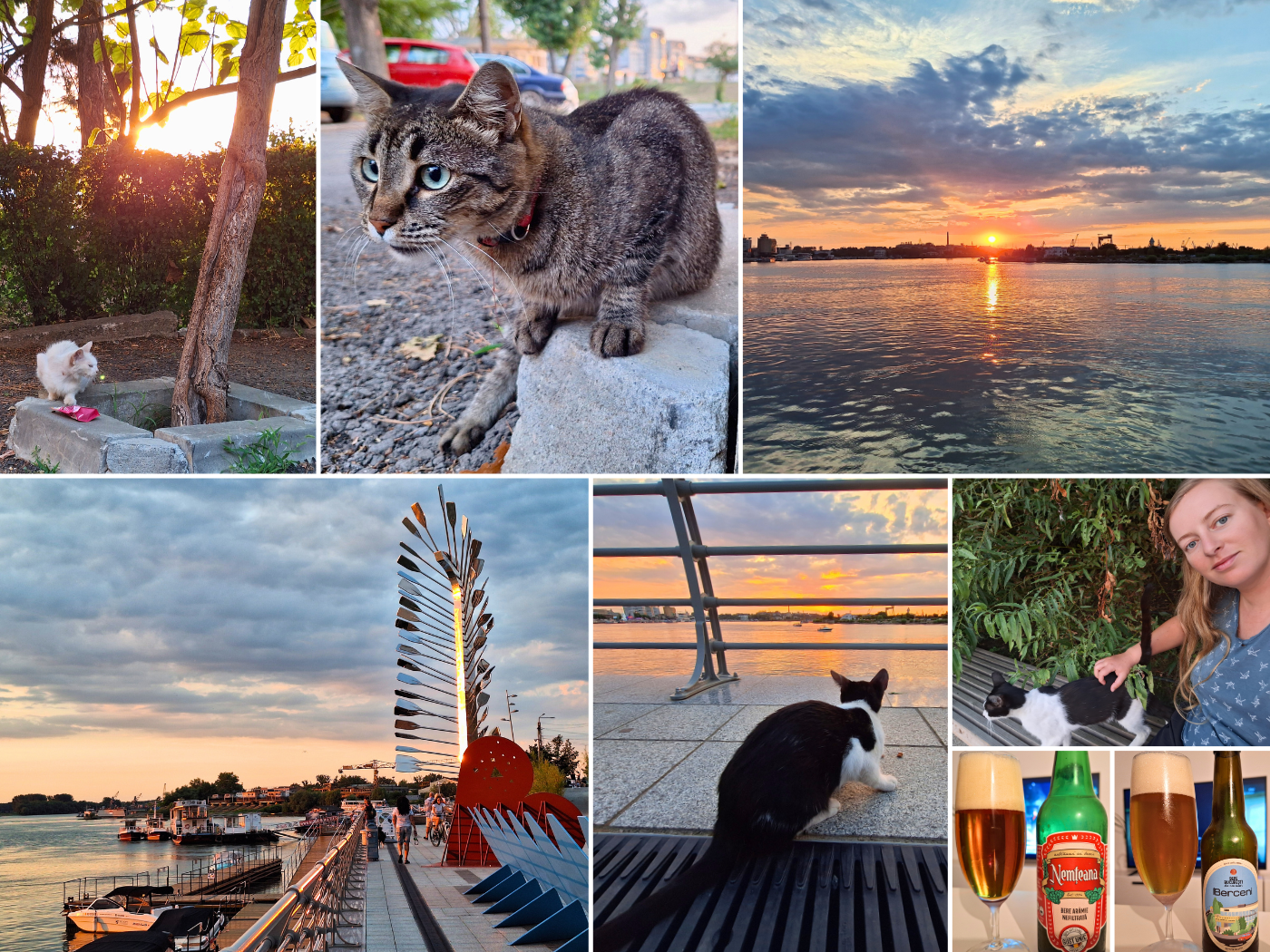
Jonas walked away right after the sunset and left me hanging. He’s been doing this whole abandoning me in public spiel a lot lately, walking away before I’m ready even if I’m showing clear signs of getting ready to leave. And yes, I’ve addressed this. He keeps doing it. Back at home, we (I) tried some new (craft) beers of Romania and watched some Netflix before going to bed.
Tuesday: we just stayed in, worked a little, and spent the day trying to get better. We received an update from our hosts in Rasova, upstream in Romania. They had hosted another kayaker. From only Danube cyclists to suddenly an influx of paddlers!
Since this underperforming Airbnb isn’t available after the 1st of August, we found another one to book for four nights so we can rest and recover more. It happens to be an Airbnb within this same building. Nice.
The day after a paddling high, I came down and realized how horrible and cold Jonas’ behavior has been towards me. Just turning every little thing into a struggle or a fight. Ignoring me when I ask something. Saying ‘no’ by default, even when I make a fucking good point. It’s exhausting. I’m exhausted. And I’m so depressed.
I was thinking all of this over while I was doing more laundry in the shower. Jonas had left the apartment and was going for a walk without me. While he was vibing by himself, I was in the shower sobbing on the floor with a knife. I haven’t felt this suicidal since 2011 or 2012 (I’ve been trying to forget).
But I didn’t want to die yet. Not before finishing this kayak trip to the Black Sea. If Jonas doesn’t want to come, at this point I’ll do it myself. I’ll do it solo and I’ll do it out of spite. He has thoroughly poisoned the experience this should have been with a thousand little snide remarks, sneaky sabotage, being hot-and-cold, and stonewalling.
And for what? Why does he do that? How does it benefit him to kayak with me but be grumpy about it all the time? At this point, he’s not ‘doing it for me’. He chooses to be angry all the time. And it’s gotten worse since my last thought on this issue in Ruse. I was expecting that finishing the Danube trip would have been as good (maybe even better) for our relationship as kayaking the first half to Mohács in 2019. I haven’t changed much since then. Why is Jonas changing so rapidly, switching up on me? Why is he actively dulling my spark till my hair falls out as evidenced by this bathroom floor? At the start of this trip in Mohács, he wasn’t like this.
Eventually, I pulled myself together. The front door opened and I heard a “Love?” from outside the bathroom. I hid the knives, dried myself off, and exited the bathroom. There he was, sitting on the couch on his phone, ready to ignore me again for the coming hours (unless he needs something from me).
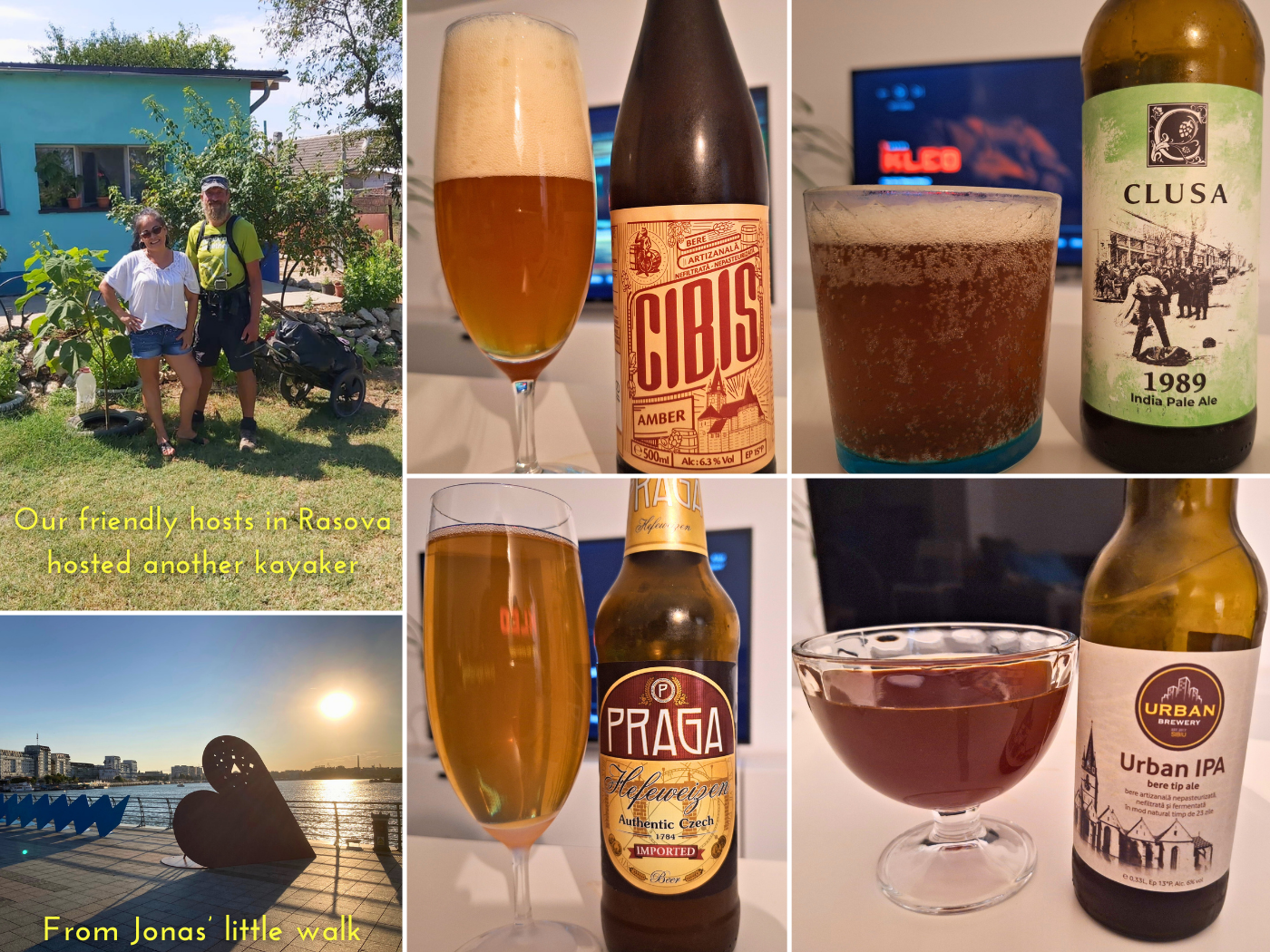
The rest of the evening, my last as a 32-year-old, we shared some craft beers until Jonas went to bed and I continued well past midnight. Happy 33rd to me. Some things never change.
Wednesday: it’s my 33rd birthday! But I feel terrible physically and mentally. I cannot stress enough how unhappy I am.
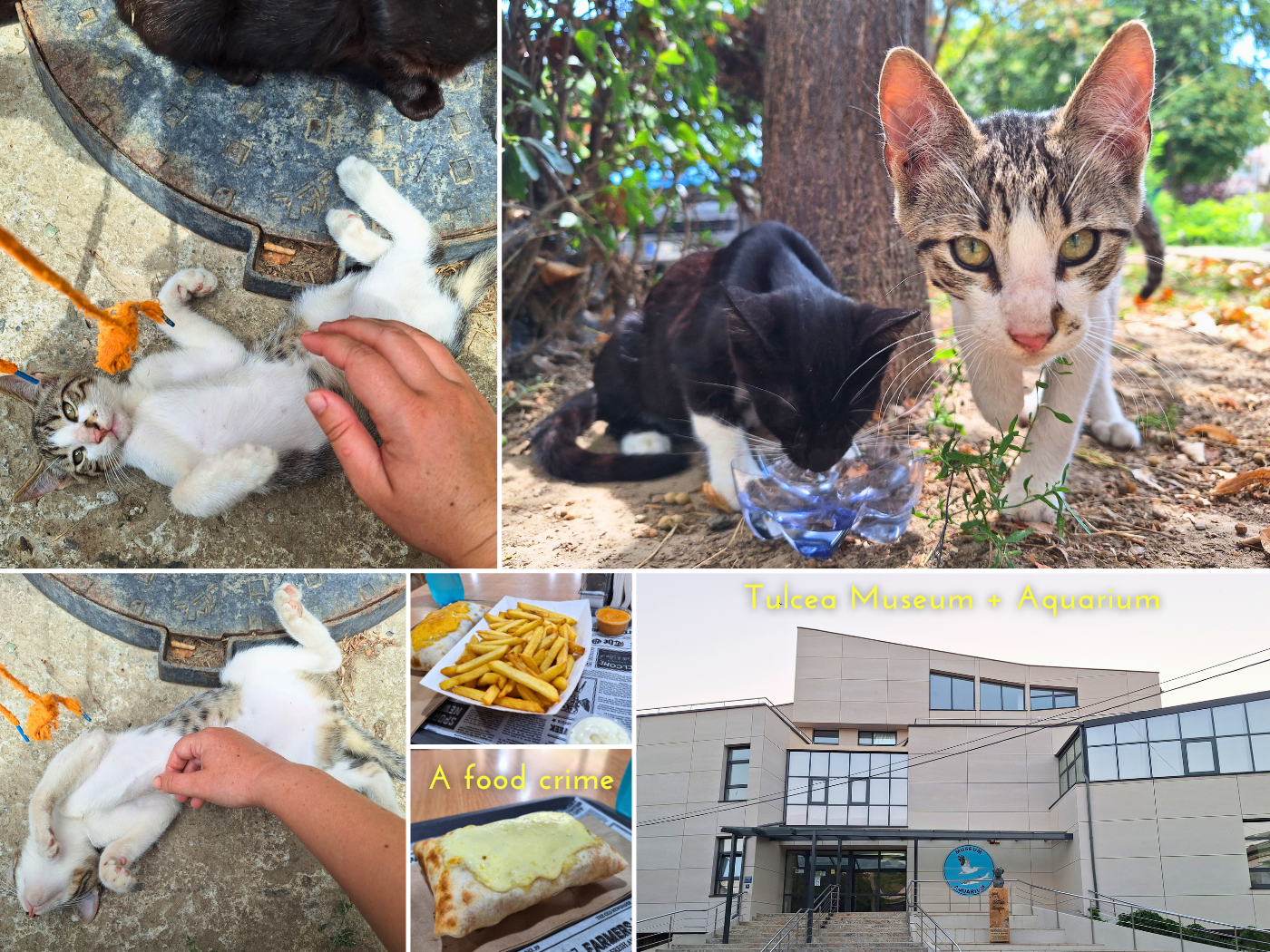
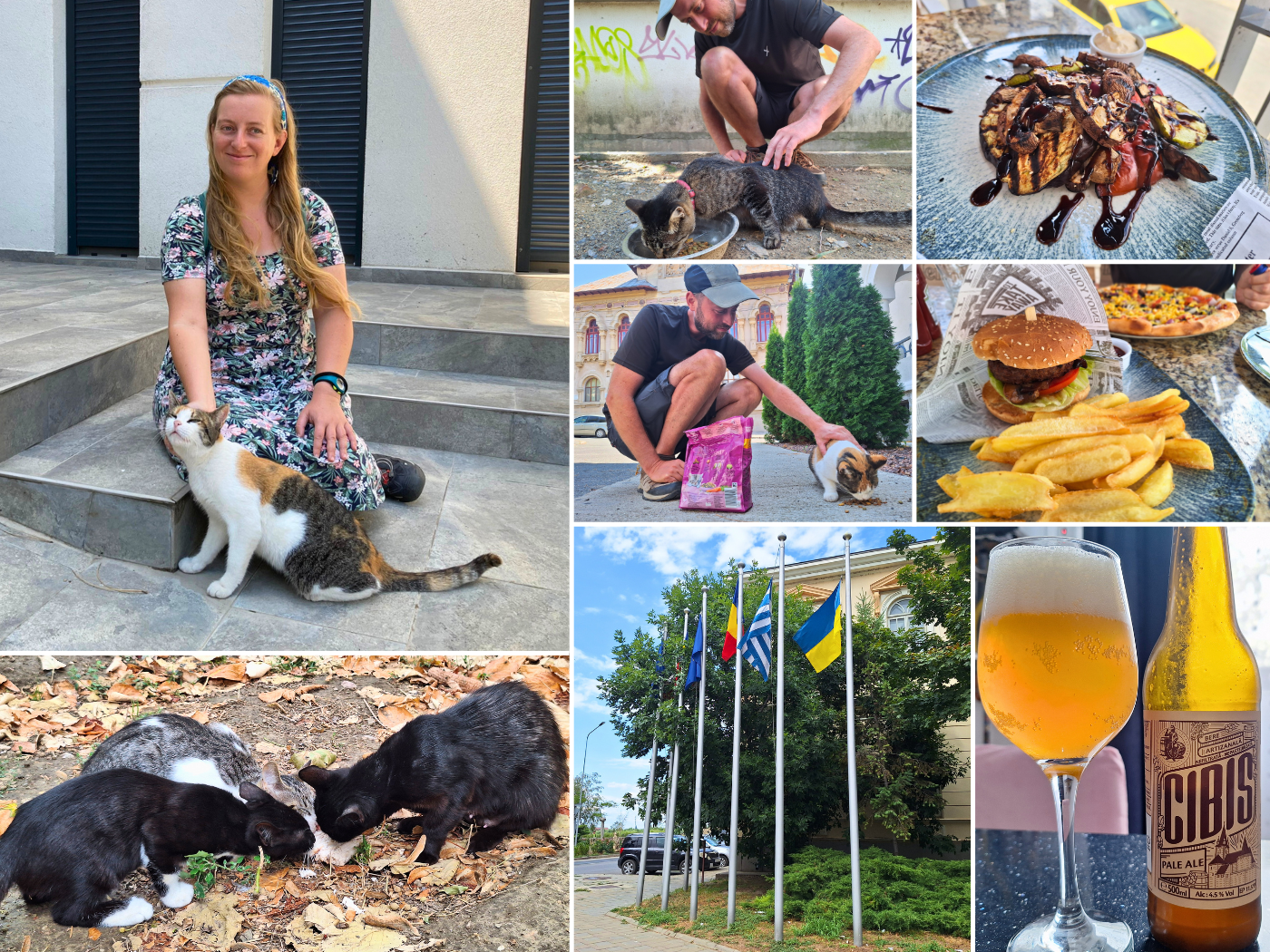
We didn’t do much early in the day. In the evening, we went out for a cat walk in Tulcea via the Danube Delta Museum. There are many very sweet strays who love pets, food, and playtime. There were especially these two kittens at a park near a bust of Taras Shevchenko that I could hang with for hours.
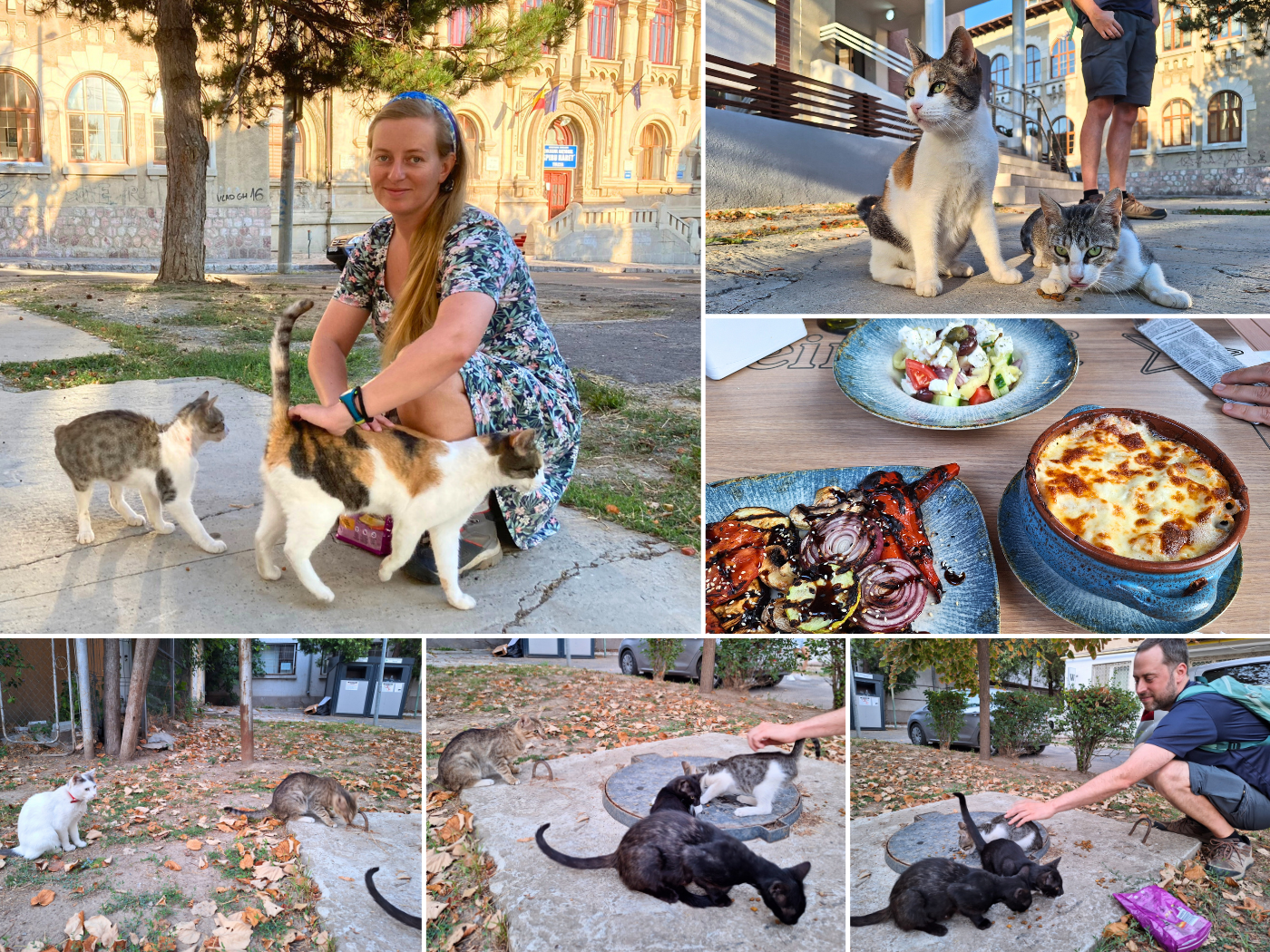
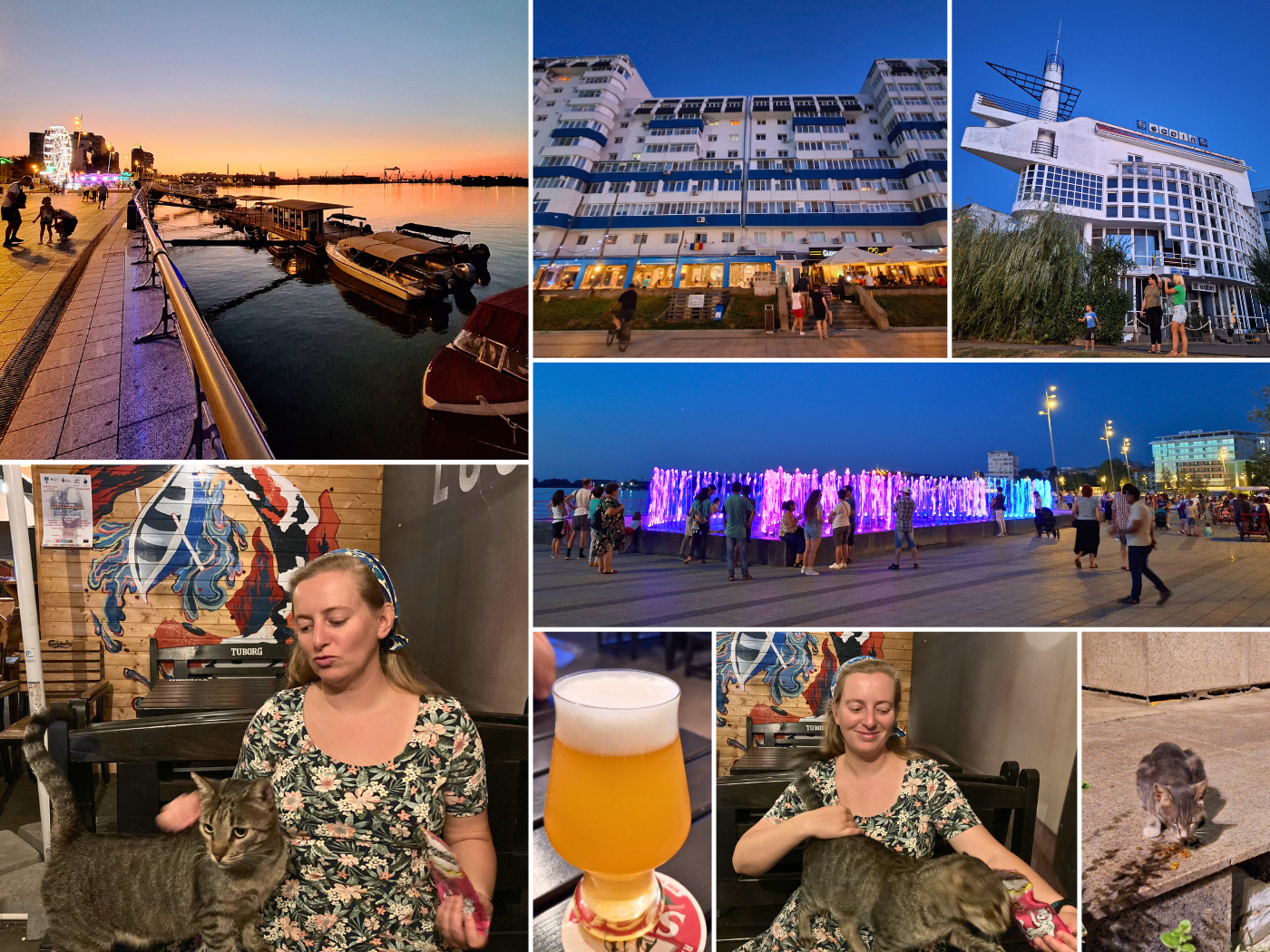
Cats and craft beer are pretty much my entire personality by now. We continued our walk over the boulevard after sunset and saw the atrociously large building we’d spotted from the river. There were also some nice/funny buildings on the boulevard, plus a ferris wheel and a dancing fountain with music. We had a birthday craft beer at Cheers Pub Tulcea and met a really sweet boy cat there who loved attention and playtime.
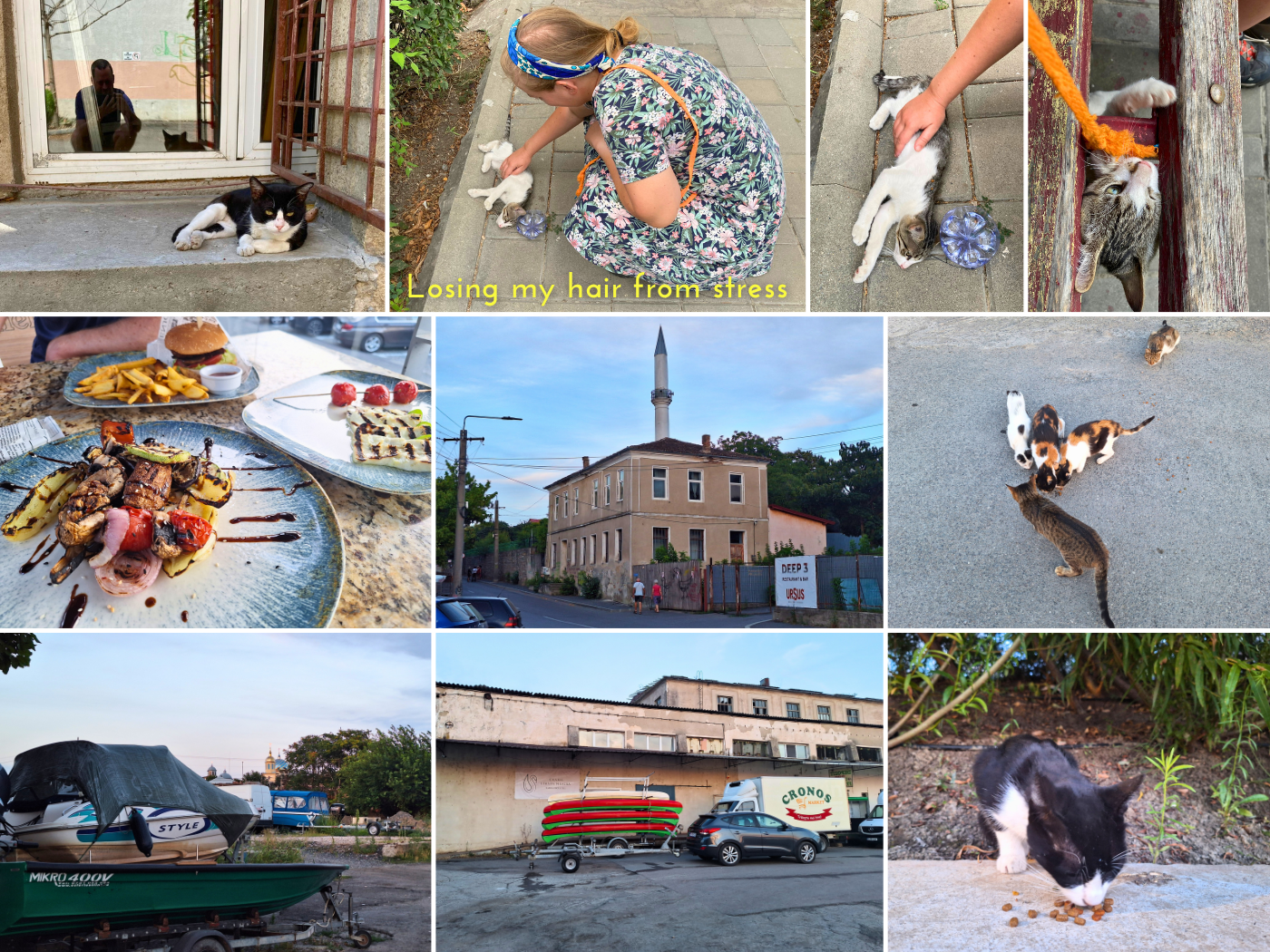
Thursday: after moving apartments, we settled into the new place and got some more work done. In the evening, we went for another cat walk and visited the playful and thirsty kittens again. We had dinner at The Corner Café, which was excellent. Afterwards, we walked past the Ottoman-era Aziziye Mosque (from 1863) towards the waterfront to scout a new entry location for when we continue kayaking to either Mahmudia or Murighiol.
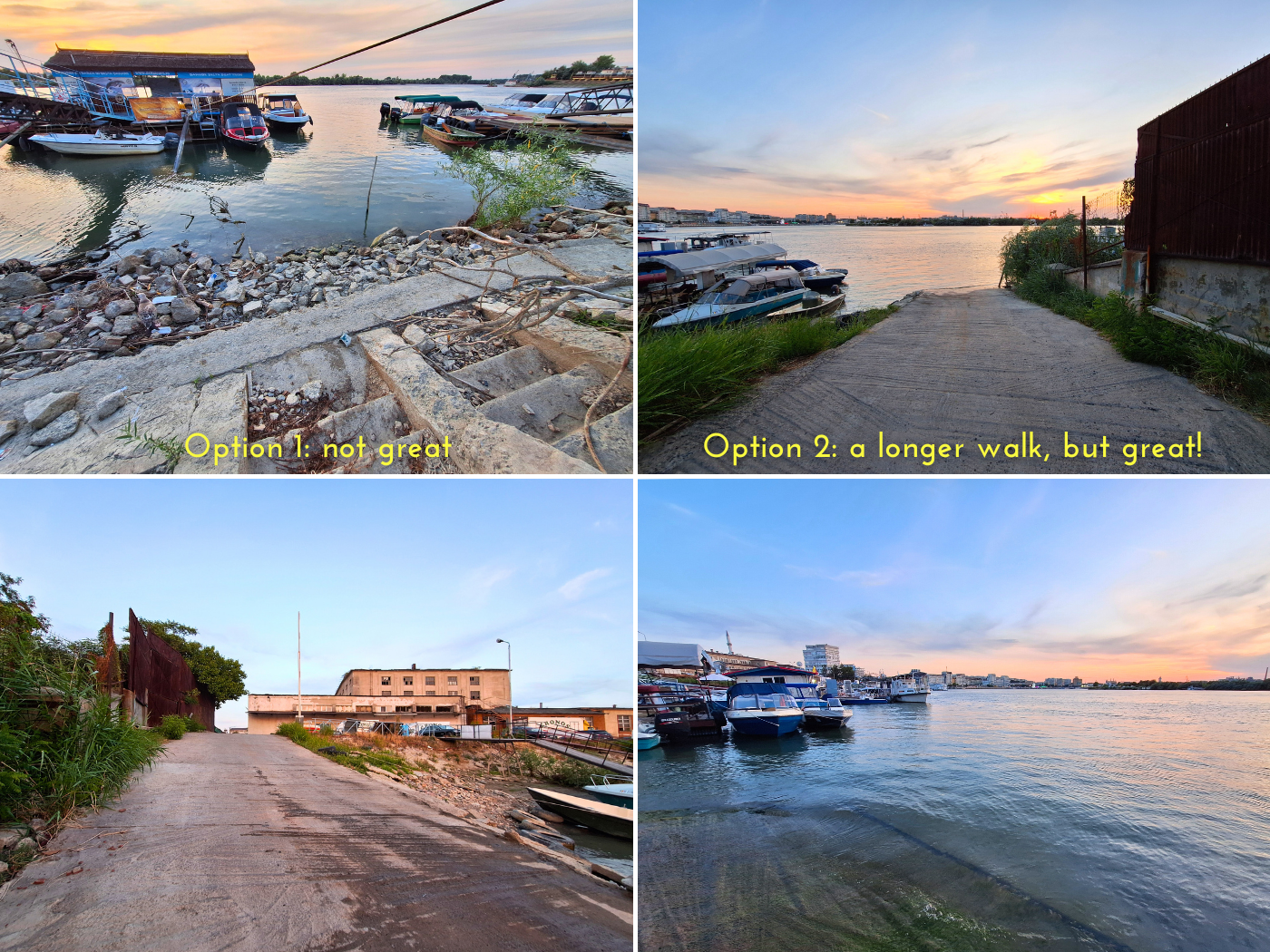
We checked out several stairs that were a shorter walk, but not ideal for setting up. In the end, the backup slipway for when we arrived was simply the obvious choice. The kind of neglected area also had evidence of a kayak rental place and lots of sweet stray cats beneath small motorboats on land. After settling on a launch spot, we returned home.
Friday: after lunch at The Corner Café and brushing teeth at home, we took a Bolt to the Edent Clinic to go to the dentist. It was time. They did a very thorough job of cleaning out my pockets both in the stomatological as well as the pecuniary sense. But it was time and this was very important to me.
We then visited Kaufland again for some grocery shopping and visited the cats and the kittens at the Taras Shevchenko bust. They were particularly playful and loved climbing the trees. I’m teaching them to be great and fearless hunters.
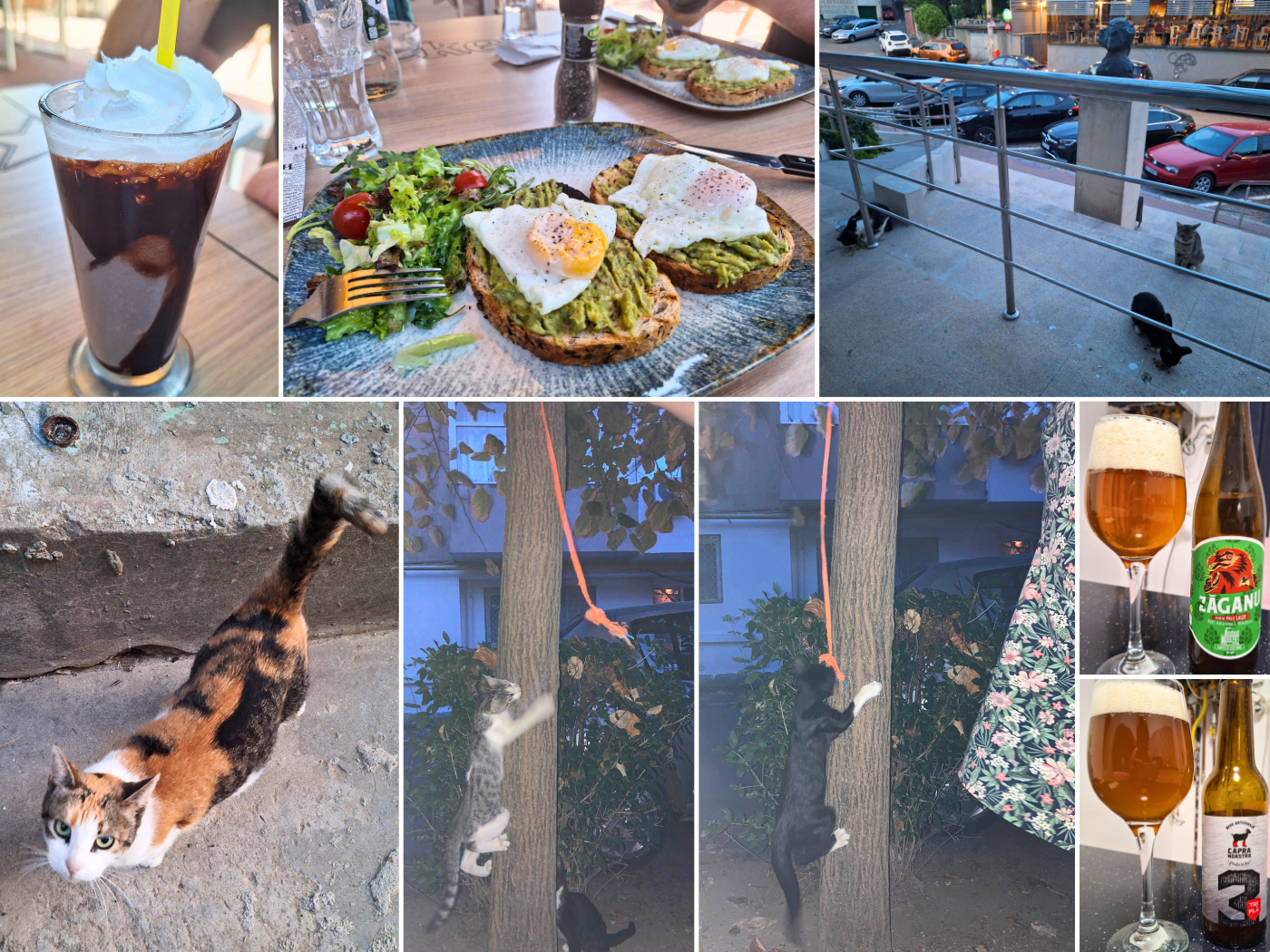
Afterward, we cooked at home and drank some more Romanian beers.
Saturday: after morning work, we went out for lunch. I wanted to walk past a fishing gear shop with our broken manometer to ask if they sell the dial bit. The man was helpful, but he didn’t sell them unfortunately. I still think getting a pump with an integrated PSI meter would be an awesome upgrade that will prevent any overinflation. We used those in Rodrigues for blowing up the kites for kitesurfing. Anyway, he pointed us in another direction, which had a webshop. But their manometers all had very different scales. Like for tire pressure instead of squishy boats.
Afterward, we ate “French tacos” at this place called Tacos King Tulcea that does them with falafel. I didn’t want to get any if they couldn’t keep the fries outside of the burrito, because I think soggy fries are a food crime. Thankfully, they kept them out and we were happy. Though I will never understand why it exists under this name. The most misleading food on the planet, in my opinion. Then we walked via the playful kittens to the Danube Delta Museum and Aquarium of Tulcea.
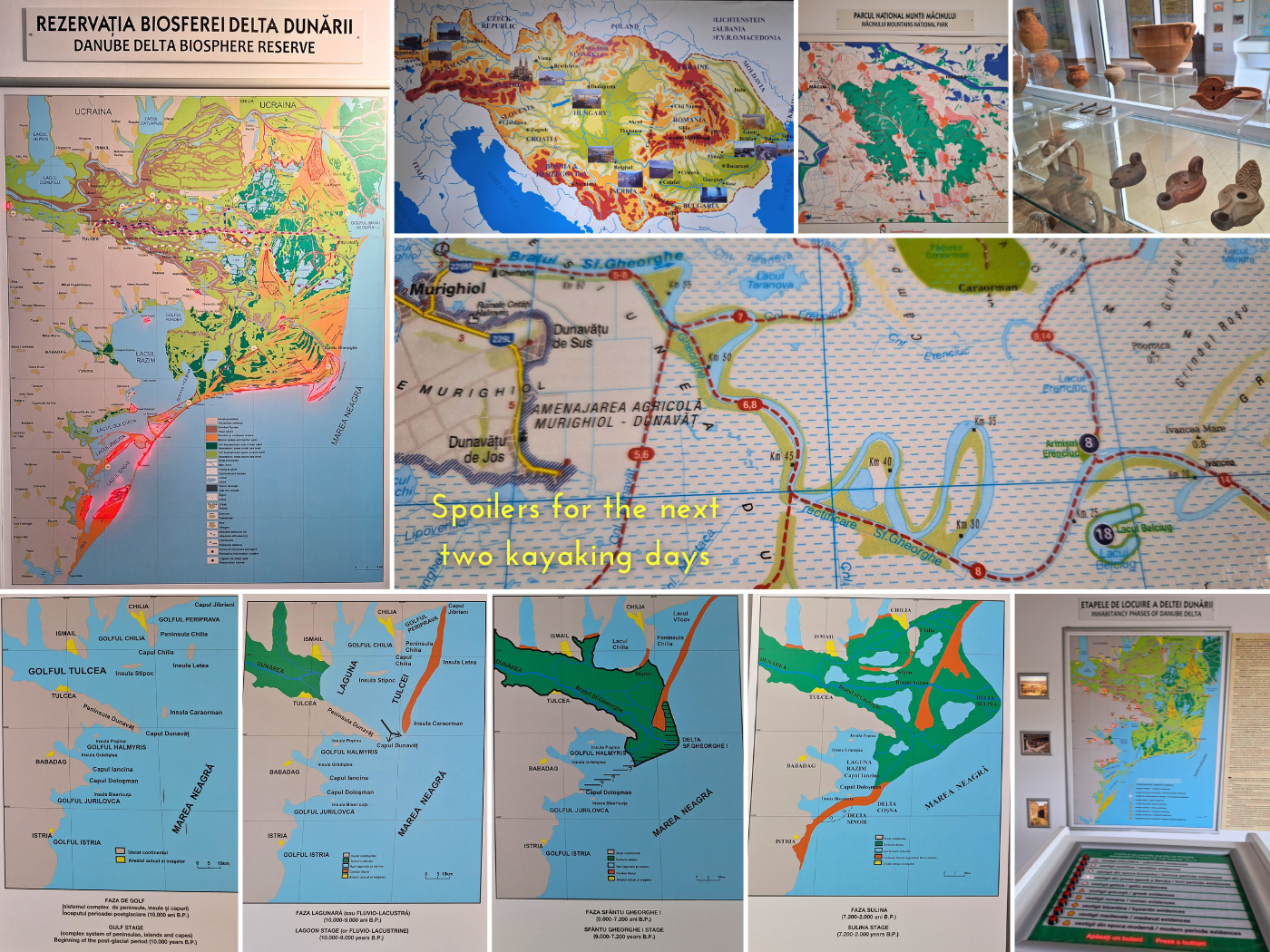
I found the exhibition quite interesting and it answered some questions about the delta and its problems. Jonas wasn’t too thrilled with this section, while I was enjoying the geological breakdown and all the cool maps. Mostly cool maps.
It had lots of dioramas of traditional fisherman’s life in the Danube Delta, or scenes with taxidermized species from the delta, the forests, and the Măcin Mountains, which were interesting but also always a little icky. Unfortunately, the chances of us encountering any of the cool mammals are practically zero, due to 21st century circumstances. And then there were water animals in formaldehyde on display.
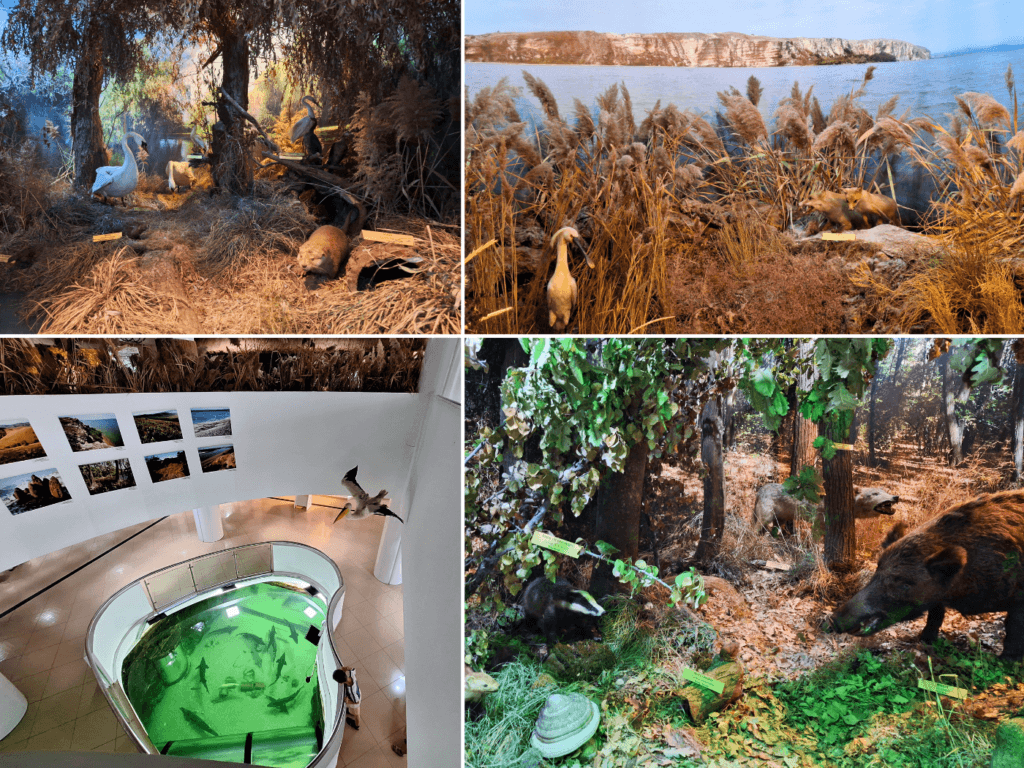
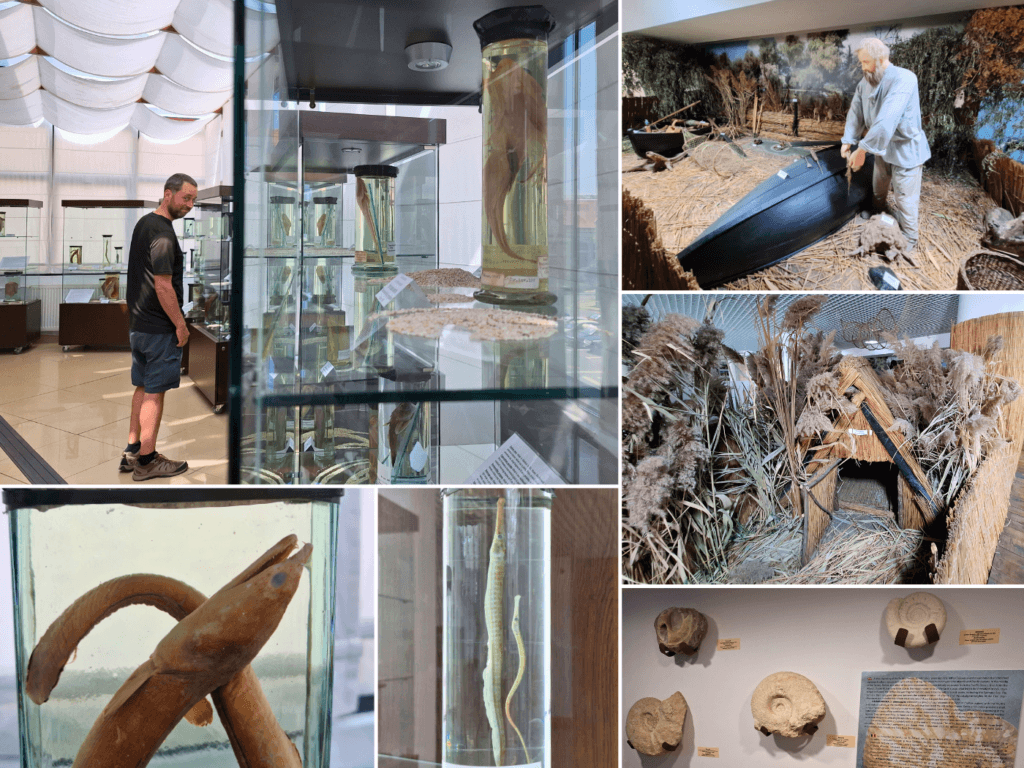
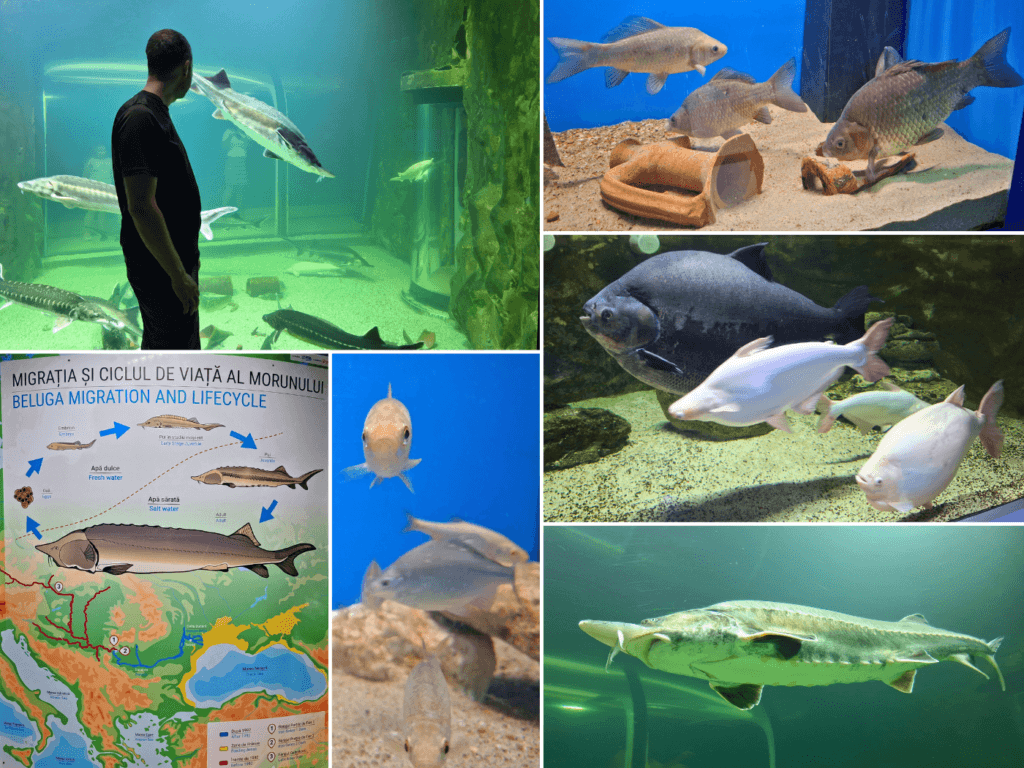
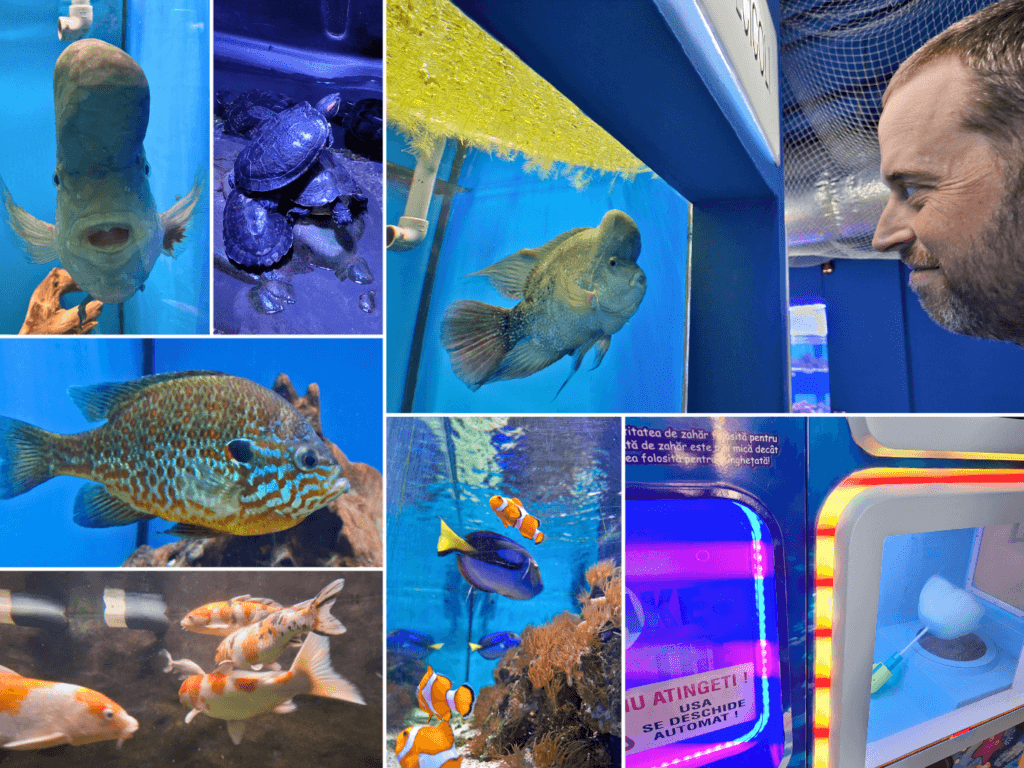
We also visited the aquarium, which was cool and very sad. These fish are too big and just want us to let the river flow freely and stop overfishing them. They also had tropical fish which have nothing to do with the Danube Delta and are pure fanservice for the kids there who watched Finding Nemo. The cotton candy robot was cool.
We returned home, napped, played Little kitty, big city, cooked, and watched The Decameron on Netflix.
Sunday: I wrote, Jonas developed the web, and we had lunch at The Corner Café again and ordered too much food so we could take some. Tomorrow we will kayak to Murighiol, the last stop before Sfântu Gheorghe and the Black Sea.
Saying goodbye to my favorite cats and kittens in Tulcea wasn’t difficult, because we will need to travel back through Tulcea on the way back out.
Helpful post? Please consider making a donation


Similar posts:
 Kayak Trip Day 83: Galați to Isaccea – Bombed Grain Silos in Reni, Kayaking the Ukrainian–Romanian Border Danube
 Kayak Trip Day 81: Hârșova to Brăila! – An Unexpected 70-Kilometer Day in the Vâlciu Branch
 Kayak Trip Day 80: Cernavodă to Hârșova – Third Leak + Swimming Cows
 Kayak Trip Day 74: Svishtov to Ruse – the Southernmost Point of the Danube
 Kayak Trip Day 75: Ruse to Tutrakan – New Kayak Sail + 1000 Kilometers Paddled