












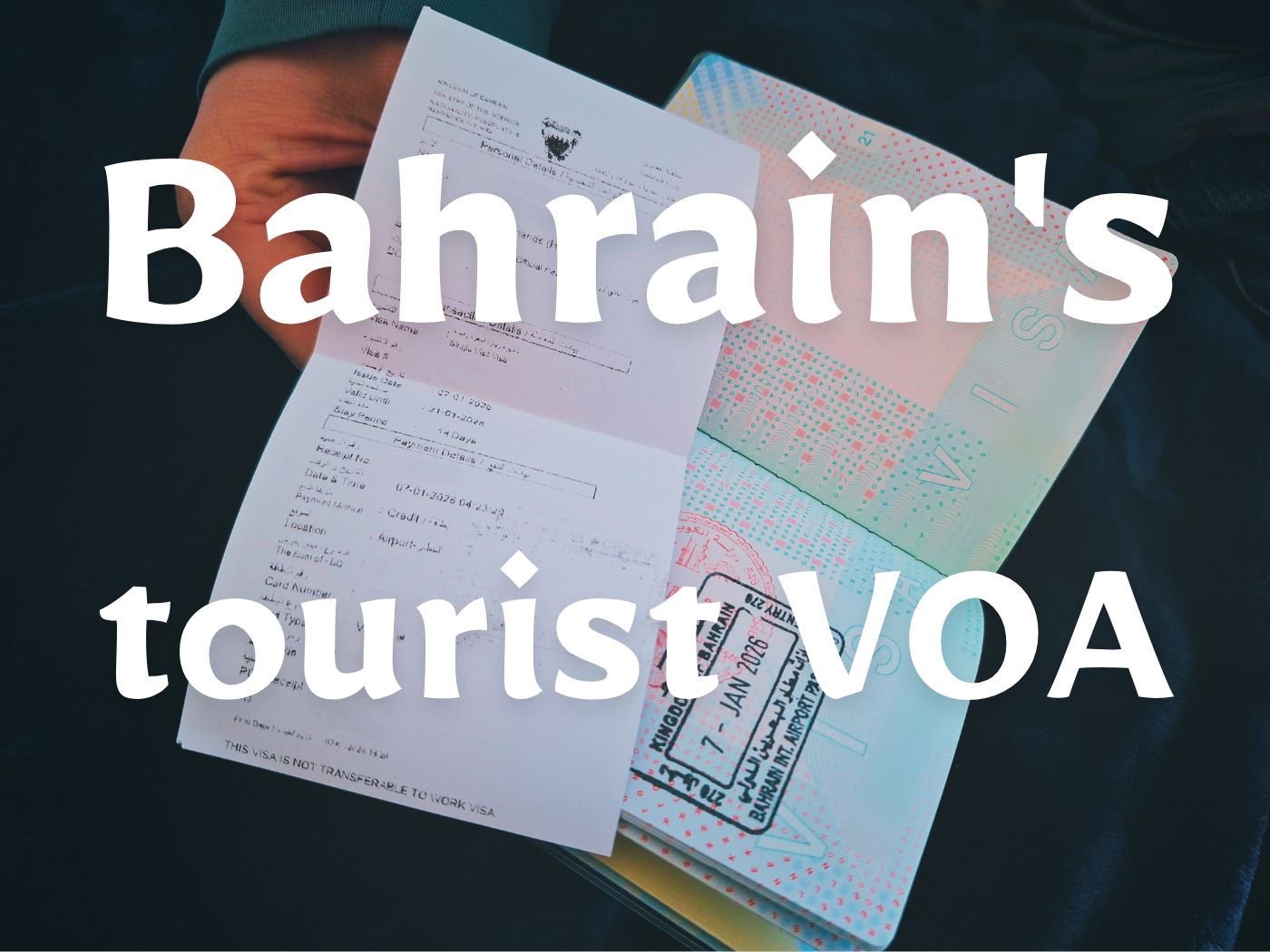
We arrived in Bahrain from Kuwait on the 7th of January, 2026 and stayed for 11 days. We chose to opt for a Bahraini visa on arrival (VOA) instead of an eVisa. Here’s what the process is like, what documents you need to bring, and whether you should choose an eVisa or the VOA. In early 2026, the tourist visa costs between 5 BHD and 25 BHD, depending on your length of stay
Contents
Bahrain Visa Online Research
For most nationalities, Bahrain has two options to enter as a tourist: the eVisa or the visa on arrival (VOA). The eVisa has been around since about 2014. If you’re coming to Bahrain as a tourist, your passport still needs to be valid for at least 6 months upon entry. This is typical for most countries on earth.
For short tourist stays in Bahrain, you have the following options, with our choice in bold:
| 14-day eVisa = 10 BHD/€23/US$27 | 14-day VOA = 5 BHD/€11/US$13 |
| 30-day eVisa = 17 BHD/€39/US$45 | 30-day VOA = 12 BHD/€28/US$32 |
The 14-day visas are single entry, while the 30-day visas are multiple entry. In the eVisa category, you can also get more days of stay in Bahrain. But for the purpose of this article I’ll only compare apples to apples. Here’s a screenshot without prices from the Bahraini eVisa portal with all options:
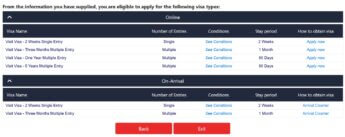
After not having a great experience entering Kuwait on their visa on arrival, we reconsidered getting the eVisa for Bahrain. While the eVisa might have had the advantage of entering Bahrain a little quicker, the increased cost was off-putting. We already had a flight out of Bahrain after 11 days, so for us, paying more money for a longer visa with multiple entry to go to Saudi Arabia also didn’t make sense. So we chose the single entry 14-day visa on arrival for Bahrain.
Where to get the Bahraini visa on arrival?
There are realistically only two* points of entry into Bahrain: the Bahrain International Airport (BAH) and the King Fahd Causeway land border from Saudi Arabia.
The Bahraini border with Saudi Arabia on Passport Island has a visa on arrival booth. When traveling by car or on a tour, the internet reports say any non-GCC passport owner will automatically enter another queue. Here you can either show them your eVisa or buy a visa on arrival. The cost of the visa on arrival at the land border is the same as at the airport.
*Bahrain and Qatar launched a ferry service in late 2025. However, it was not working during my stay in early 2026. Some reports say that the boats don’t function well in high waves and wind. Anyway, in theory, there will be a sea border to enter Bahrain as well, presumably with the same services such as VOA. However, if I entered Bahrain like this, I’d consider the eVisa.
Where to get the Bahraini eVisa?
On their government website. You’ll have to pay online and check your visa progress yourself. There’s of course no guarantee it will arrive on time. It takes about five working days before your eVisa gets approved. The eVisa has a long validity before entry, so make sure to plan enough time if you’re taking the eVisa route.
Future multiple GCC countries eVisa
For the Arab Gulf countries (Kuwait, Saudi Arabia, Bahrain, Qatar, the UAE, and Oman) there’s a better system in the making: the GCC Unified Tourist Visa. This future (perhaps still in 2026) eVisa will give travelers access to all these countries for 30 or 90 days, multiple entry, allowing them to use land/sea borders as well. Like a Schengen visa. If it had existed already in late 2025/early 2026, we would have traveled overland (perhaps by hitchhiking, or perhaps with public transportation) from Kuwait to Bahrain instead of taking a silly short (and delayed) flight between the two.
Flight from Kuwait to Bahrain
Because we wanted to move east to India quicker, there was no time for us to visit Saudi Arabia as well. So we chose to take a shorty-short flight between these two Gulf countries. Our three-flight itinerary from Amsterdam to Kuwait to Bahrain to Goa was booked on one ticket via one of those third-party websites instead of on three separate airline websites. I know, bad form and a little sketchy, but it was much cheaper.
We took Kuwaiti budget airline Jazeera Airways, which has its own terminal (number 5) at Kuwait International Airport (KWI). Stamping out of Kuwait was easy, but the terminal was in chaos as every flight was delayed. There were lots of flights to Jeddah and Madinah in Saudi Arabia, with many Umrah travelers in their Ihram clothing. There were also many Umrah group tours from Uzbekistan, Qazaqstan, and Kyrgyzstan, with people wearing a Kolpak or Doppi with their authorized Umrah travel agent’s vest. This reminded me of what a good time I’ve had in Central Asia and that I definitely want to go back there sooner rather than later.
Our total delay was over two hours for our one-hour flight. They moved our gate at some point and the information screens weren’t synced up, so one of us had to walk to the updated screen every now and then. The constant state of vigilance was quite exhausting and the amount of seating was not really enough.
Once we could board, a group of young men tried to skip the queue in front of us, which added to my state of mind. A bus ride to the airplane. Then arguing with a woman who tried to get our window and middle seat so she, her husband, and their child could have the whole row. I didn’t allow it. She eventually relented and we got our seats on the left side of the plane.
We both napped a few minutes on the plane. The departure over Kuwait showed the Sheikh Jaber Al-Ahmad Al-Sabah Causeway, Failaka Island, and some ships at sea.
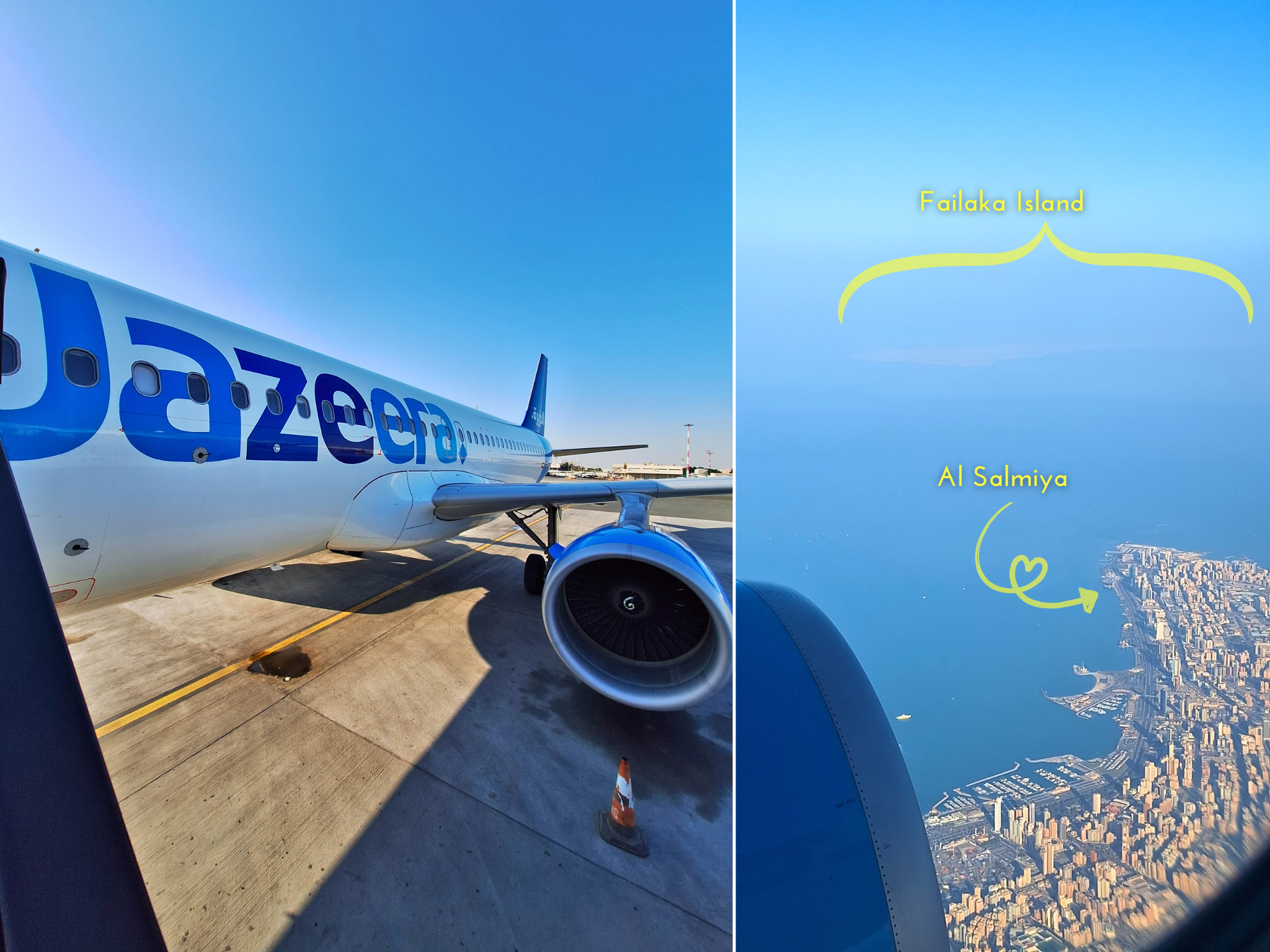
The visibility wasn’t good enough to see Iran across the Gulf. Our direction took us through Saudi airspace just a little away from Iran’s Farsi Island. I could see it from my window, but not in great detail. After that, the plane already started its descent through clouds and haze. I couldn’t see much of Bahrain until we were quite low.
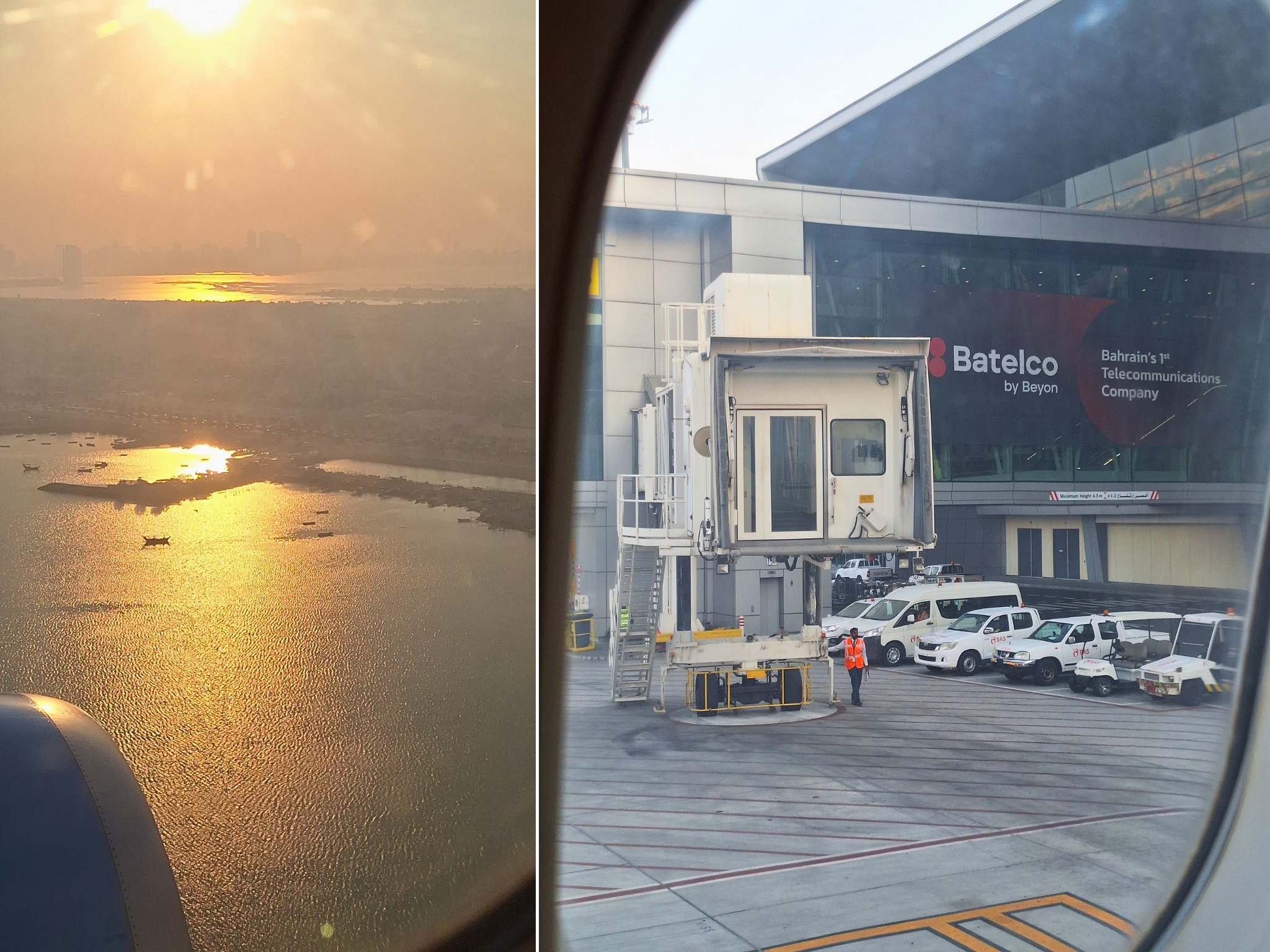
Bahrain International Airport (BAH) graced us with the jet bridge treatment (always a plus) and before we knew it, we were wandering through the liminal airport space, slowly guided into the queue at Bahraini immigration.
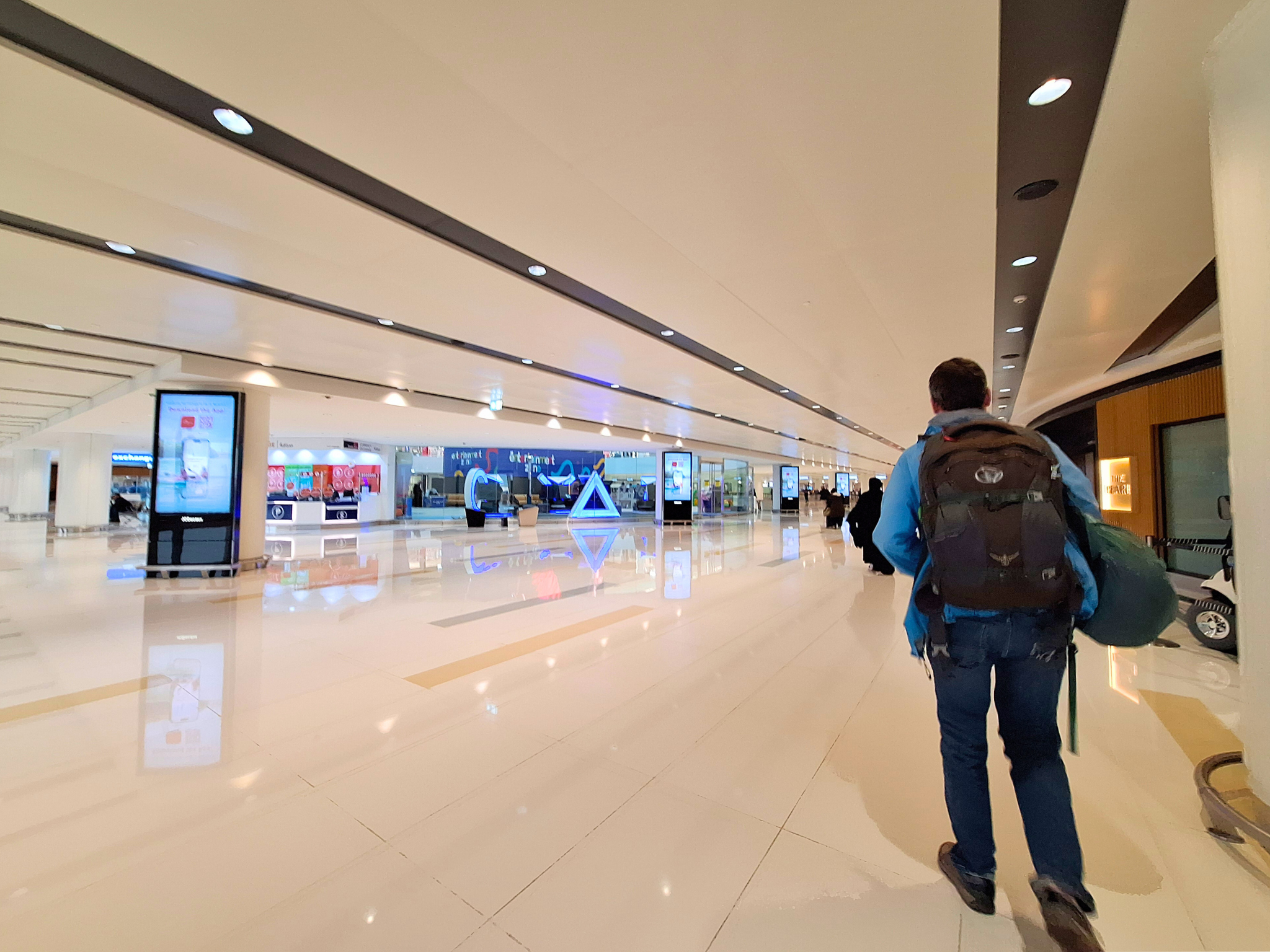
Getting the Visa on Arrival at Bahrain International Airport
The queue moved fast. We had a moment to discuss whether we’d go through Bahraini immigration together or separately. A man in a booth further back waved us over and we decided to go together, which was no problem.
This nice guy spoke good English. He asked us how long we were going to stay in Bahrain and where. I said 11 days, near the Hilton. I was still fumbling our stack of paperwork with our booking confirmation and onward flight, in case he wanted to see that. He joked that we carried a lot of paperwork and that it was fine to put it away as he was typing in details.
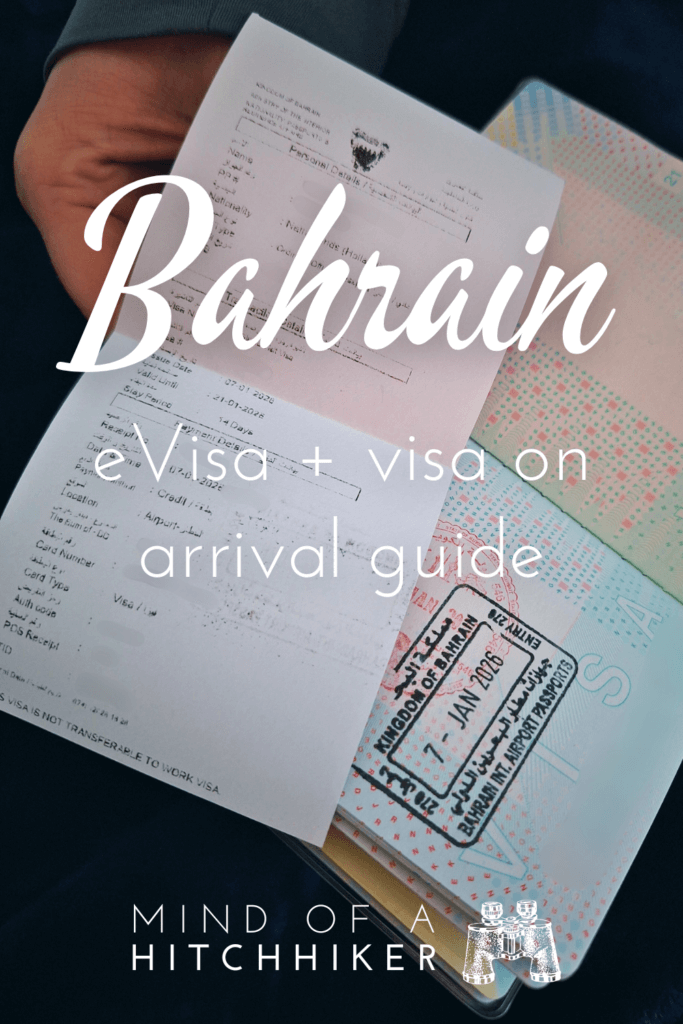
He then told us he’d give us the 14-day tourist visa, single entry (emphasis made with eye contact), and that it costs 5 BHD. My passport went first. Jonas paid by card (VISA debit card), followed by a printer noise and the sound of *stamp stamp*. They didn’t require a sacrifice of finger prints, an awkwardly-close photo of our faces, or an iris scan.
I received my passport and my eVisa. Jonas was next and it went the same. It’s always too bad we can’t do the transaction in one go. We were welcomed to Bahrain and continued on to the arrivals hall.
On the way down, I checked what we’d received; a neat little stamped receipt that’s our visa on arrival plus a passport stamp. Unfortunately, the Bahraini entry stamp went over my Kuwaiti exit stamp before I snapped a picture of that one.
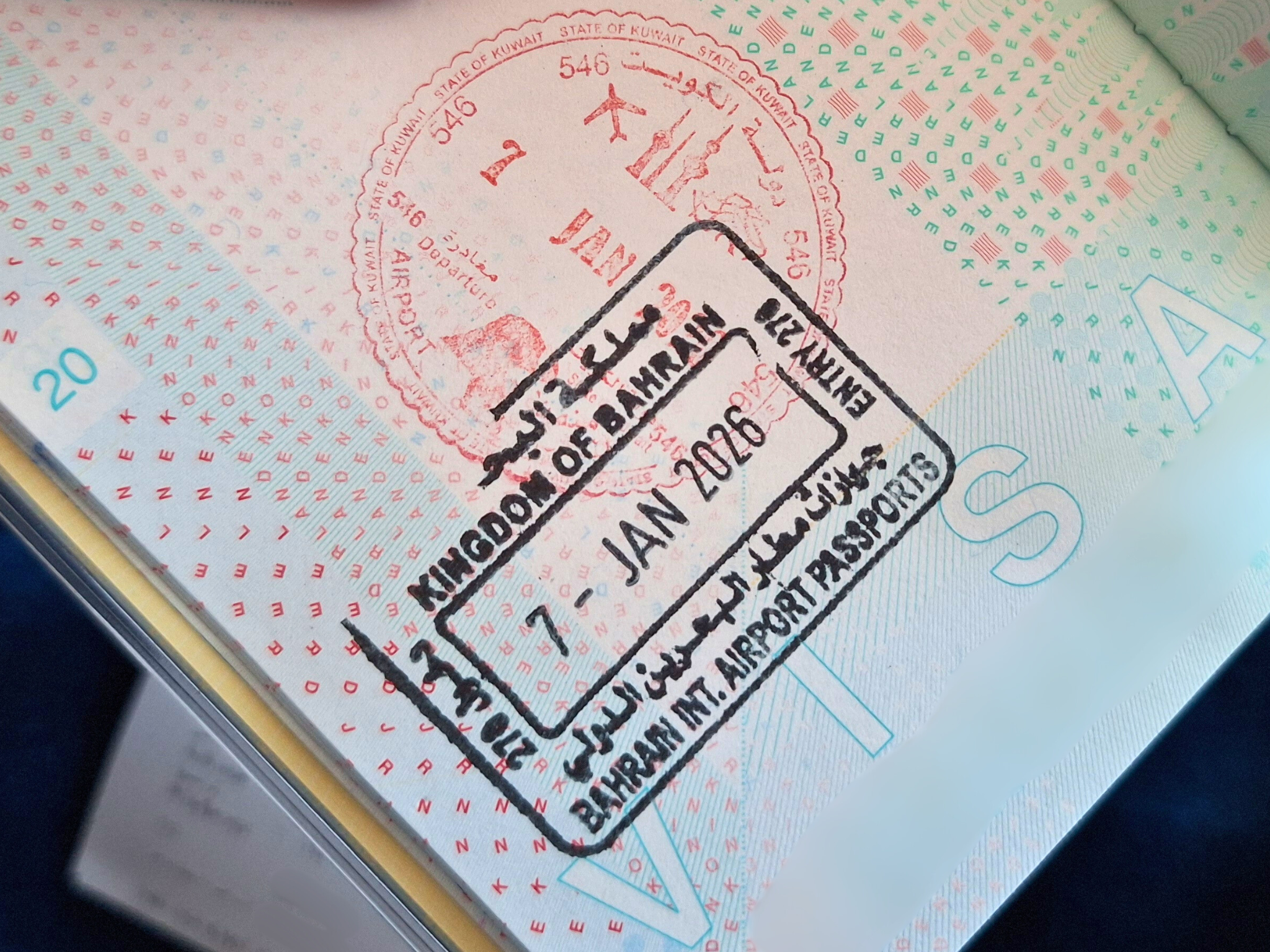
This was – as far as immigration goes – the best experience with a visa on arrival ever. So smooth, 10/10. The polar opposite of our visa on arrival to Kuwait. And the little receipt fits perfectly in my passport cover.
Down in the arrivals hall, we bought a Bahraini SIM card for me and ordered a Careem taxi to bring us to our accommodation in Bahrain.
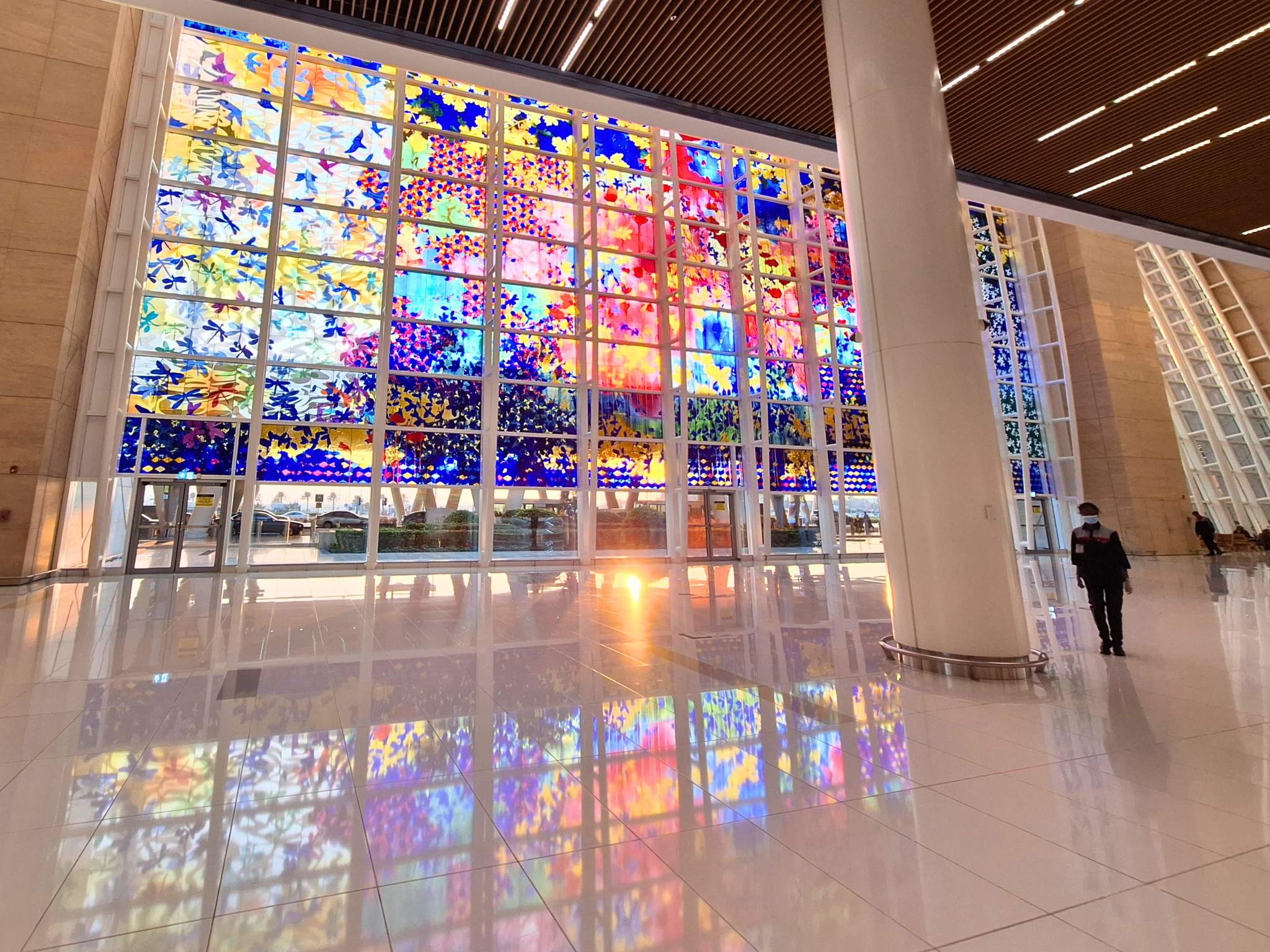
Departing Bahrain
After 11-ish days in Bahrain, it was time to continue our journey east and go to India. Our Gulf Air flight from BAH to GOI was scheduled to depart quite late in the evening. The 2025-2026 Iran protests against their government were escalating during some of those days. Threats from Iran to retaliate against a US strike on US airbases in the Gulf were quite serious, especially because there’s precedent from 2025 on neighboring Qatar. Back then, all countries in the Gulf grounded their flights and closed their airspaces. I had a fear this would happen on our departure day, which would mess not only with our arrival in India, but also with our almost-expired visa on arrival for Bahrain.
Thankfully – for our flight – no such things happened. At Bahrain International Airport, we slowly cruised through the terminal. We couldn’t get our Gulf Air digital boarding pass changed into a physical one without going through a long queue. We didn’t need that and there’d be a chance people would want us to check in our hand luggage. So we went to immigration with our boarding passes on our phones.
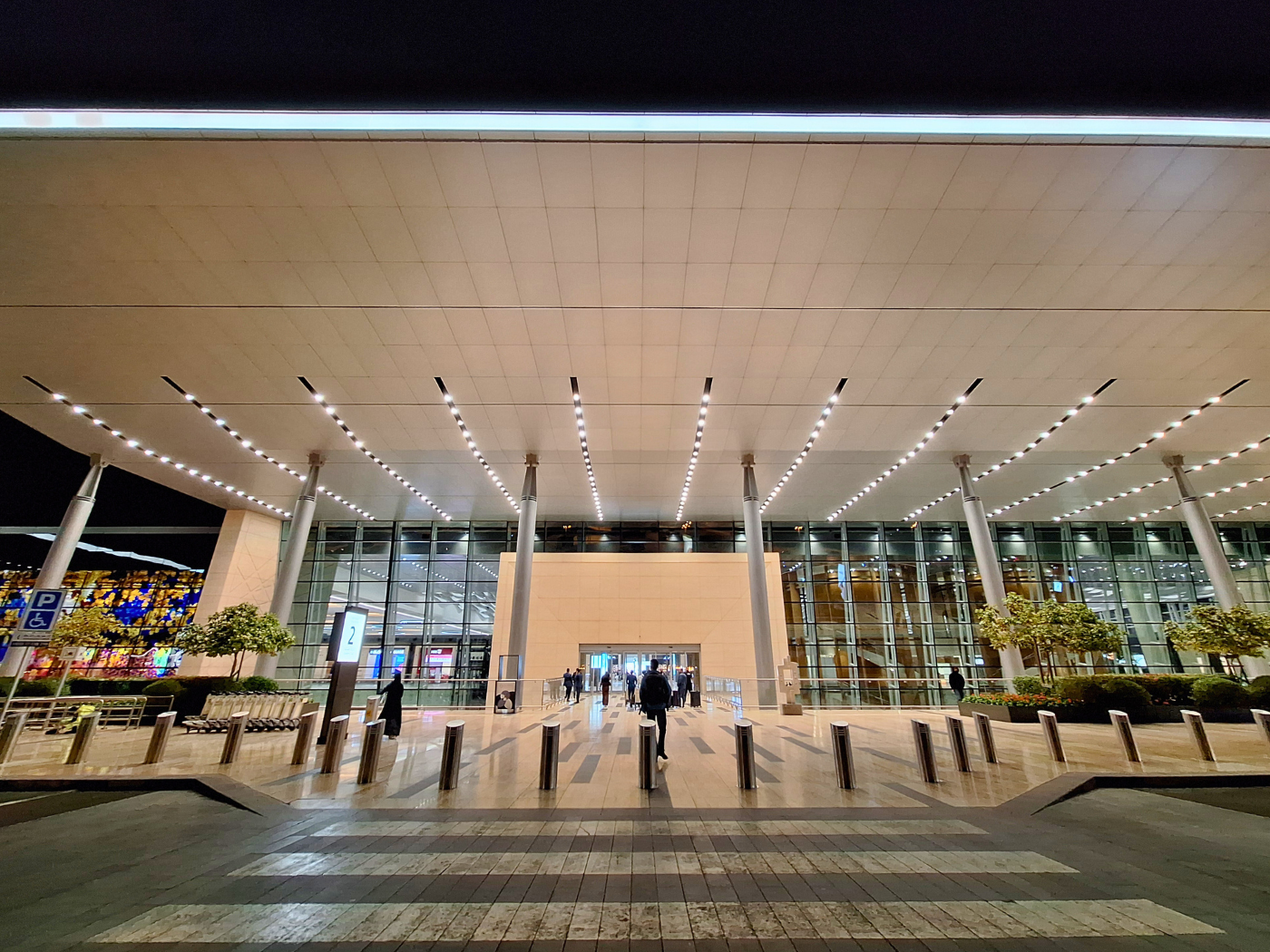
At immigration, I went to a non-GCC desk first while Jonas was invited in parallel to a GCC desk. My immigration officer had lots of questions about my flight. I showed him my boarding pass, had to read out my flight number to him, and told him I’m going to India, Goa, yes, Goa India. I was still sick at this point, so I couldn’t speak loud enough and you could hear the illness in my voice. He wasn’t interested in my Bahraini visa on arrival at all and I kept it. He typed some things into his computer. Eventually, he let me through—no passport stamp.
Jonas’ experience was different; the guy just looked at his passport, typed some things, then gave him his passport back. Also no stamp, but at least no questions asked.
Going through security was a long queue but otherwise a breeze. They had the machines where you don’t need to take your laptop out. This was easily the least humiliating airport security theater I’ve experienced in a while. Kudos for that!
When leaving Bahrain, we still had some Bahraini Dinars to exchange. However, we forgot to do it on the landside of the airport. On the airside, currency exchange Travelex and another would eat up about 50% of the value of our 6 BHD. We could have bought one sad Corona with 4.5% alcohol for 5.300 BHD at the airport, but Jonas decided he’d rather try his luck exchanging it at the airport in Goa or anywhere else in India. Spoiler: the rates were slightly better, but Jonas still hangs on his small stash, for now.
So the advice is to try to spend all your Bahraini Dinars before you come to the airport. Perhaps on the landside, the rates are better. Perhaps it also depends which currency you’re exchanging to (in Kuwait, exchanging KWD to BHD was with a minimal fee, as per Islamic law) and Bahraini Dinars to Indian Rupees is just a feast for currency exchanges to make money. If you’re leaving to Saudi Arabia, I wouldn’t be pressed about exchanging it quickly as we often received Saudi Riyals as change for our Bahraini Dinars at shops (though we always asked them to change it).
I hope this information helped you have a smooth entry into and exit from Bahrain!
Good info? Consider buying me a sparkling water

Similar posts:
 Tourist Visa on Arrival in Kuwait: Our Experience + Advice (Get the eVisa)
 How to Get a SIM Card in Bahrain: eSIM Options + Batelco, Zain, and STC
 Staying Online in Kuwait: eSIM Options + Kuwaiti SIM Card
 How to Get the Mauritanian eVisa Introduced in 2025
 Accommodation in Kuwait: Al Salmiya Apartment + City Hotels